
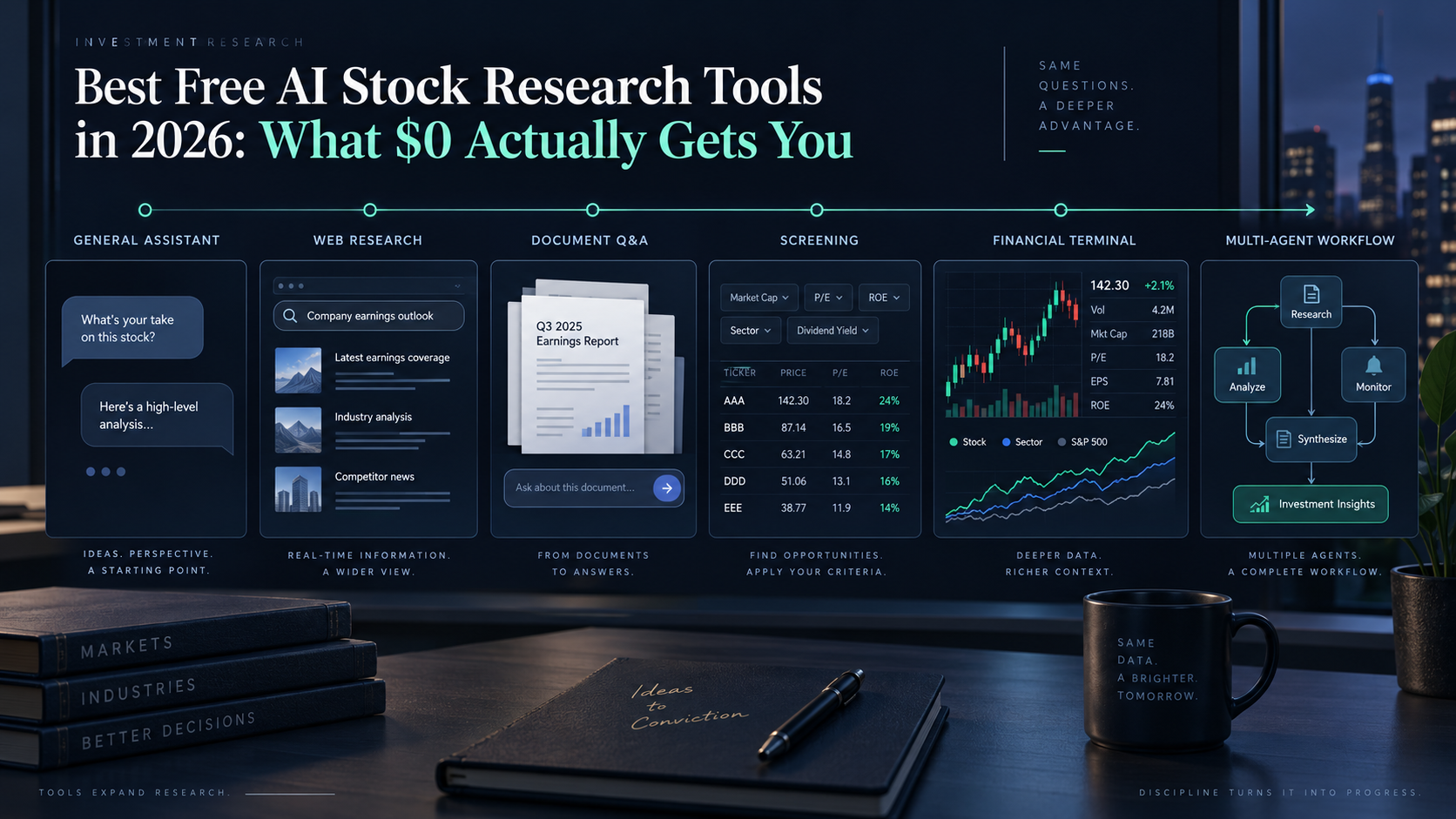
The promise of artificial intelligence in financial research is speed, scale, and clarity. The reality for most retail investors is a frustrating maze of paywalls, token limits, and demo tiers disguised as free software. In 2026, almost every financial AI platform advertises a free plan. Yet within fifteen minutes of researching a company, most investors hit a wall: a ten-prompt monthly quota, missing balance sheet history, paywalled citations, or outright AI hallucinations.
The useful question is not whether free AI stock research tools exist. They do. The critical question is what zero dollars actually buys you in 2026, where each free tier breaks down, and how to combine complimentary tools into a serious, repeatable research workflow without paying institutional subscription fees.
This guide analyzes six leading AI stock research platforms on their free tiers, using product limits verified in September 2026. It maps out what each tool delivers for zero dollars, where the hidden restrictions lie, and how to assemble an auditable research stack on a zero-dollar budget.
The Reality of Free Financial AI in 2026
To use free AI tools effectively, you must understand the business models behind them. Running frontier artificial intelligence models and licensing institutional market data is expensive. When a platform offers a free tier, it typically makes one of three trade-offs:
First, general chatbots subsidize free users by relying on generalized training data and web search, but they omit structured financial databases. They can discuss business strategy fluently, but they cannot give you ten years of segment-level operating margins with verified SEC filing links.
Second, dedicated financial terminals offer institutional data on their free tiers, but severely throttle the volume of research you can conduct. A free plan that allows ten AI queries per month is a promotional sample, not an ongoing research environment. A single earnings review can easily consume twenty queries.
Third, quantitative screeners offer automated scores on thousands of stocks for free, but withhold the underlying qualitative thesis, historical audit records, and portfolio stress tests.
Understanding these structural trade-offs prevents wasted effort. Instead of searching for one magical free platform that does everything, successful self-directed investors construct a modular zero-dollar stack: one tool for initial scanning, one for fundamentals data, and one for structured evidence verification and thesis tracking.

The Four Traps of Free AI Stock Tools
Before comparing individual platforms, keep these four common pitfalls in mind when using free tiers:
1. The Prompt Quota Trap
Many specialized financial copilot tools boast about their advanced financial reasoning, only to reveal after registration that free accounts receive five to ten queries per calendar month. If you are examining a semiconductor company and need to check inventory turnover, customer concentration, and data center revenue guidance, your monthly quota is exhausted on the first company.
2. The Stale or Fabricated Data Trap
When a free tool lacks live connections to regulatory filing repositories like SEC EDGAR, it relies on standard web retrieval or its internal training memory. In financial research, this is hazardous. A general language model will confidently invent quarterly EPS numbers, merge GAAP net income with non-GAAP adjusted earnings, or cite a management quote from 2024 as if it occurred yesterday.
3. The Click-Through Paywall Trap
Several financial portals display attractive AI-generated company summaries for free, but lock the source citations behind a premium subscription. If you cannot click on a reported number to verify the exact page, table, and paragraph of the original 10-K filing, you do not have research. You have unverified prose.
4. The Memory Reset Trap
Consumer chatbots have no long-term memory of your investment rationale. You can spend an entire evening drafting a thesis on a renewable energy stock, but once you close the window, that research is lost. When the company reports earnings three months later, the free chatbot cannot tell you which of your original assumptions proved right or wrong.
At a Glance: What $0 Gets You Across 6 Platforms
The following comparison matrix evaluates the free tiers of six prominent AI investment platforms across data sources, monthly capacity, source citations, thesis memory, and primary constraints:
| Platform | Best Role at $0 | Monthly Free Allowance | Financial Data Depth | Source Citations at $0 | Thesis Memory & Testing | The Catch on the Free Tier |
|---|---|---|---|---|---|---|
| ChatGPT (Free) | Qualitative framing & idea brainstorming | Unlimited text prompts; limited daily file uploads | Web search & uploaded files only; no structured financial layer | Web links via search; citations not guaranteed | None; chat sessions reset | Frequent hallucination on detailed metrics; strict file upload caps |
| Perplexity (Free) | Fast cited news & market event scanning | Unlimited standard search; approximately 5 Pro searches per day | Live web indexing with basic financial snapshots | Native clickable citations on every claim | Limited; no persistent thesis tracking | Lacks deep multi-year financial tables; Pro search runs out quickly |
| Fiscal.ai (Free) | Historical financial statement charting | 10 AI Copilot prompts per month; 1 dashboard; 10-year financials | 100,000+ securities; 10-year financial statement history | Available on higher tiers; basic links on free | None; dashboards only | 10 prompts per month is exhausted immediately during deep research |
| Danelfin (Free) | Fast quantitative scoring & screening | 10 stock reports per month; 1 portfolio with up to 5 stocks | Technical, fundamental, and sentiment feature scores | Track records published, but individual claims unlinked | Portfolio alerts; no qualitative thesis tracking | Hard cap of 10 reports per month; maximum of 5 tracked holdings |
| invest-like (Free) | Value framework sanity checking | 3 Buffett Brain verdicts per week; Buffett Fit Score on 21,000+ stocks | Fundamentals plus Berkshire Hathaway shareholder letters | Explicit checklist scoring behind each verdict | None; no backtesting or alerts on free | Limited to 3 verdicts per week; other value frameworks require paid tier |
| AlphaVue (Free) | Evidence-linked research & thesis tracking | 15 full analyses per month; 10 watchlist stocks; 1 Strategy Lab backtest; 1 Forward Test | Comprehensive web, filings, news, and events via Evidence Layer | Direct citations linked to primary SEC filings & transcripts | 7-day Thesis Change Log; 1 backtest & 1 forward test per month | 15 analyses per month cap; 7-day change log (Pro offers 200 analyses & 90-day history) |
Pricing and feature allowances reflect official product disclosures verified as of September 2026. Platforms adjust free tiers frequently, so confirm current limits before relying on a specific feature.

Detailed Breakdown: The Best Free AI Stock Research Tools
1. ChatGPT (Free): The Flexible Qualitative Brainstormer
ChatGPT remains the world's most widely accessed general AI assistant. On its free tier, OpenAI provides access to models such as GPT-4o mini, with limited, dynamic access to more capable reasoning models.
#### What $0 Gets You
- Unlimited conversational questions on business strategy, competitive dynamics, and industry jargon.
- Ability to upload occasional files, such as a PDF press release or an earnings call transcript, for summarization.
- Fast drafting of initial research checklists and comparative qualitative overviews.
#### Where the Free Tier Breaks Down
Apply this research method to your stock
Enter one ticker and get a research summary you can keep exploring.
- Financial data vacuum: ChatGPT possesses no native financial database. It cannot generate a clean table comparing the free cash flow margins of four competitors over five years unless you supply all the underlying data manually.
- Hallucination risks: When asked for specific numerical guidance or non-GAAP reconciliations, free conversational models frequently invent numbers that sound plausible but are mathematically incorrect.
- File upload restrictions: Free users encounter strict hourly and daily rate limits on document uploads, making comprehensive 10-K analysis difficult.
#### Best Used For Use free ChatGPT at the very beginning of your research to understand how a business makes money, brainstorm potential supply chain risks, and generate questions to investigate in regulatory filings.
2. Perplexity (Free): The Cited Search Companion
Perplexity functions as an answer engine that combines language modeling with live web indexing. Its hallmark is appending clickable citation numbers to virtually every statement it generates.
#### What $0 Gets You
- Unlimited standard search queries grounded in live web information.
- Immediate source citations for recent news events, analyst commentary, and executive statements.
- Basic financial overview cards displaying current stock prices, market capitalizations, and high-level valuation ratios.
- A handful of Pro searches per day, allowing deeper multi-source synthesis.
#### Where the Free Tier Breaks Down
- Shallow financial statements: While Perplexity can summarize yesterday's news accurately, its free layer cannot parse multi-year balance sheet trends or segment-level geographic performance.
- Quota exhaustion: The complimentary Pro searches run out within minutes, reverting the user to standard search, which often summarizes surface-level financial blog posts rather than authoritative primary sources.
- No thesis memory: Perplexity answers queries in isolation; it does not track whether an earlier thesis assumption has decayed over the past six months.
#### Best Used For Use Perplexity to track current catalysts, management changes, regulatory developments, and recent competitor product announcements.
3. Fiscal.ai (Free): The Fundamentals Data Viewer
Formerly known as FinChat, Fiscal.ai is built specifically for fundamental equity analysts, offering clean data feeds and structured financial statement visualization.
#### What $0 Gets You
- Ten years of standardized financial statements (Income Statement, Balance Sheet, Cash Flow) for thousands of global equities.
- One customizable dashboard to organize key metrics and charting widgets.
- Up to ten AI Copilot conversational prompts per month.
#### Where the Free Tier Breaks Down
- The ten-prompt barrier: Ten queries per month is virtually unusable for sustained research. Once you ask two questions about gross margin drivers and two questions about debt maturity, half your monthly allowance is gone.
- Restricted advanced metrics: Advanced features like segment-level KPIs, consensus estimate revisions, and direct click-through filing audits are reserved for the Pro tier ( per month).
#### Best Used For Use Fiscal.ai on the free plan as a reliable visual charting terminal to review multi-year revenue growth, operating margin trends, and share count dilution. Do not rely on its AI Copilot for extensive questioning unless you budget your ten prompts carefully.
4. Danelfin (Free): The Quantitative AI Screener
Danelfin takes a quantitative approach to stock selection, utilizing predictive models that evaluate hundreds of technical, fundamental, and sentiment indicators to generate an overall AI Score between one and ten.
#### What $0 Gets You
- Ten complete stock reports per month featuring Danelfin's proprietary AI Score and sub-scores.
- One virtual portfolio tracking up to five ticker symbols with daily alert notifications.
- Broad access to top-ranked stock ideas based on historical model track records.
#### Where the Free Tier Breaks Down
- Strict coverage cap: Ten reports per month restricts broad idea discovery. If you run a screen that returns twenty potential stocks, you cannot inspect half of them without upgrading.
- No qualitative reasoning: Danelfin provides numbers and scores, but no written investment case, qualitative analysis of management, or explanation of why a particular score changed.
- Five-stock portfolio ceiling: You cannot track a realistic personal watchlist on the free plan.
#### Best Used For Use Danelfin as an idea generation engine to uncover stocks with strong technical and fundamental momentum that you can subsequently investigate with qualitative research tools.
5. invest-like (Free): The Value Framework Verdict Engine
invest-like specializes in algorithmic value investing, evaluating public companies against the documented investment frameworks of legendary investors such as Warren Buffett, Charlie Munger, and Benjamin Graham.
#### What $0 Gets You
- Access to the Buffett Fit Score across a universe of more than 21,000 global equities.
- Three detailed Buffett Brain verdict assessments per week, explaining whether a company meets specific criteria such as economic moats, return on equity, and debt-to-profitability thresholds.
- Retrieval-augmented analysis referencing historical Berkshire Hathaway shareholder letters.
#### Where the Free Tier Breaks Down
- Extreme weekly throttling: Three verdicts per week means you can evaluate only twelve companies a month.
- Single framework access: Free accounts can only access the Warren Buffett checklist; evaluating companies under Peter Lynch, Joel Greenblatt, or Walter Schloss requires paid plans.
- No dynamic monitoring: The free tier does not provide forward monitoring, portfolio risk analysis, or alert systems when quarterly metrics deviate from the framework.
#### Best Used For Use invest-like as an objective reality check on mature, cash-generative companies to confirm whether their return on invested capital and balance sheet conservatism meet classic value standards.
6. AlphaVue (Free): The Evidence-Linked Workflow Platform
AlphaVue is engineered around the complete lifecycle of an investment idea, emphasizing verifiable evidence chains, multi-agent debate, and persistent thesis tracking.
#### What $0 Gets You
- Fifteen comprehensive stock analyses per month, providing structured company profiles, financial highlights, and risk factors.
- Watchlist capacity for up to ten companies.
- Seven-day Thesis Change Log, preserving what you believed and recording recent updates.
- One Strategy Lab backtest run per month to test investment rules against historical market data.
- One Forward Test observation per month to track a thesis forward in real time.
- Evidence Layer access: Material claims are anchored to primary source disclosures with clickable citations to SEC filings and earnings transcripts.
#### Where the Free Tier Breaks Down
- Capacity limits: The fifteen-analysis monthly cap is generous for individual stock pickers, but active researchers reviewing dozens of earnings reports may eventually need the Pro plan (.90 per month).
- Historical window: The seven-day change log provides immediate memory, but long-term thesis tracking across multiple quarters requires the 90-day archive on the paid tier.
- Backtest volume: One Strategy Lab execution per month allows you to validate a core thesis rule, but does not support rapid strategy iteration.
#### Best Used For Use AlphaVue as your central research workspace where your thesis, evidence links, bull-and-bear debate, and forward monitoring live together.
How to Assemble the Ultimate $0 AI Investing Stack
Rather than struggling against the limits of a single platform, the smart strategy in 2026 is connecting complementary free tiers into a structured, four-step pipeline.

Real-World Example: Researching a Cloud Software Company for $0
Consider how this zero-dollar pipeline functions in practice:
- Identification: You notice an enterprise cloud software company flagged by Danelfin with an AI Score of 9/10, driven by accelerating fundamental indicators.
- Value check: You run the ticker through invest-like to review its recurring revenue stability and gross margin sustainability under the Buffett framework.
- Event sweep: You consult Perplexity to find out what occurred during the most recent earnings call, identifying management comments regarding customer renewal rates.
- Core synthesis: You bring the candidate into AlphaVue. The platform retrieves reported metrics, anchors claims to official SEC 10-Q disclosures, exposes potential downside risks through multi-agent challenge, and documents your thesis in the Thesis Change Log.
You have conducted institutional-caliber due diligence without spending a single dollar.
When Is It Actually Worth Paying for AI Stock Research?
While a disciplined investor can achieve substantial results on a zero-dollar budget, free tiers inevitably encounter boundaries when research volume expands.
You should consider upgrading from a free tier when:
- Your coverage universe exceeds fifteen stocks: If you monitor twenty to fifty holdings across multiple sectors, free monthly allowances become a bottleneck.
- You need persistent thesis tracking across multiple earnings cycles: Tracking whether a thesis remains intact over nine to twelve months requires deep historical change logs rather than seven-day rolling windows.
- You require deep filing-level auditability on every metric: Advanced click-through validation from financial models directly to SEC footnotes saves hours of manual checking during peak earnings season.
- You want to test quantitative strategies systematically: Running dozens of historical backtests and forward simulations requires dedicated computational resources.
When upgrading, cost-effectiveness varies dramatically. Institutional terminals like AlphaSense cost thousands of dollars per year. Fundamentals copilot tools like Fiscal.ai Pro charge per month. In contrast, AlphaVue Pro (.90 per month or per year) offers the most accessible path to full-featured workflow depth, providing 200 monthly analyses, 100 watchlist slots, a 90-day thesis change log, and regular Strategy Lab testing.

The Takeaway
The best free AI stock research tool in 2026 is not a single product. It is a deliberate workflow that respects the strengths and boundaries of each platform.
Use Danelfin for quantitative signals, Perplexity for live cited news, Fiscal.ai for long-term financial charts, and ChatGPT for qualitative brainstorming. Most importantly, anchor your findings in a dedicated workflow platform like AlphaVue that links claims to primary evidence, challenges consensus through multi-agent review, and preserves your thesis over time.
You do not need an expensive terminal subscription to make disciplined, evidence-based investment decisions. You only need a structured process that prevents errors, validates sources, and tracks your reasoning from idea to execution.
Start an evidence-backed stock research workflow for free on AlphaVue