
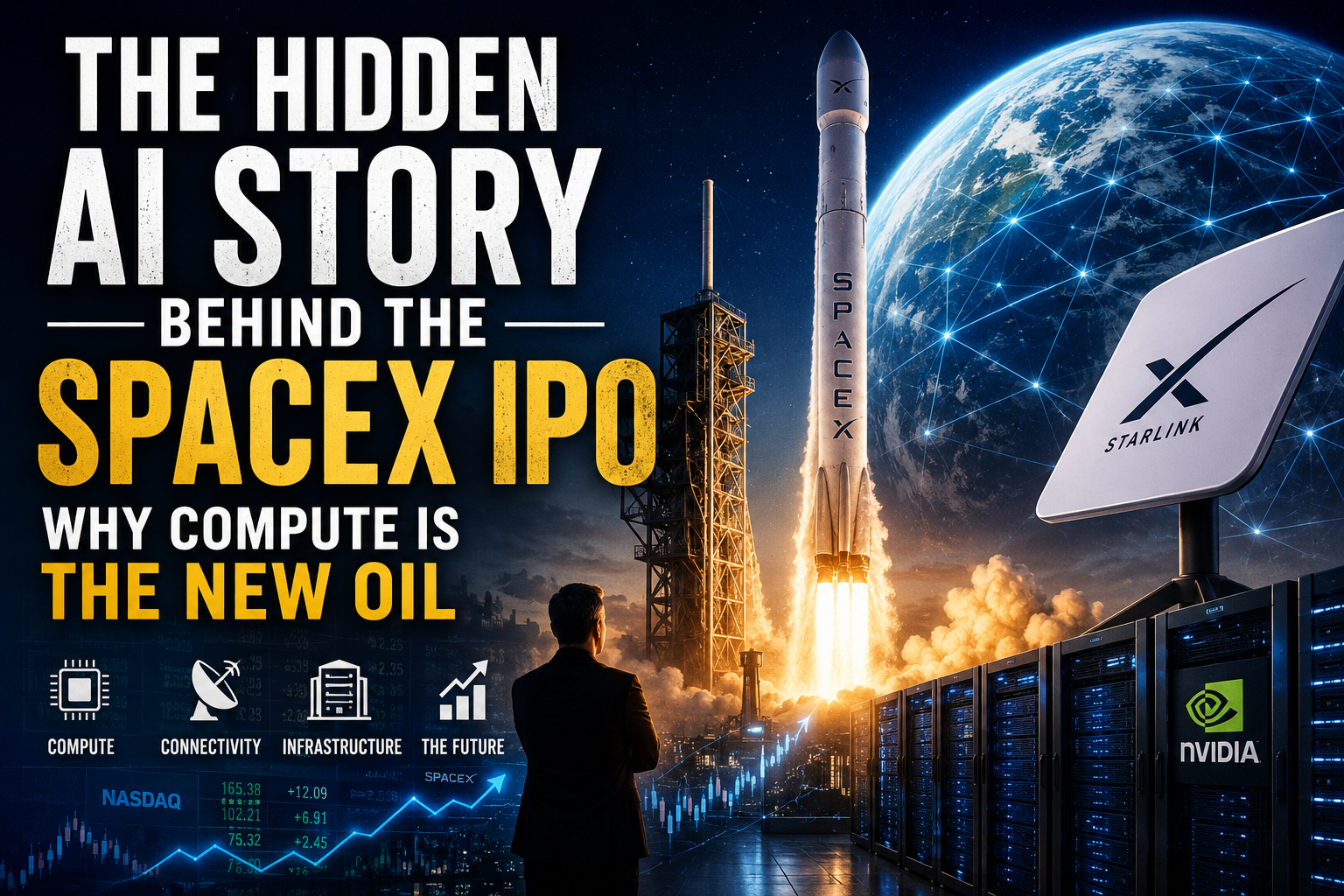
For years, investors have described SpaceX as a rocket company.
That description is now too small.
SpaceX still launches rockets. It still lands boosters. It still builds Starship. It still dominates commercial space transportation in a way that once seemed impossible. But the more important story behind the SpaceX IPO may not be about rockets at all.
The hidden story is artificial intelligence infrastructure.
As SpaceX moves toward what could become one of the largest public offerings in history, the company is being revalued not only as a space business, but as an infrastructure platform sitting at the intersection of rockets, satellites, communications, defense, cloud computing, and AI.
That is why the phrase “compute is the new oil” matters.
In the twentieth century, oil powered transportation, industry, geopolitics, and financial markets. In the twenty-first century, compute may play a similar role. Artificial intelligence does not run on abstract intelligence alone. It runs on GPUs, data centers, electricity, networking, cooling systems, chips, memory, fiber, satellites, and software orchestration.
Behind every chatbot response, every AI-generated image, every autonomous driving decision, every financial model, and every AI research assistant is a physical infrastructure layer that must be built, financed, operated, and scaled.
That infrastructure is becoming one of the most valuable layers of the global economy.
SpaceX is entering public market conversation at exactly the moment when investors are beginning to understand this shift.
1. The SpaceX IPO Is Bigger Than a Space Story
The obvious SpaceX IPO story is simple: a private company founded by Elon Musk built reusable rockets, reduced launch costs, won major government and commercial contracts, created Starlink, and became one of the most important aerospace companies in the world.
That story is already powerful.
But it is not the full story.
Recent reporting around the IPO has focused on an extraordinary fundraising target and a valuation that places SpaceX among the most valuable companies in the world. Reuters reported that SpaceX planned to price the IPO at $135 per share, targeting a $75 billion raise and a valuation around $1.75 trillion. That alone would make the IPO historically significant.
Yet the market is not only paying for rockets. A trillion-dollar-plus valuation requires a much larger narrative. Investors need to believe SpaceX is not simply a launch provider, but a platform capable of capturing value across multiple future industries.
That is where artificial intelligence enters the story.
SpaceX has increasingly become linked to massive compute capacity, AI workloads, and cloud infrastructure partnerships. Reuters reported that SpaceX signed a multi-year cloud services agreement with Google, giving Google access to roughly 110,000 Nvidia GPUs and other computing resources. The deal reportedly involves payments of $920 million per month from October 2026 to June 2029 after a ramp-up period.
This changes how investors should think about the company.
SpaceX is not merely sending payloads into orbit. It is becoming part of the AI infrastructure supply chain.
2. Why Compute Is Becoming the New Oil
Every technological era has a scarce resource.
During the Industrial Revolution, coal powered factories, railways, and manufacturing. In the twentieth century, oil powered cars, airplanes, logistics, global trade, and military strategy. In the internet era, bandwidth and data became critical economic resources.
In the AI era, compute is becoming the scarce resource.
Compute is the ability to process data at scale. In artificial intelligence, that usually means access to GPUs, accelerators, memory, storage, high-speed networking, and data center infrastructure. The more advanced AI becomes, the more compute it requires.
Training frontier AI models demands enormous clusters of specialized chips. Running those models for millions or billions of users requires even more ongoing inference capacity. As AI shifts from experimental tools to everyday business infrastructure, compute demand grows rapidly.
This is why Nvidia became one of the central companies of the AI boom. Its GPUs became the engines of modern AI. But GPUs are not enough by themselves. They need power. They need cooling. They need data centers. They need networking. They need software. They need customers. They need global distribution.
The next phase of AI competition is not only about who has the best model. It is about who controls the infrastructure required to run models at global scale.
That is why compute is the new oil.
Oil was valuable because it powered the physical economy. Compute is valuable because it powers the intelligent economy.
3. The AI Industry Is Moving From Models to Infrastructure
For much of the AI boom, public attention focused on models.
GPT versus Claude. Gemini versus Llama. OpenAI versus Anthropic. Google versus Meta. New benchmarks. New context windows. New reasoning scores. New coding results. New multimodal demos.
Models matter, but models are becoming only one layer of the AI stack.
The deeper stack includes:
Chips: GPUs, TPUs, AI accelerators, networking hardware, memory, and storage.
Data centers: physical facilities that house compute clusters and cooling systems.
Power: electricity generation, grid access, backup systems, and energy contracts.
Connectivity: fiber networks, cloud routing, edge networks, satellite internet, and low-latency communications.
Cloud platforms: software environments that make compute usable by enterprises and developers.
AI applications: the products users actually touch, from coding agents to financial research tools.
Investors are starting to recognize that the infrastructure layer may be more durable than individual model leadership.
A model can lose its benchmark advantage in months. Infrastructure takes years to build. Data centers require land, power, hardware procurement, construction, and long-term contracts. Satellite networks require launch capacity, orbital infrastructure, ground stations, terminals, spectrum rights, and operational expertise.
That makes infrastructure strategically valuable.
SpaceX already controls unique infrastructure: launch capacity, satellite manufacturing, orbital deployment, Starlink connectivity, and now increasingly compute capacity. This combination is rare.
4. Starlink Is Not Just Internet. It Is an AI Connectivity Layer.
Many investors still view Starlink as a consumer satellite internet service.
That view is too narrow.
Starlink is a global connectivity platform. It serves households, ships, aircraft, remote businesses, military users, governments, and regions where traditional broadband is weak or unavailable. According to Starlink’s own network update, SpaceX deployed more than 2,300 Starlink satellites in the past year and added nearly 450 Tbps of cumulative capacity.
Public data also shows how rapidly the constellation has expanded. Starlink has grown from an ambitious satellite internet project into one of the largest satellite networks ever built.
Why does this matter for AI?
Because artificial intelligence is moving beyond browsers and apps.
The next phase of AI will involve physical-world systems:
Autonomous vehicles
Industrial robots
AI-powered drones
Smart factories
Remote mining operations
Maritime logistics
Aviation systems
Military intelligence networks
Disaster response systems
Global IoT devices
These systems require reliable connectivity. In cities, fiber and 5G can solve part of the problem. But in remote regions, oceans, deserts, mountains, conflict zones, and disaster areas, satellite connectivity becomes far more important.
This is where Starlink becomes strategically powerful.
It can connect AI systems where traditional infrastructure does not exist.
That means Starlink may become more than a broadband service. It may become a backbone for edge AI, defense AI, autonomous logistics, and remote industrial automation.
5. The Google Compute Deal Changes the Narrative
The reported Google-SpaceX cloud services agreement is important because it changes investor perception.
Before this kind of deal, SpaceX could be understood primarily as a launch and satellite company. After it, SpaceX becomes harder to classify. Is it aerospace? Telecom? Defense technology? Cloud infrastructure? AI compute? The answer may be all of them.
Google reportedly gains access to around 110,000 Nvidia GPUs through the SpaceX agreement. That is not a small side arrangement. That is serious AI infrastructure capacity.
From Google’s perspective, the logic is clear. Demand for AI services is rising rapidly. Enterprises want AI tools. Developers want model access. Consumers want better assistants. Search is becoming more AI-driven. Cloud customers need more compute. If internal capacity is not enough, external compute agreements become valuable.
From SpaceX’s perspective, the logic is equally powerful. Compute capacity can generate recurring revenue. It can support the IPO narrative. It can demonstrate that SpaceX owns infrastructure useful beyond space transportation. It can create a bridge between satellite connectivity and AI workloads.
That is why the deal matters.
It suggests SpaceX may monetize infrastructure in more ways than investors previously expected.
6. The Anthropic Angle: AI Companies Are Hungry for Capacity
The Google deal also follows reporting about another major agreement involving Anthropic and SpaceX-linked compute capacity. The broader message is simple: leading AI companies need more compute than the market can easily provide.
AI labs are constrained by capacity.
Even if a company has world-class researchers and great models, it still needs GPUs to train and serve those models. It needs data centers to house them. It needs power to run them. It needs networking to connect them. The physical bottleneck is real.
This is one reason infrastructure providers are gaining bargaining power.
In the early internet era, companies that controlled distribution, servers, and networks became extremely valuable. In the AI era, companies that control compute and connectivity may occupy similar positions.
SpaceX is interesting because it has a unique infrastructure DNA. It builds difficult physical systems. It integrates hardware, software, manufacturing, launch operations, networking, and government relationships. That capability may matter more in AI infrastructure than many investors realize.
7. Data Centers Are the New Factories
During the Industrial Revolution, factories were symbols of economic power.
In the AI era, data centers are becoming the new factories.
They produce intelligence at scale.
Every AI response is a small unit of computational labor. Every generated image, summarized document, research report, coding suggestion, customer support reply, and financial analysis consumes compute.
As businesses adopt AI, demand for these “intelligence factories” grows.
The physical requirements are enormous:
Large amounts of electricity
Reliable grid access
Cooling systems
GPU clusters
High-bandwidth networking
Security systems
Operational expertise
Long-term capital investment
This is why AI is no longer just a software story. It is a capital expenditure story.
The companies that can finance and operate AI infrastructure may gain a long-term advantage. This includes hyperscalers like Google, Microsoft, Amazon, and Meta. It includes chip suppliers like Nvidia. It includes energy providers. It includes data center operators. And increasingly, it may include companies like SpaceX.
8. SpaceX’s Unique Advantage: Physical Execution
Many technology companies are excellent at software.
Fewer are excellent at physical execution.
SpaceX’s core advantage has always been execution in the physical world. It built reusable rockets when many experts doubted the economics. It improved launch cadence. It vertically integrated manufacturing. It created Starlink by repeatedly launching satellites at scale. It developed systems that operate in harsh environments where failure is expensive.
That culture is relevant to AI infrastructure.
AI infrastructure is not only about writing code. It is about building and operating complex physical systems. It requires supply chain management, hardware reliability, power planning, cooling, logistics, deployment speed, and operational discipline.
SpaceX has demonstrated these capabilities in aerospace.
If it can apply similar execution to compute infrastructure, investors may begin to value the company differently.
9. The Investment Case for SpaceX Is Becoming Multi-Layered
The traditional investment case for SpaceX includes several obvious pillars:
Reusable rocket technology
Lower launch costs
Government contracts
Commercial satellite launches
Starship potential
Starlink subscriber growth
The emerging investment case adds new layers:
AI compute revenue
Cloud infrastructure partnerships
Satellite connectivity for AI systems
Defense AI and secure communications
Edge AI infrastructure
Potential future orbital data centers
This multi-layered narrative is exactly why the IPO is attracting so much attention.
SpaceX is no longer valued only on launches or broadband subscriptions. It is being valued as a possible infrastructure platform for several of the largest technology markets of the next decade.
That does not mean the valuation is automatically justified.
But it explains why the market is willing to consider numbers that would have seemed impossible a few years ago.
10. Why the IPO Could Force Index Investors to Pay Attention
If SpaceX becomes public at a very large valuation, it could eventually become important for major index funds.
That matters because many investors do not only buy individual stocks. They buy broad market exposure through index funds, retirement accounts, ETFs, and pension plans.
A giant public SpaceX could become a major component of market-cap weighted indexes over time, depending on eligibility rules, float, profitability, governance, and index committee decisions.
This creates a second-order effect.
Even investors who never actively choose to buy SpaceX may eventually gain exposure through index products if the company becomes large and widely included.
That is why the IPO matters beyond day-one trading.
It could reshape the composition of technology, growth, aerospace, defense, communications, and AI infrastructure exposure in public markets.
11. Why Investors Should Be Careful With the Hype
The SpaceX IPO may be historic, but historic does not automatically mean cheap.
Investors should separate two questions:
Is SpaceX an extraordinary company?
Is SpaceX a good investment at the IPO price?
Those are not the same question.
A great company can still be overvalued. A transformative business can still disappoint investors if expectations become too high. A powerful narrative can still lead to poor returns if the entry price assumes perfection.
There are real risks investors should consider.
Valuation Risk
If the IPO valuation already prices in decades of growth, future returns may depend on flawless execution. High valuations reduce margin of safety.
Execution Risk
Rockets, satellites, data centers, and AI infrastructure are difficult businesses. Delays, failures, cost overruns, and technical setbacks can affect financial results.
Regulatory Risk
SpaceX operates in highly regulated areas, including launch systems, satellite communications, defense contracts, spectrum rights, and international markets.
Concentration Risk
If a large share of future AI revenue depends on a few major customers, contract terms and renewal risk become important.
Capital Intensity
AI infrastructure requires enormous upfront investment. The business may generate large revenue but also require continuous spending to remain competitive.
Competitive Risk
Google, Microsoft, Amazon, Oracle, Meta, Nvidia, specialized data center operators, telecom companies, and governments are all investing heavily in AI infrastructure.
Investors should not treat “compute is the new oil” as a guarantee that every compute-related asset will generate attractive returns. Oil created enormous fortunes, but it also created cycles, crashes, overcapacity, regulation, and geopolitical risk.
Compute may follow a similar pattern.
12. The New AI Supply Chain
To understand the long-term opportunity, investors should map the AI supply chain.
Layer Key Assets Representative Companies Why It Matters Chips GPUs, accelerators, memory, networking Nvidia, AMD, Broadcom, TSMC AI models require specialized hardware to train and run efficiently. Data Centers Compute clusters, cooling, power systems Hyperscalers, data center REITs, private infrastructure firms Physical facilities turn chips into usable AI capacity. Power Electricity, grid access, backup energy Utilities, energy companies, nuclear developers AI infrastructure is increasingly power-constrained. Connectivity Fiber, cloud networks, satellite internet SpaceX Starlink, telecom operators, cloud providers AI systems need fast, reliable access to users and devices. Models Foundation models and specialized AI systems OpenAI, Anthropic, Google, Meta, xAI Models convert compute into useful intelligence. Applications AI assistants, coding tools, financial research, customer support Software companies and AI startups Applications capture user demand and business value.
SpaceX is unusual because it touches multiple layers at once.
It has connectivity through Starlink. It has physical deployment capability through launch operations. It has defense and government relationships. It is now connected to large-scale compute agreements. It has the ambition to build infrastructure beyond Earth.
That is why the company’s AI story is bigger than a single cloud deal.
13. Why AI Investing Is Becoming Harder
The SpaceX IPO also illustrates a broader challenge for investors.
AI is making markets more complex.
In the past, an investor could analyze a company by reading financial statements, understanding its products, and comparing valuation multiples. That still matters, but it is no longer enough.
Today, investors must understand how companies fit into fast-changing technology ecosystems.
A rocket company may become an AI infrastructure company.
A chip company may become a platform company.
A cloud company may become an AI operating system.
A search company may become an agentic workflow company.
A telecom network may become an edge AI layer.
Industry boundaries are blurring.
This makes traditional analysis more difficult. It also makes emotional investing more dangerous. Hype cycles move quickly. Social media can amplify narratives before fundamentals are clear. Investors may chase headlines without understanding the underlying business model.
That is why AI-assisted investment research is becoming more useful.
The goal is not to let AI blindly pick stocks. The goal is to use AI to process information more effectively, compare competing narratives, identify risks, and reduce human bias.
14. What SpaceX Teaches Us About the Future of AI Stocks
SpaceX shows that the next generation of AI winners may not look like traditional software companies.
Some winners may be:
Chip companies
Power companies
Data center builders
Satellite operators
Defense technology firms
Cloud infrastructure providers
Industrial automation platforms
Robotics companies
AI-native financial research platforms
This is important for investors because the AI trade is expanding.
In the first phase, investors focused on obvious AI names. In the second phase, they focused on semiconductors. In the third phase, they focused on hyperscalers. The next phase may focus on power, connectivity, infrastructure, and real-world deployment.
SpaceX sits directly in that next phase.
It represents the idea that AI is no longer only digital. AI is becoming physical, industrial, and geopolitical.
15. How Multi-Agent AI Changes Stock Research
As AI infrastructure becomes more complex, investment research also needs to evolve.
A single analyst perspective is often not enough. One investor may focus on revenue growth. Another may focus on valuation. Another may focus on competitive advantages. Another may focus on regulation. Another may focus on technical risk.
Multi-agent AI systems can simulate this kind of debate.
For example, a strong AI stock research workflow might include:
A fundamental analysis agent
A valuation agent
A risk analysis agent
A macroeconomic agent
A sentiment analysis agent
A technical analysis agent
A news monitoring agent
A competitive landscape agent
This does not eliminate uncertainty. But it can help investors avoid one-dimensional thinking.
When analyzing SpaceX, such a system might ask:
Is the valuation supported by realistic revenue growth?
How much of the future narrative depends on AI compute?
Are cloud compute deals recurring, temporary, or cyclical?
How durable is Starlink’s competitive advantage?
What regulatory risks could affect satellite deployment?
How much capital will be needed to keep scaling?
How should investors compare SpaceX with Nvidia, Google, Amazon, and defense technology firms?
This is where platforms like AlphaVue.ai become relevant. The future of investing is not about replacing human judgment with one AI answer. It is about using multiple AI perspectives to improve research quality, reduce emotional bias, and make complex markets easier to understand.
In other words, AI investing is not about predicting the future with certainty.
It is about seeing more of the map before making a decision.
16. Why the SpaceX IPO Could Become a Defining Market Moment
Some IPOs are important because of their size.
Others are important because they mark a change in how markets think.
The SpaceX IPO could be both.
If investors value SpaceX mainly as a rocket company, the IPO is a space story. If investors value SpaceX as a satellite communications company, it is a telecom story. If investors value SpaceX as a defense technology company, it is a geopolitical story.
But if investors value SpaceX as an AI infrastructure platform, the IPO becomes something larger.
It becomes a signal that public markets are moving into the next phase of the AI boom.
The first phase was about models.
The second phase was about chips.
The third phase was about cloud platforms.
The next phase may be about infrastructure: compute, power, connectivity, and deployment.
That is the hidden AI story behind the SpaceX IPO.
17. The Future: Orbital Data Centers and Space-Based Compute
One of the most futuristic ideas connected to SpaceX is space-based compute.
At first, it sounds like science fiction. Why put data centers in orbit?
There are theoretical reasons.
Space offers access to solar energy. It avoids some land constraints. It may support future lunar or orbital manufacturing. It could enable new forms of communications and distributed infrastructure.
There are also enormous challenges, including launch cost, maintenance, radiation, heat management, latency, orbital debris, and economics.
Investors should not assume orbital data centers are inevitable.
But the fact that the idea is even being discussed shows how far the AI infrastructure conversation has moved. Compute demand is becoming so large that companies are exploring solutions that once would have sounded absurd.
That is what happens when a resource becomes strategically important.
The world looks for new ways to produce more of it.
18. Practical Takeaways for Investors
For investors watching the SpaceX IPO, the most important lesson is not simply “buy” or “avoid.” The better lesson is how to think.
Here are the key takeaways:
First, SpaceX is no longer just a rocket company.
The company now sits across launch, satellite communications, defense, connectivity, and AI infrastructure.
Second, compute is becoming a strategic resource.
AI demand is making GPUs, data centers, power, and connectivity more valuable.
Third, Starlink may be more important than many investors realize.
Its role in global connectivity could become increasingly important as AI moves into physical-world systems.
Fourth, valuation still matters.
A great company can still be risky if expectations are too high.
Fifth, AI investing requires broader analysis.
Investors need to understand technology ecosystems, not just financial ratios.
19. Conclusion: The Real Story Is Infrastructure
The SpaceX IPO is not only about rockets.
It is not only about Starship.
It is not only about Elon Musk.
It is not only about satellite internet.
The deeper story is infrastructure.
Artificial intelligence is becoming the central technology of the next decade, and AI requires massive physical infrastructure to function. It requires chips, power, cooling, data centers, networks, satellites, and global deployment capacity.
SpaceX is one of the few companies that can credibly tell a story across several of these layers.
That is why investors are paying attention.
The future may not belong only to companies with the best AI models. It may belong to companies that control the resources required to run AI everywhere.
In the twentieth century, oil shaped the global economy.
In the twenty-first century, compute may do the same.
And the hidden AI story behind the SpaceX IPO is that SpaceX may be trying to become one of the companies that helps supply it.
20. Why This Story Matters for Long-Term SEO and Investor Attention
The SpaceX IPO is likely to generate short-term attention because of its size, its founder, and its potential effect on public markets. But the reason this topic may continue attracting search traffic is deeper than the IPO date itself.
Investors are trying to understand the next phase of the artificial intelligence economy.
Search demand around AI stocks, AI infrastructure, Nvidia GPUs, data centers, power demand, cloud computing, and satellite internet is likely to remain strong because these themes are not one-day news events. They are structural market trends.
That makes the SpaceX IPO a useful lens for explaining a broader transition. The company combines several themes that investors already care about: Elon Musk, commercial space, Starlink, AI compute, Google, Nvidia, cloud services, defense infrastructure, and potential index inclusion.
For content strategy, this matters because a strong evergreen article should not only summarize a news event. It should answer the deeper questions users will continue searching for after the news cycle fades.
Those questions include:
Why is the SpaceX IPO so important?
Is SpaceX an AI infrastructure company?
How does Starlink connect to artificial intelligence?
Why does AI require so much compute?
What does “compute is the new oil” mean?
How should investors analyze AI infrastructure stocks?
Could SpaceX become part of major stock indexes?
Answering these questions gives the article a longer life than a simple news summary.
21. The Difference Between AI Hype and AI Infrastructure
One of the biggest mistakes investors make is treating every AI-related story the same way.
Some AI stories are mostly hype. They depend on vague promises, unclear revenue models, and aggressive marketing. Other AI stories are infrastructure stories. They involve hard assets, customer demand, capacity constraints, and long-term capital commitments.
The SpaceX story is interesting because it belongs closer to the infrastructure category.
Infrastructure stories are different from software hype stories. They are usually slower to build, more expensive to scale, and harder for competitors to replicate. They also tend to involve long-term contracts, regulatory relationships, operational reliability, and large customers.
That does not make them risk-free. In fact, infrastructure businesses often carry heavy debt, high capital expenditures, complex execution risk, and cyclical demand. But they are grounded in physical constraints.
AI compute is a physical constraint.
When companies cannot obtain enough GPUs, their AI ambitions are limited. When data centers cannot access enough power, growth slows. When networks cannot connect users and machines reliably, AI applications become less useful. When latency is too high, real-time systems fail.
This is why the infrastructure layer deserves serious investor attention.
AI applications may change quickly. Consumer interfaces may come and go. Model rankings may shift every quarter. But the need for compute, power, and connectivity is likely to keep expanding as AI becomes embedded into more parts of the economy.
22. SpaceX, Defense, and the Geopolitics of AI Infrastructure
Another reason SpaceX matters is its connection to defense and geopolitics.
AI infrastructure is not only a commercial issue. It is also a national security issue.
Governments care about secure communications, satellite resilience, military logistics, intelligence gathering, autonomous systems, and battlefield connectivity. AI will increasingly influence each of these areas.
SpaceX already has deep relevance to government and defense markets because of launch services and satellite connectivity. Starlink has also demonstrated the importance of resilient communications in difficult environments.
As AI systems become more important in defense, the companies that control secure infrastructure may gain strategic importance. This could include cloud providers, semiconductor companies, satellite operators, defense contractors, cybersecurity firms, and companies that can deploy physical infrastructure quickly.
This geopolitical dimension makes SpaceX different from many ordinary technology companies.
Its products are not only consumer tools. They can become part of national infrastructure. That gives the company potential advantages, but it also creates political and regulatory complexity.
Investors should understand both sides.
Strategic importance can support demand and strengthen customer relationships. But it can also attract scrutiny, export controls, government intervention, international restrictions, and political controversy.
In the AI era, infrastructure companies may become too important to ignore and too sensitive to regulate lightly.
23. What Could Go Wrong With the “Compute Is the New Oil” Thesis?
The phrase “compute is the new oil” is powerful, but investors should not treat it as a perfect analogy.
Oil is a commodity. Compute is a combination of hardware, software, energy, networking, and operational capability. Oil markets are shaped by geology and geopolitics. Compute markets are shaped by chip supply, manufacturing capacity, model efficiency, energy costs, software optimization, and demand from AI applications.
Several things could weaken the compute thesis.
Model Efficiency Could Improve Faster Than Expected
If AI models become dramatically more efficient, companies may need less compute per unit of intelligence. This would not eliminate demand, but it could reduce pricing power for some infrastructure providers.
Overcapacity Could Emerge
When capital floods into a hot market, supply can eventually exceed demand. Data centers, GPUs, and cloud capacity could face pricing pressure if too many companies build too much infrastructure too quickly.
Energy Constraints Could Limit Growth
Compute requires power. If electricity supply, grid infrastructure, or regulatory approvals cannot keep up, AI infrastructure expansion may slow.
Customer Concentration Could Create Risk
Large compute contracts may look attractive, but they can create dependence on a small number of major customers. If those customers renegotiate, terminate, or build their own capacity, revenue could change quickly.
Technology Could Shift
Specialized chips, optical computing, distributed inference, edge AI, or other innovations could change the economics of compute over time.
None of these risks invalidates the thesis. But they remind investors that infrastructure investing requires discipline.
The correct takeaway is not that every compute asset is automatically valuable. The correct takeaway is that compute has become strategically important, and investors must analyze which companies can convert that importance into durable profits.
24. A Framework for Analyzing SpaceX After the IPO
Once SpaceX becomes public, investors will need a framework for evaluating the company beyond headlines.
A useful framework should include at least six dimensions.
Revenue Quality
Investors should separate recurring revenue from one-time revenue. Starlink subscriptions, long-term compute contracts, launch contracts, defense agreements, and other business lines may have different margins and durability.
Segment Margins
Launch services, satellite internet, AI compute, and defense technology may have very different economics. A high-revenue segment is not necessarily a high-profit segment.
Capital Expenditure Requirements
SpaceX operates capital-intensive businesses. Investors should watch how much cash must be reinvested to support growth.
Customer Concentration
Major government contracts and large cloud agreements can be valuable, but they also increase dependence on key customers.
Regulatory Exposure
Launch approvals, spectrum rights, satellite rules, export controls, defense restrictions, and international market access are all important.
AI Infrastructure Optionality
The market may assign value to future AI infrastructure opportunities before they are fully proven. Investors should separate current financial performance from future optionality.
This framework helps prevent emotional decision-making.
Instead of asking whether SpaceX is exciting, investors can ask whether the business fundamentals support the valuation.
25. The Bigger Lesson: AI Is Becoming a Physical Economy
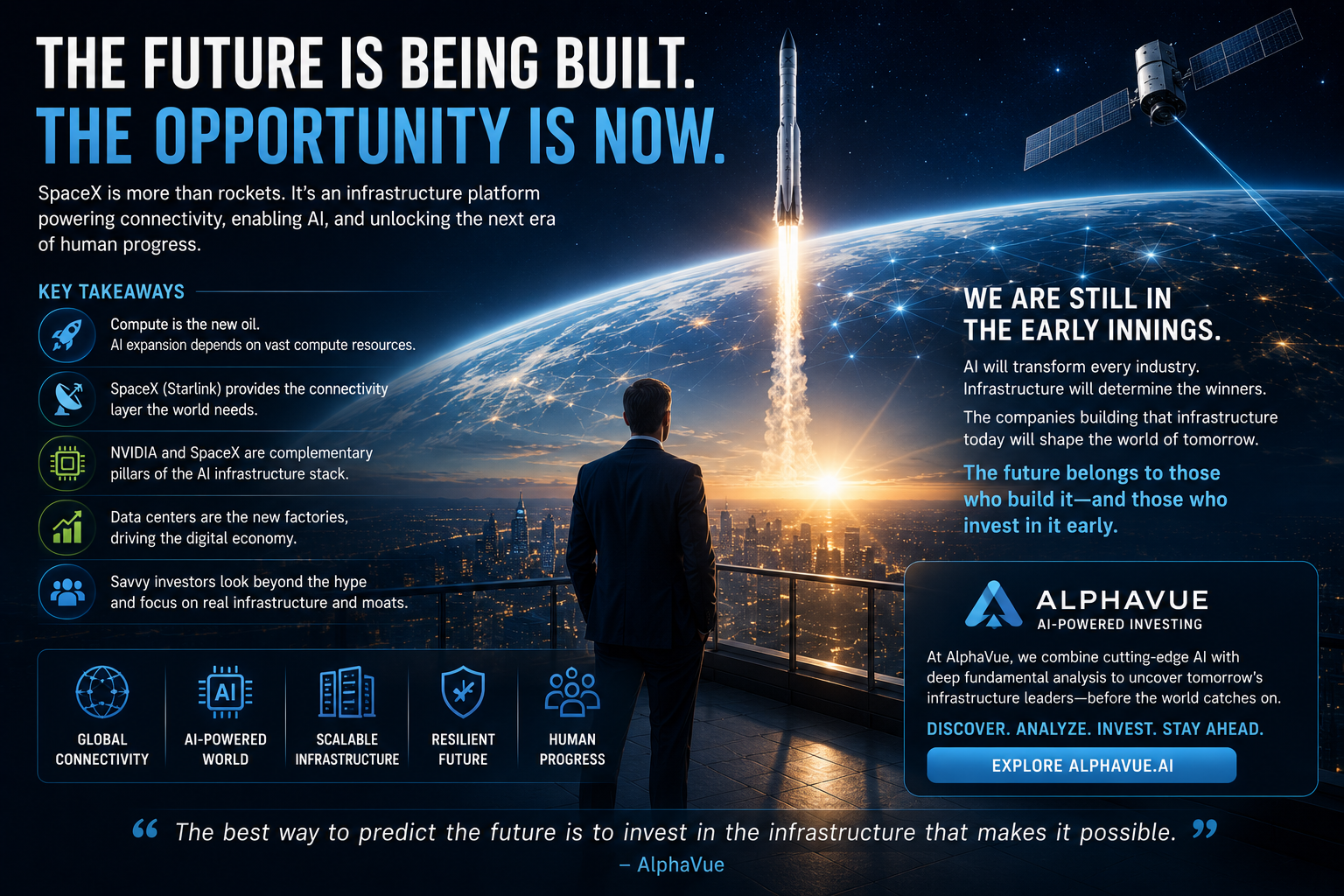
The most important lesson from the SpaceX IPO is that artificial intelligence is becoming physical.
For many users, AI feels like software. You type a prompt, receive an answer, and move on. But at scale, AI is deeply physical.
It depends on factories that produce chips. It depends on mines that supply materials. It depends on data centers that consume power. It depends on networks that connect users. It depends on cooling systems, power grids, satellite constellations, undersea cables, and logistics.
This is why AI may reshape more industries than software alone.
It will affect energy demand. It will affect real estate. It will affect utilities. It will affect defense. It will affect telecommunications. It will affect capital markets. It will affect how investors value infrastructure.
SpaceX is important because it shows how the boundaries between industries are dissolving.
A company can begin as a rocket company and become a communications company. It can become a defense infrastructure company. It can become an AI compute partner. It can become a public market mega-cap candidate.
That is the new AI economy.
The winners may be companies that combine software intelligence with physical infrastructure.