
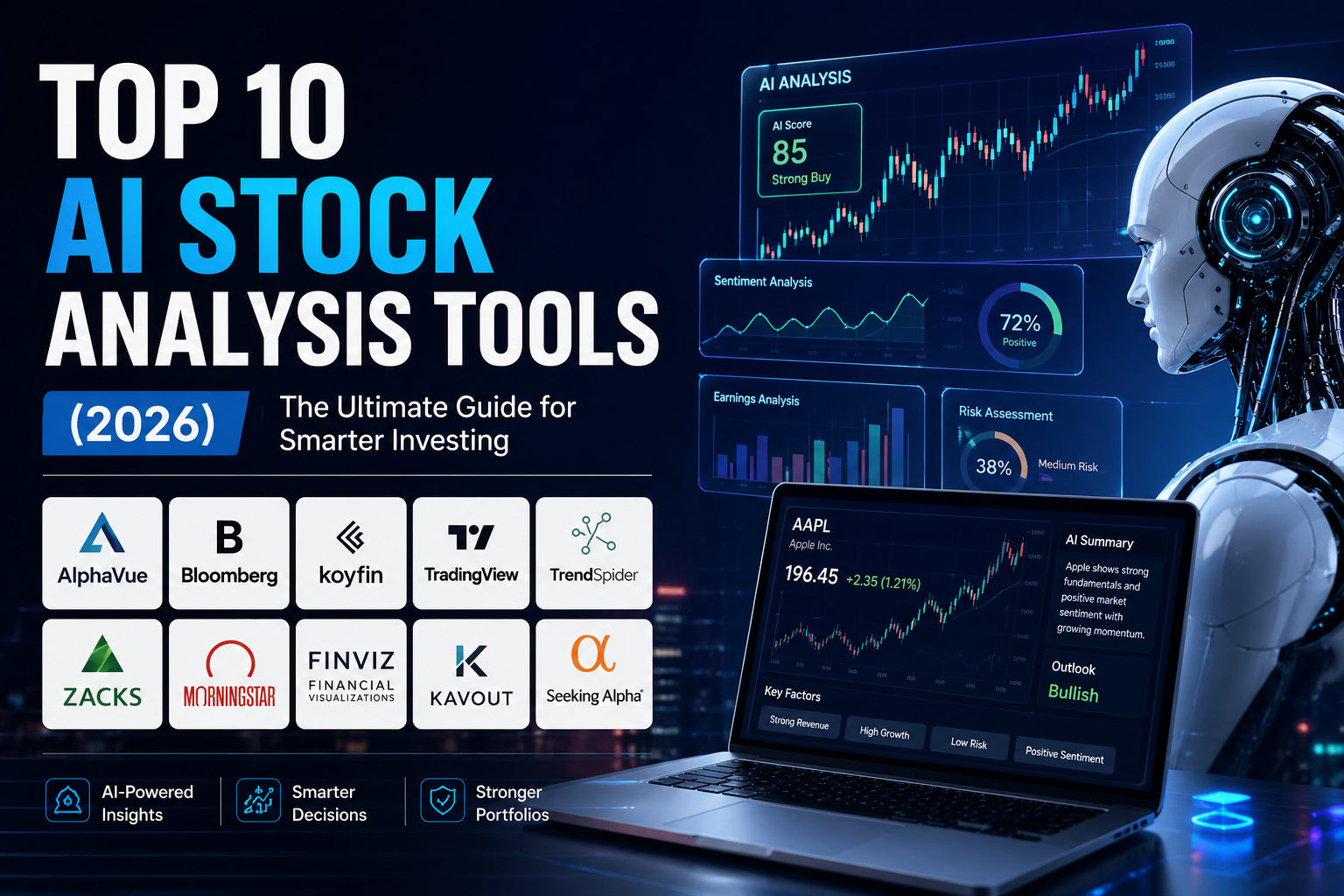
The explosion of AI in finance has created a new category of tools promising smarter, faster, and more accurate stock analysis. But most investors face a critical problem:
Not all AI stock tools are built the same — and many are just thin layers on top of traditional analytics.
This guide goes beyond surface-level reviews. We break down the top 10 AI stock analysis tools in 2026 from a technical, strategic, and practical perspective — including how they work, what they optimize for, and where they fail.
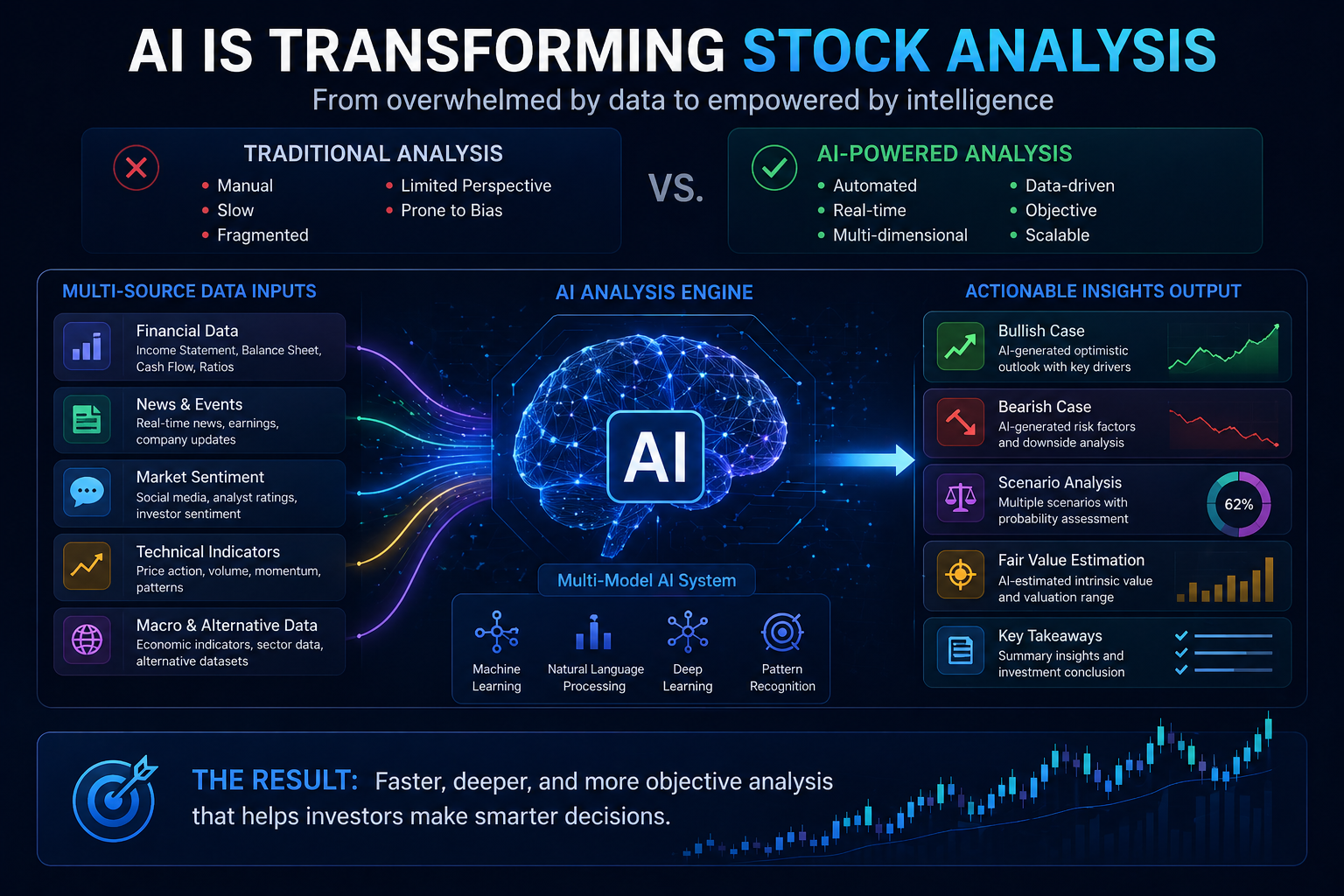
What Defines a “Real” AI Stock Analysis Tool?
Before comparing tools, we need to define what “AI-driven” actually means in investing.
There are three distinct levels of AI adoption:
Level 1 — AI-assisted: Adds summaries or basic signals (e.g., news summarization)
Level 2 — AI-enhanced: Uses machine learning for predictions or scoring
Level 3 — AI-native: Multi-model reasoning, autonomous analysis, decision frameworks
Most tools on the market today are still at Level 1 or 2.
Only a few platforms are truly AI-native.
Evaluation Framework (How We Ranked These Tools)
To ensure objective comparison, we evaluated each platform across six dimensions:
DimensionDescriptionData CoverageFundamentals, news, technicals, alternative dataAI DepthRule-based vs ML vs multi-agent reasoningExplainabilityCan users understand why a decision is made?Real-Time CapabilityLatency and update frequencyUsabilityEase of use for retail investorsDecision SupportDoes it actually help you decide?
Top 10 AI Stock Analysis Tools (Deep Breakdown)
1. AlphaVue.ai — AI-Native Multi-Agent Investment System
Category: Level 3 (AI-native)
AlphaVue represents a new paradigm in stock analysis: instead of relying on a single AI model, it orchestrates 20+ specialized AI agents, each focusing on a specific dimension of analysis.
These agents operate simultaneously and produce:
Independent analysis results
Bullish and bearish arguments
Structured reasoning outputs
This creates something fundamentally different from traditional tools: an internal debate system.
Key Insight: Investment decisions are rarely about finding “the answer” — they are about understanding conflicting perspectives.
FeatureAlphaVueAI TypeMulti-agent systemOutputDebate-based reasoningTransparencyHighBest ForDeep decision-making
2. Bloomberg Terminal (AI Enhanced)
Apply this research method to your stock
Enter one ticker and get a research summary you can keep exploring.
Category: Level 2
Bloomberg integrates AI primarily to enhance data processing rather than redefine decision-making.
Strength lies in:
Unmatched data access
Institutional-grade analytics
Real-time market feeds
Limitation: Not designed for AI-driven reasoning — more of a data engine.
3. Koyfin AI
Focuses on combining visualization with AI insights. Strong in macro-level analysis but limited in predictive modeling depth.
4. TradingView AI Indicators
AI here is primarily used to enhance technical indicators. It excels in pattern detection but lacks fundamental integration.
5. TrendSpider
Automates technical workflows such as trendline detection and backtesting. Strong for traders but narrow in scope.
6. Zacks Investment Research
Uses quantitative models and earnings-based signals. Reliable for ranking, but limited explainability.
7. Morningstar AI
Focuses on long-term valuation and moat analysis. AI is used conservatively within a traditional framework.
8. Finviz Elite
Primarily a screening tool enhanced with AI filters. Fast but shallow in analysis depth.
9. Kavout
Uses machine learning to generate stock scores. Good for quick insights but lacks transparency.
10. Seeking Alpha AI
AI is used to summarize content rather than generate analysis. Useful but not decision-oriented.
Full Comparison Table
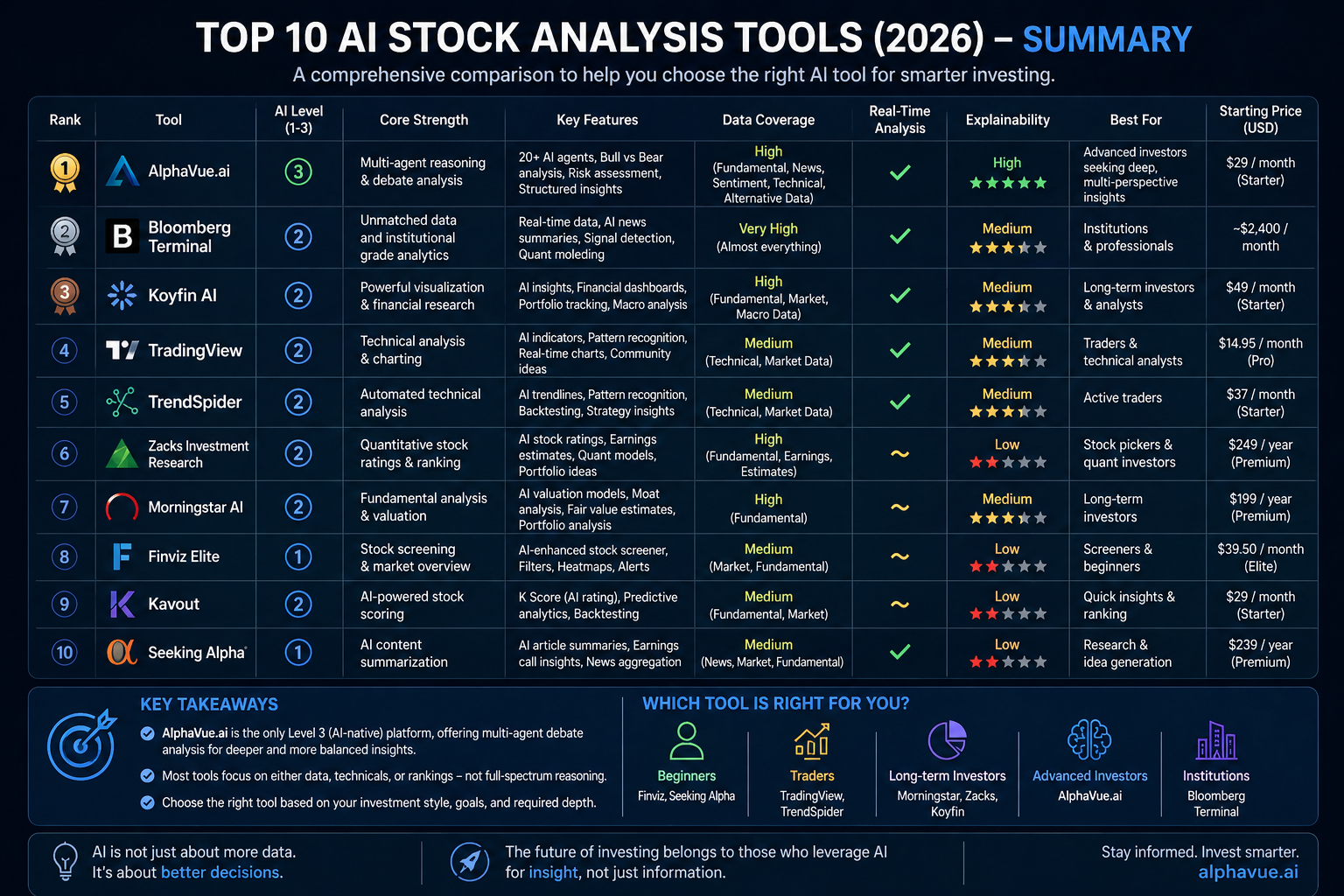
ToolAI LevelCore StrengthWeaknessBest For AlphaVueLevel 3Multi-agent reasoningNew platformDeep analysis BloombergLevel 2Data coverageExpensiveInstitutions KoyfinLevel 2VisualizationLimited AI depthMacro investors TradingViewLevel 2ChartsNo fundamentalsTraders TrendSpiderLevel 2AutomationNarrow scopeTechnical traders ZacksLevel 2Quant rankingBlack boxStock pickers MorningstarLevel 2FundamentalsSlow updatesLong-term FinvizLevel 1SpeedShallow analysisScreening KavoutLevel 2AI scoringLow explainabilityQuick insights Seeking AlphaLevel 1Content aggregationNo decision supportResearch reading
Key Insight: Most AI Tools Don’t Solve the Core Problem
Despite the rapid growth of AI in finance, most tools fail at one critical task:
Helping investors make decisions under uncertainty.
They provide:
More data
More signals
More indicators
But not better decisions.
This is why AI-native systems (like multi-agent models) are gaining attention — they focus on reasoning, not just prediction.
How to Choose the Right Tool (Strategic Guide)
User TypeRecommended Tool BeginnerFinviz, Seeking Alpha TraderTradingView, TrendSpider Long-term investorMorningstar, Zacks Advanced investorAlphaVue InstitutionBloomberg
The Future: From AI Tools to AI Decision Systems
The next evolution of AI in investing will include:
Autonomous research agents
Real-time debate systems
Continuous learning from outcomes
In this future, investors won’t just use tools — they will interact with AI decision systems.
Final Thoughts
The real question is no longer:
“Should you use AI for stock analysis?”
But:
“Which type of AI system gives you the strongest decision advantage?”
Most tools optimize for efficiency.
A few optimize for insight.
Only the best optimize for decision quality.