AlphaVue: A Multi-Agent Intelligent Analysis Platform Reshaping AI Equity Research
In modern financial markets, investors' biggest challenge is not a lack of information but information overload, multidimensional complexity, and rapid change. Traditional stock analysis tools often rely on human experience or a single AI model, making it difficult to cope with market complexity and variability. AlphaVue was created to fill this gap: through multi-agent collaborative analysis, structured signal output, and intelligent decision support, it helps investors make more scientific and robust decisions in complex markets.
1. Limitations of Traditional AI Stock Analysis
Most AI stock analysis tools on the market rely on a single model and generate a buy, sell, or hold conclusion via natural language. At first glance, this seems to provide convenient decision support, but in practice there are several problems:
Insufficient information coverage: A single model finds it hard to simultaneously synthesize financial statements, technical indicators, market news, investor sentiment, and risk factors.
Outputs are unverifiable: Conclusions usually lack explicit data sources and quantitative metrics, so users cannot assess their credibility.
Instability: Input methods, data updates, or time changes can all lead to significant differences in output results.
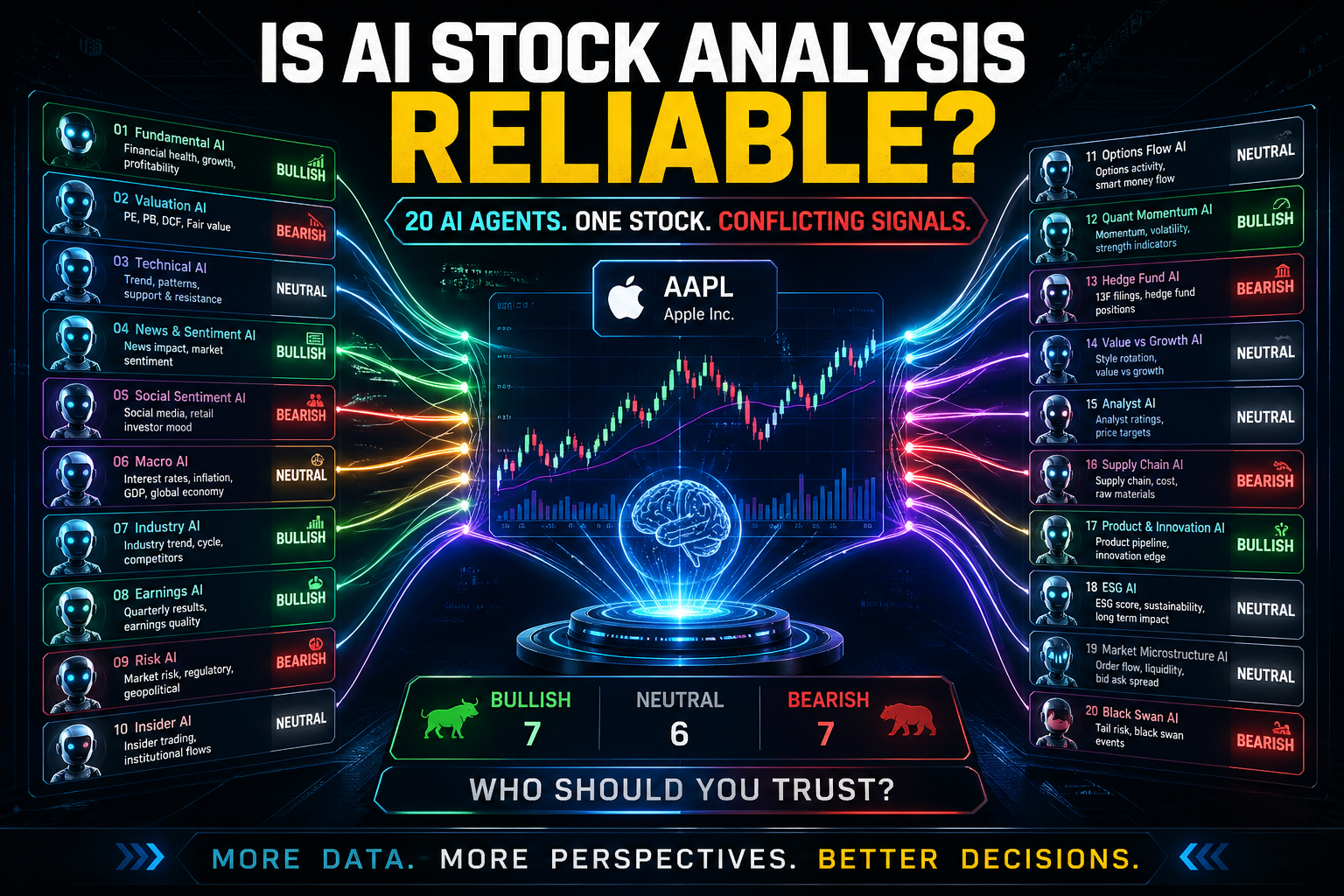
For example, the same stock may receive completely opposite recommendations from different models:
Model analysis conclusion potential issue AI Model A Buy Ignores recent industry policy risks AI Model B Hold Underestimates the company's fundamental growth potential AI Model C Sell Based only on short-term market sentiment fluctuations
This demonstrates that a single AI analysis is unlikely to form a reliable, verifiable investment judgment.
2. AlphaVue Multi-Agent Architecture Design
To overcome the limitations of a single AI, AlphaVue adopts a multi-agent collaborative analysis architecture. Each agent is responsible for a dedicated analysis dimension, focuses on processing corresponding information, and outputs quantitative signals:
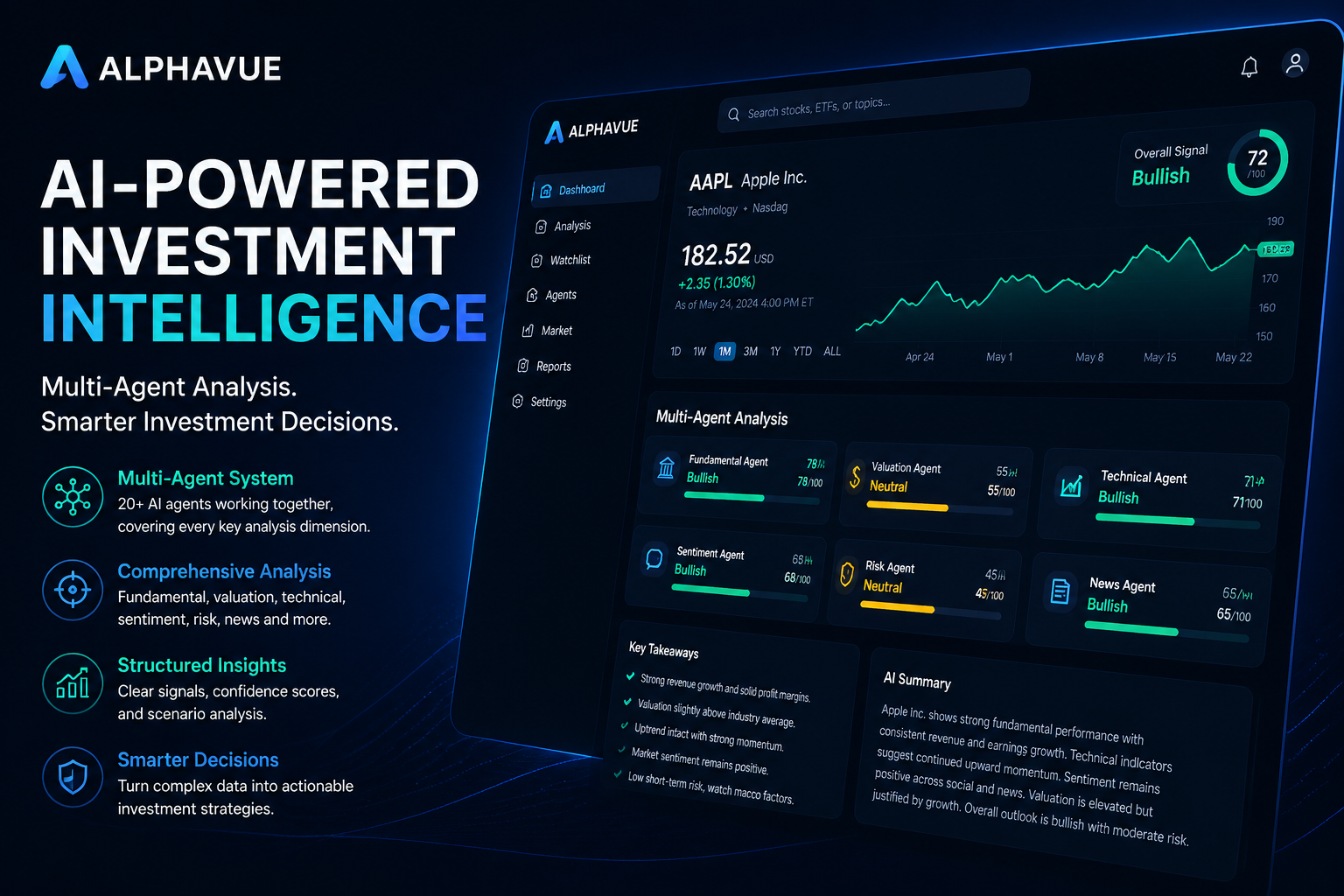
Agent typeAnalysis dimensionOutput signalUser valueFundamental AgentFinancial statements, profitability, cash flowCompany stability score (0-100)Assess long-term investment valueValuation AgentPE, PB, DCF valuationValuation reasonableness score (Low/Medium/High)Help assess reasonable buy priceTechnical AgentTrends, moving averages, volume indicatorsShort-to-medium term trend scoreAssist short-term decisions and timingSentiment AgentMarket sentiment, investor discussionSentiment index (0-100)Evaluate market sentiment highs/lowsRisk AgentMacro, industry, policy risksRisk level (Low/Medium/High)Identify potential downside risksNews AgentCompany and industry news eventsEvent impact score (Positive/Negative/Neutral)Judge short-term event impactCompetitive Landscape AgentIndustry competition, market share, moat analysisCompetitive advantage score (0-100)Assess company's long-term relative advantage
This architecture is similar to the division of labor in a real research team; each agent independently processes signals, ensuring clear analysis dimensions and comprehensive coverage.
3. Signal Aggregation Principles of the Multi-Agent System
The core of the multi-agent system is signal aggregation. Outputs from various agents may conflict or be biased; AlphaVue quantifies and integrates these signals through an aggregation mechanism and generates structured analysis reports:
Signal weighting: Adjust weights based on market environment, historical data, and user strategy
Confidence assessment: Measure the consistency among multiple agents
Risk coverage: Highlight potential downside factors
Signal typeQuantitative metricExplanationNotesFundamental score82/100Strong long-term corporate growth potentialValuation score70/100Price is relatively high; exercise cautionTrend score55/100Recent stock price trend weakeningSentiment index90/100Investor sentiment is high, increasing short-term riskRisk levelMedium-HighMacroeconomic policy and industry risks still need attention
Users can understand the source and meaning of each dimension through visualizations and quantitative indicators, rather than relying solely on a single conclusion.
4. Information Coverage and the Real Value of AI
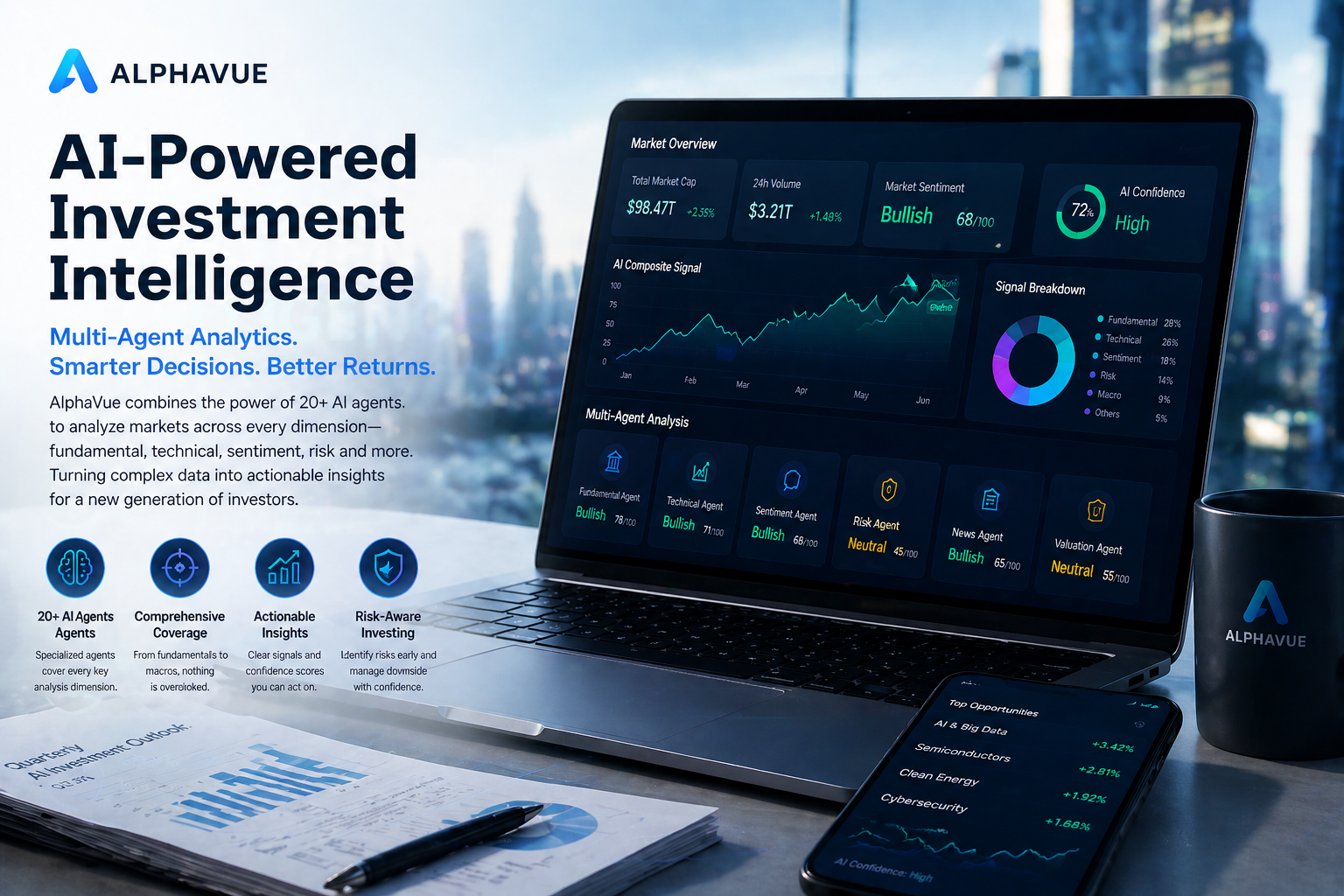
AlphaVue’s most important innovation is not predicting the future but information coverage. Single AI models can easily miss critical data, while a multi-agent system can extract signals from multiple dimensions:
Fundamental indicators, financial data, trend signals
News events, market sentiment, sentiment indices
Macro risks, industry policies, competitive landscape
This information coverage reduces investors' cognitive blind spots and enables more comprehensive investment decisions, rather than blindly relying on “prediction results.”
5. Conflict Handling and Decision Explainability
A multi-agent system will inevitably produce signal conflicts. For example:
Fundamental Agent: Bullish
Valuation Agent: Overvalued
Sentiment Agent: Overheated
Technical Agent: Neutral to weak
AlphaVue does not hide these divergences; instead, it uses aggregation mechanisms to provide explanations that help investors understand the source of conflicts and adjust decisions based on different strategies.
6. Real-time Updates and Strategy Assistance
The platform supports real-time update features:
Automatic retrieval of financial reports, announcements, and industry data
Immediate monitoring of news and events
Dynamic updates of market sentiment indices
Configurable strategy conditions to trigger notifications
This ensures users' analysis information remains up to date while assisting in strategy adjustments.
7. User Scenarios and Target Audience
Professional investors: Quickly obtain comprehensive signals
Quant research teams: Use for strategy backtesting and optimization
Long-term investors: Analyze companies' long-term value and potential risks
Retail investors: Assist in scientific decision-making and reduce information blind spots
Not suitable for scenarios such as short-term speculation or fully relying on AI to place trades.
8. Platform Market Differentiation
Compared with single-AI analysis tools on the market, AlphaVue's differentiating advantages are:
Multi-agent collaborative analysis and structured output
Conflicting signals are preserved and quantitatively explained
Real-time data updates and aggregated decision-making
Exportable full reports for team use or post-trade review
Systematic signal interpretation and investment strategy support
9. Long-term Investment Value and Risk Control Logic
AlphaVue not only provides data analysis but also helps users understand investment logic:
Long-term value analysis: Company fundamentals and competitive advantages
Risk alerts: Macro policy, industry cycles, valuation bubbles
Trend assessment: Combining short-term technicals and market sentiment
Strategy support: Signal weight adjustment and condition triggers
These features help investors build a robust, verifiable long-term investment framework.
10. Conclusion
AlphaVue breaks down, quantifies, and integrates complex stock information through multi-agent collaborative analysis and outputs explainable analysis signals. It is not just an AI analysis tool but a complete research system that helps investors make scientific decisions.
From signal coverage and conflict explanation to aggregated decision-making, AlphaVue provides a systematic, structured analysis process that enables investors to maintain information completeness and judgment robustness in complex markets. This is the core value that distinguishes AlphaVue from traditional AI stock analysis platforms.