
1. Executive Summary: The AI Model War Has Moved Beyond Chatbots
The debate around frontier AI models has changed dramatically. In the early ChatGPT era, the central question was simple: which model writes better answers? Users compared models by asking for essays, emails, summaries, poems, translations, or basic coding snippets. That phase is largely over. In 2026, the most important AI question is not whether a model can respond intelligently to a prompt. The real question is whether it can complete economically valuable work with enough reliability, speed, and cost efficiency to be trusted inside a business process.
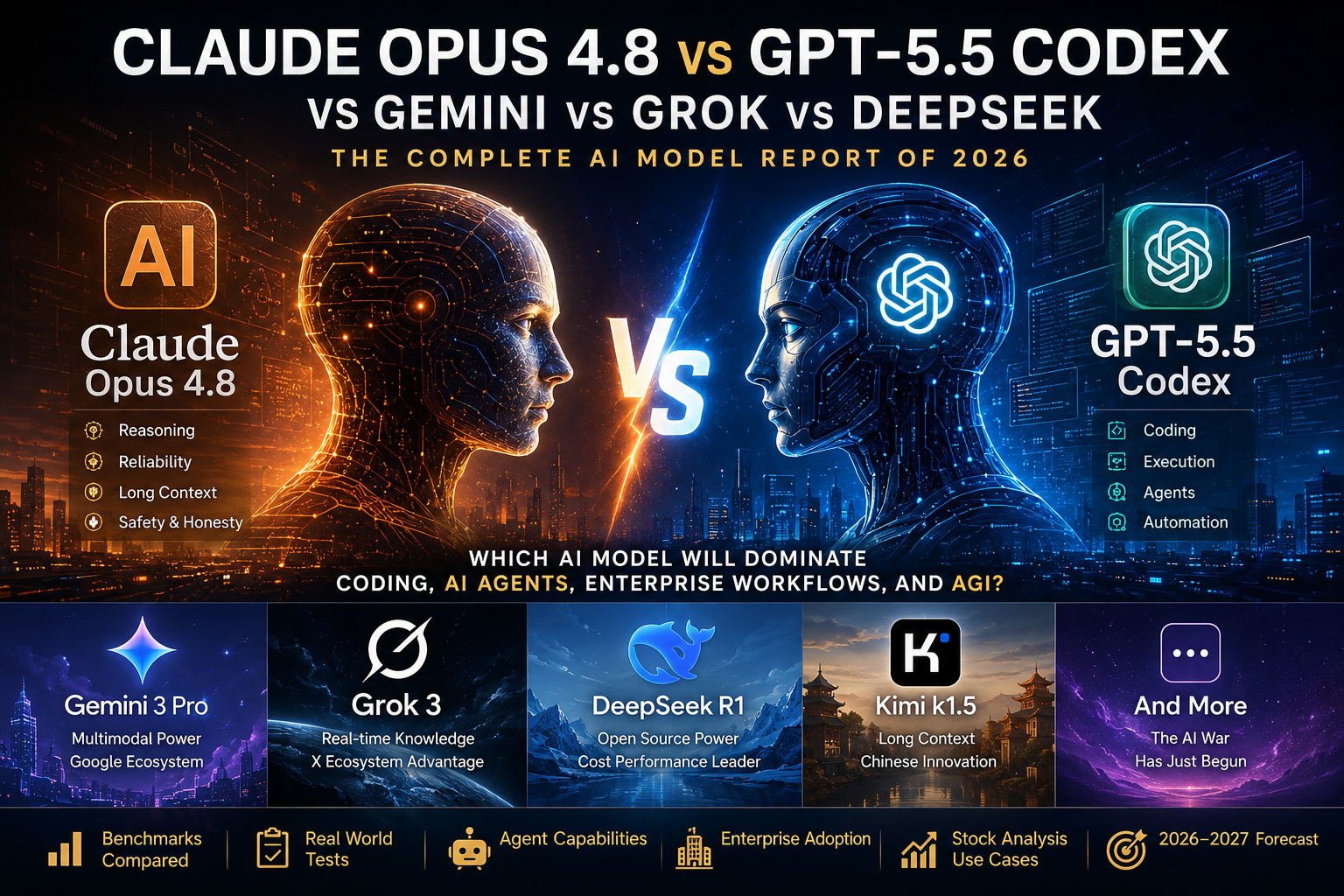
That is why the comparison between Claude Opus 4.8 and GPT-5.5 Codex matters. Claude Opus 4.8, released by Anthropic in late May 2026, is being positioned as a more reliable, more honest, and more collaborative frontier model. Anthropic’s messaging is unusually focused on the model’s ability to recognize uncertainty, avoid unsupported claims, and work independently for longer periods. GPT-5.5, released by OpenAI in April 2026 and deeply connected to Codex workflows, is being positioned as OpenAI’s strongest agentic coding model, with strong performance on command-line workflow benchmarks and real-world software engineering tasks.
At the same time, this is no longer a two-player race. Google’s Gemini line remains strategically important because of its multimodal capabilities and deep integration with Search, Workspace, Android, YouTube, and cloud infrastructure. xAI’s Grok is important because it sits close to real-time social and market conversations on X. DeepSeek and other Chinese model families matter because they have changed the economics of AI by showing that strong reasoning and coding performance can be delivered at lower inference costs. Kimi, GLM, Qwen, MiniMax, and other Asian model ecosystems are also becoming increasingly relevant for companies that care about cost, local compliance, multilingual performance, and deployment flexibility.
The headline conclusion is straightforward. If your priority is deep reasoning, long-form analysis, knowledge work, and lower-risk collaboration, Claude Opus 4.8 looks extremely strong. If your priority is software execution, command-line workflows, autonomous coding tasks, and developer productivity, GPT-5.5 Codex is one of the most important models in the market. If your priority is multimodal search and integration with Google’s ecosystem, Gemini remains dangerous. If your priority is real-time social intelligence, Grok should not be ignored. If your priority is large-scale cost efficiency, DeepSeek and other open or semi-open models deserve serious attention.
The most important conclusion, however, is that the future of AI is not a single-model future. Enterprises are increasingly moving toward multi-model routing and multi-agent architectures. One model may plan. Another may code. Another may search. Another may evaluate sentiment. Another may verify financial assumptions. In that world, the winner is not simply the model with the highest score on one benchmark. The winner is the system that knows how to combine specialized intelligence into a reliable workflow.
2. Why 2026 Is Different: From Model Intelligence to Work Completion
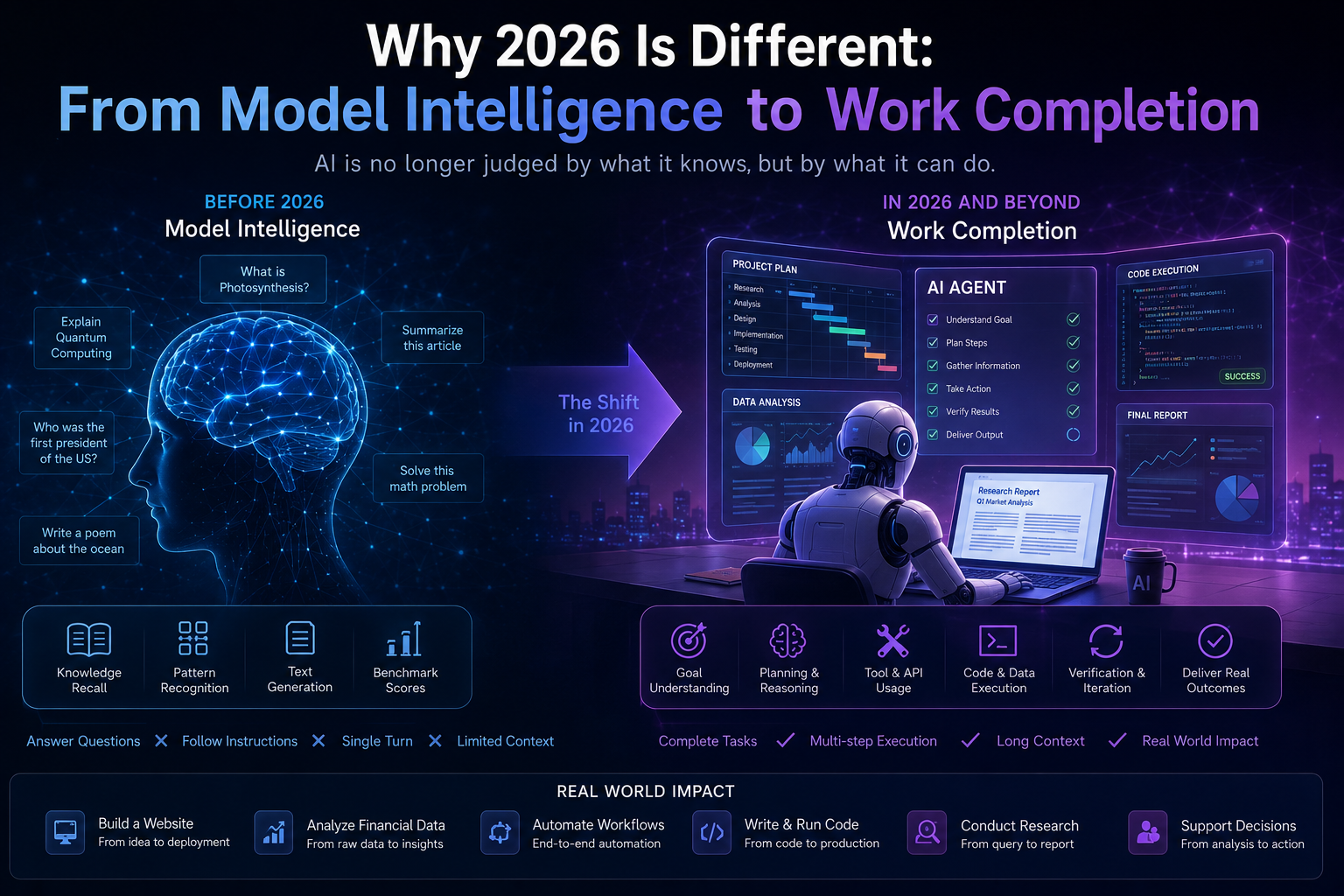
For years, AI labs competed through benchmark announcements. Every release came with a chart showing improvements on MMLU, HumanEval, GSM8K, GPQA, ARC, or other academic-style tests. Those benchmarks were useful because they gave the industry a way to measure progress. They still matter. But they no longer capture the full value of modern AI systems.
A model can perform well on a static benchmark and still fail badly in a real company. The reason is simple: real work is messy. Real software projects require reading existing code, understanding architecture, respecting conventions, running tests, debugging failures, and coordinating changes across files. Real financial research requires interpreting filings, news, macro data, market sentiment, valuation, technical indicators, and risk factors. Real enterprise knowledge work requires retrieval, verification, reasoning, summarization, compliance awareness, and sometimes refusal. A benchmark question is a single task. Business work is a chain of tasks.
This is why new evaluation categories have become more important. SWE-Bench and SWE-Bench Pro attempt to measure whether models can resolve real GitHub issues rather than merely write toy functions. Terminal-Bench tests whether models can perform complex command-line workflows involving planning, iteration, and tool coordination. OSWorld and computer-use evaluations test whether models can navigate software environments and complete tasks through interfaces. AgentBench-style evaluations attempt to capture multi-step behavior rather than isolated answers. These benchmarks are imperfect, but they point toward the right question: can the model act?
The shift from “answering” to “acting” changes the competitive landscape. A model that writes beautiful prose may not be the best model for a CI/CD pipeline. A model that passes coding benchmarks may not be the best model for high-stakes legal analysis. A model that is cheap may be the best option for millions of routine classification jobs, even if it is not the strongest frontier model. A model with access to real-time social data may outperform a more intelligent model in trend detection. The right model depends on the workflow.
This also explains why the phrase “best AI model” has become less meaningful. Best for what? Best for writing? Best for coding? Best for command-line execution? Best for financial research? Best for customer support? Best for long-context document analysis? Best for cost per task? Best for compliance? The answer changes depending on the job.
Claude Opus 4.8 and GPT-5.5 Codex are important because they embody two different answers to the question of work completion. Anthropic appears to be saying that the next generation of AI must be trustworthy enough to collaborate on complex tasks. OpenAI appears to be saying that the next generation of AI must be capable enough to execute tasks directly. Both are right, but they emphasize different parts of the intelligence stack.
3. Claude Opus 4.8: The Reliability-First Frontier Model
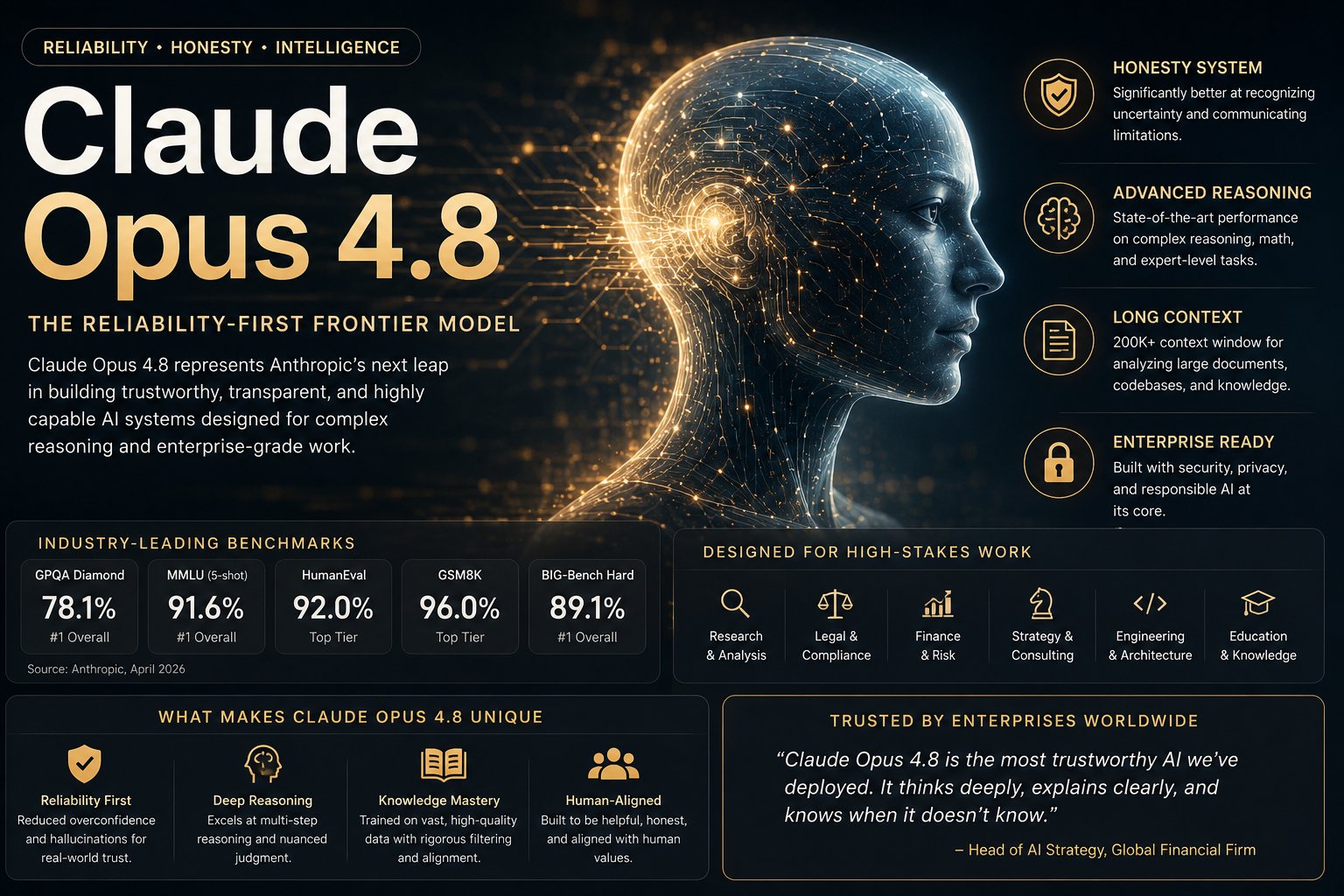
Claude Opus 4.8 is not merely another model release. The most interesting part of Anthropic’s launch is not that the model is better at coding or reasoning. Every major model release claims benchmark improvements. The more important signal is Anthropic’s emphasis on honesty, uncertainty awareness, and collaborative reliability. In a market full of models that can produce convincing answers, Anthropic is trying to differentiate Claude as the model that is less likely to pretend it knows something it does not know.
This matters because overconfidence is one of the biggest barriers to enterprise AI adoption. A wrong answer is bad. A wrong answer delivered with confidence is much worse. In software engineering, an overconfident model may claim that a patch is complete even when tests have not passed. In finance, it may summarize a company’s risks while silently missing a debt covenant, regulatory investigation, or margin compression pattern. In legal analysis, it may invent case law. In healthcare, it may give dangerous advice. In enterprise knowledge management, it may answer from memory instead of retrieved evidence.
Anthropic’s public messaging around Opus 4.8 suggests that the company is treating honesty as a first-class capability. Media reports around the launch highlighted the model’s tendency to admit uncertainty and its improved ability to identify issues in code. The Verge reported that Opus 4.8 is much less likely than its predecessor to overlook flaws in code it generates, and noted Anthropic’s introduction of “effort control,” allowing users to influence how much reasoning effort the model applies to a task. Reuters also reported that Opus 4.8 launched at the same price as its predecessor while emphasizing transparency and uncertainty handling.
For enterprise buyers, this is a major point. A model that is slightly slower but more honest may be preferable in workflows where trust matters. If an AI is helping with compliance, financial research, risk analysis, knowledge base QA, or executive decision support, the cost of unsupported confidence can be high. Claude’s value is not just that it can reason well, but that it is increasingly optimized to behave like a careful collaborator rather than an overconfident autocomplete system.
Claude’s historical strengths also align with this positioning. The model family has often been praised for long-form writing, nuanced analysis, instruction following, and complex document reasoning. In many user workflows, Claude feels less like a tool that simply predicts the next token and more like a professional collaborator that can maintain context, evaluate tradeoffs, and explain assumptions. That subjective experience is difficult to capture in one benchmark, but it is very important in real work.
In coding, Claude Opus 4.8 appears especially strong on tasks that require understanding complex code and making careful changes. Public comparisons circulating after the launch reported Claude Opus 4.8 at 69.2% on SWE-Bench Pro compared with GPT-5.5 at 58.6%, while OpenAI’s own GPT-5.5 announcement reported 58.6% on SWE-Bench Pro. Those figures should be interpreted carefully because benchmark configurations can vary. Still, the direction is clear: Claude is highly competitive in real-world coding issue resolution, especially when the task rewards judgment rather than raw terminal execution.
The model’s weakness is not that it cannot act. Claude can perform agentic workflows and tool use. But its personality and product positioning often feel more deliberative than aggressively executable. In some environments, that is a strength. In fast-moving developer workflows, it can sometimes feel less direct than OpenAI’s Codex environment. Claude is strongest when the problem requires careful analysis, long context, and risk-aware reasoning. GPT-5.5 Codex is often strongest when the problem requires rapid execution inside a developer toolchain.
4. GPT-5.5 Codex: The Execution-First AI Engineer
GPT-5.5 Codex should not be understood as just another chat model with better code generation. Its deeper significance is that OpenAI is pushing AI toward software execution. Codex is not only about writing functions. It is about reading repositories, understanding issue context, editing multiple files, running commands, testing changes, interpreting errors, and iterating toward completion. That is a much more valuable capability than code autocomplete.
OpenAI’s GPT-5.5 announcement emphasized agentic coding. The company reported that GPT-5.5 achieved 82.7% on Terminal-Bench 2.0, a benchmark designed to test complex command-line workflows requiring planning, iteration, and tool coordination. OpenAI also reported 58.6% on SWE-Bench Pro for real-world GitHub issue resolution. These numbers matter because they suggest that GPT-5.5 is not merely better at writing code in isolation. It is better at operating in environments where code must be executed, tested, and fixed.
This distinction is essential. Traditional coding benchmarks ask whether a model can produce a correct answer. Modern software engineering asks whether a model can maintain a loop: understand, act, observe, repair, and continue. GPT-5.5 Codex is designed for that loop. It is closer to an AI junior engineer than a writing assistant. It may not always have the most elegant explanation, but it is increasingly capable of moving a task forward in a practical toolchain.
For developers, that is the real productivity breakthrough. A model that writes a snippet saves minutes. A model that fixes a failing test suite saves hours. A model that opens a repository, understands a bug report, edits the right files, and produces a working patch changes team economics. Even if the final code must be reviewed by a human engineer, the AI has moved from passive assistant to active contributor.
GPT-5.5 Codex also benefits from OpenAI’s ecosystem. OpenAI has strong developer mindshare, a large API customer base, and product integrations that make it easy for teams to experiment. Codex workflows are especially attractive for engineering teams because the model can be placed close to source code, terminals, tests, and deployment pipelines. In practical adoption, product packaging matters as much as raw intelligence. A slightly weaker model inside a better workflow can outperform a stronger model that is harder to integrate.
The main risk with an execution-first model is that acting quickly can amplify mistakes. If a model is too eager to modify files, run commands, or assert completion, human teams need strong guardrails. The future of AI software engineering will therefore depend on verification loops: test suites, static analysis, code review, sandboxing, permission boundaries, and human approval. GPT-5.5 Codex is powerful, but it should be treated as an agent operating within a controlled environment, not as an unsupervised senior engineer.
The best way to summarize GPT-5.5 Codex is this: it is not simply competing to be the smartest model. It is competing to become the default execution layer for software work. If OpenAI wins that layer, it can become deeply embedded in how software is built, reviewed, tested, and maintained. That would be a much larger business opportunity than chat.
5. Benchmark Data: What the Numbers Say and What They Do Not Say
Benchmark data is useful, but only if interpreted correctly. The following table combines public claims and widely circulated third-party comparisons around Claude Opus 4.8, GPT-5.5, and other frontier models. Because evaluation harnesses, prompts, tool access, and sampling configurations can differ, these numbers should be treated as directional rather than absolute.
CategoryClaude Opus 4.8GPT-5.5 CodexGemini 3.1 Pro / Gemini LineGrok / xAI LineDeepSeek / Open ModelsInterpretationSWE-Bench ProReported around 69.2% in post-launch comparisonsOpenAI reports 58.6%Some media comparisons place Gemini 3.1 Pro lower than Claude and GPT-5.5Strong in some coding rankings but varies by benchmarkStrong cost-performance, often competitive below frontier tierClaude appears very strong for issue-resolution style coding.Terminal-Bench 2.0Competitive, but not the headline leader in most reportsOpenAI reports 82.7%Gemini CLI appears on public leaderboards, but scores vary by agent implementationDepends heavily on tool environmentOften not optimized for terminal execution at frontier levelGPT-5.5 Codex is built for command-line workflows.Long-context reasoningHistorically strong and reinforced by Claude’s document-work positioningStrong, especially in agent workflowsGoogle is strategically strong in multimodal and search-context tasksReal-time context from social data can be valuableKimi and other long-context Chinese models are important contendersLong context is no longer only about window size; retrieval and reasoning quality matter.Knowledge workVery strong for analysis, writing, synthesis, and risk-aware reasoningStrong, especially when connected to toolsStrong when tied to Google ecosystem dataStrong for social trend awarenessGood for scale and cost-sensitive document processingClaude often feels strongest for polished high-level analysis.Cost efficiencyPremium frontier pricing, but stable enterprise positioningPremium pricing; cost can rise with large output and agent loopsDepends on Google product packagingDepends on xAI plans and data accessOften best cost-performance ratioOpen and Chinese models are hard to ignore for high-volume tasks.Enterprise integrationStrong through Anthropic API and cloud partnershipsVery strong through OpenAI ecosystem and developer adoptionStrong via Google Cloud and WorkspaceMore specialized around X and real-time use casesStrong for companies needing deployment controlIntegration often matters more than marginal benchmark differences.
The key benchmark lesson is not that Claude always beats GPT or GPT always beats Claude. The key lesson is specialization. Claude appears particularly strong on reasoning-heavy coding and knowledge tasks. GPT-5.5 appears particularly strong on terminal execution and agentic development workflows. Gemini remains strategically important where multimodal search and Google ecosystem integration matter. Grok is differentiated by real-time social context. DeepSeek and other lower-cost models are differentiated by economics.
Another important point is that benchmarks are vulnerable to “leaderboard overfitting.” As soon as a benchmark becomes famous, labs optimize for it. This does not mean the benchmark is useless, but it does mean buyers should test models on their own tasks. A customer support company should benchmark models on actual customer conversations. A financial research platform should benchmark models on real filings, news, and price data. A developer team should benchmark models on its own repositories and test suites. Public benchmarks are a starting point, not a purchasing decision.
6. Gemini: The Model That Should Not Be Underestimated
It is easy to frame the 2026 AI race as OpenAI versus Anthropic. That would be a mistake. Google remains one of the most strategically important AI companies in the world, and Gemini remains one of the most dangerous competitors in the market. Google controls Search, YouTube, Android, Chrome, Gmail, Google Docs, Google Sheets, Google Cloud, and a massive advertising business. That ecosystem advantage is difficult to overstate.
Gemini’s core strength is not always that it wins every text-only benchmark. Its strength is multimodal and ecosystem integration. A model connected to Google Search, Workspace, and cloud infrastructure can become extremely valuable even if another model slightly outperforms it on a coding benchmark. In real companies, AI is rarely used in isolation. It is used inside email, spreadsheets, documents, meetings, analytics dashboards, customer data platforms, and cloud systems. Google already owns many of those surfaces.
Gemini is particularly relevant for tasks that combine text, images, video, search, and structured documents. For example, a business analyst may want to analyze a PDF report, compare it with spreadsheet data, search recent market news, summarize key risks, and generate a presentation. Google has a natural advantage in that kind of workflow because its ecosystem already contains many of the required artifacts.
The challenge for Google is product focus. Google has world-class research, infrastructure, data, and distribution, but it has sometimes struggled to turn those advantages into a developer experience as coherent as OpenAI’s or a model personality as beloved as Claude’s. In the AI market, intelligence alone is not enough. The product must feel useful. The workflow must be clear. Developers must trust the APIs. Enterprises must understand the packaging.
Still, dismissing Gemini would be a strategic error. If the next generation of AI is multimodal and deeply embedded into productivity software, Google has one of the strongest hands in the industry. The model that wins a coding leaderboard may not be the model that dominates enterprise productivity. Gemini’s path to victory is not necessarily “beat Claude at writing” or “beat GPT at terminal tasks.” Its path is to become the intelligence layer inside the daily tools that billions of people already use.
7. Grok and xAI: Real-Time Social Intelligence as a Differentiator
Grok is often discussed through the lens of personality, controversy, or Elon Musk’s public presence. That misses the more important strategic point. Grok’s differentiation is not only its model architecture. It is its proximity to real-time social data from X. In a world where markets, politics, culture, and technology narratives move through social platforms, real-time context is a serious advantage.
Many AI models are strong at reasoning over static information. But trend detection is different. If a stock is moving because of a rumor, a viral post, a regulatory leak, an earnings interpretation, or a sudden shift in market sentiment, the fastest signal may appear on social media before it appears in formal news. Grok’s access to that environment makes it uniquely relevant for sentiment analysis, media monitoring, political risk, brand tracking, and market narrative analysis.
This does not mean Grok is automatically the best model for every analytical task. Real-time data is noisy. Social platforms contain misinformation, manipulation, sarcasm, bot activity, and emotional overreaction. A model close to social data needs strong filtering and verification. But when paired with other models, Grok can be extremely valuable. It can serve as a market radar while other models perform deeper reasoning, financial analysis, or verification.
For investors, this is especially important. Markets are increasingly narrative-driven in the short term. A company’s fundamentals may not change overnight, but market perception can. Social sentiment does not replace discounted cash flow analysis, earnings quality analysis, or industry research. But it can help identify where attention is moving. In a multi-agent investment workflow, Grok-like models can contribute the “what is happening right now?” layer.
The strategic question for xAI is whether Grok can evolve beyond social intelligence into a broader enterprise platform. If it remains primarily tied to X, its use cases may be narrower than Claude, GPT, or Gemini. But if xAI combines real-time context, strong reasoning, multimodal capability, and enterprise tooling, Grok could become one of the most distinctive models in the market.
8. DeepSeek and the Cost-Performance Revolution
DeepSeek changed the AI conversation by forcing the market to think harder about cost efficiency. Frontier model debates often focus on the very best performance, but many real-world workloads do not require the absolute strongest model. They require good enough performance at massive scale. That is where DeepSeek and similar models become strategically important.
Cost matters because AI usage compounds. A company may start with a few internal users, then expand into customer support, document processing, code review, knowledge retrieval, analytics, monitoring, and agent workflows. Token usage can explode quickly. A model that is 10% weaker but several times cheaper may be the better economic choice for many tasks.
This is especially true for multi-agent systems. A single user request may trigger multiple agent calls: one model retrieves information, another summarizes, another verifies, another writes, another critiques, another formats, and another decides whether to escalate. If every step uses the most expensive frontier model, the system may be too costly to scale. A more efficient architecture routes only the hardest steps to premium models and uses cheaper models for classification, extraction, summarization, deduplication, and routine transformations.
DeepSeek and other lower-cost models also matter for deployment control. Some enterprises need private deployment, local compliance, data residency, or custom fine-tuning. Open-weight or more flexible models can be attractive even when they do not dominate every frontier benchmark. For many companies, control is a feature. Predictable cost is a feature. Ability to self-host is a feature.
The rise of cost-efficient models also puts pressure on OpenAI, Anthropic, and Google. If frontier labs charge premium prices, they must justify those prices with superior reliability, tooling, ecosystem integration, and task completion. Otherwise, enterprises will route more workloads to cheaper alternatives. This is why the market is moving toward model routing: expensive models for high-value reasoning, cheaper models for high-volume operations.
9. Kimi, GLM, Qwen, and the Chinese Model Ecosystem
The Chinese AI ecosystem is increasingly important in the global model race. Models such as Kimi, GLM, Qwen, DeepSeek, MiniMax, and others have demonstrated rapid improvement in reasoning, coding, long-context processing, and multilingual performance. Their importance is not limited to China. They influence global pricing, open-source expectations, deployment patterns, and enterprise AI architecture.
Kimi is often associated with long-context capabilities and document-heavy workflows. GLM and Qwen are important across enterprise and developer ecosystems. DeepSeek has become synonymous with cost-performance disruption. MiniMax and other players contribute to a broader competitive environment where model capability is improving quickly outside the United States. This makes the AI race more global and more fragmented.
For multinational companies, Chinese models may be relevant for localization, cost control, and regional compliance. A company operating in China may prefer local models for regulatory, language, or infrastructure reasons. A global company may use different model stacks in different regions. This reinforces the idea that the future is multi-model, not single-model.
The challenge for many Chinese models is global trust and ecosystem adoption. OpenAI and Anthropic benefit from strong global developer mindshare. Google benefits from massive product distribution. Chinese models often compete on performance and cost, but may need stronger global tooling, documentation, enterprise partnerships, and trust frameworks to capture broader international adoption. Still, the gap is narrowing. Any serious 2026 AI strategy must monitor Chinese model progress.
10. The Enterprise Decision Framework: Which Model Should You Use?
Enterprises should not choose a model based on brand loyalty. They should choose models based on task design. The best AI architecture starts by classifying work into categories. Is the task high-risk or low-risk? Does it require reasoning or extraction? Does it need real-time data? Does it need code execution? Does it require multimodal understanding? Does it need low cost at massive scale? Each answer points toward a different model strategy.
Enterprise TaskRecommended Model TypeReasonExecutive strategy memoClaude Opus 4.8 or similar reasoning-first modelRequires nuance, uncertainty awareness, structured argument, and polished writing.Repository bug fixingGPT-5.5 Codex or coding-agent environmentRequires tool use, command execution, testing, and iterative debugging.Large-scale document extractionDeepSeek, Qwen, Kimi, or other cost-efficient models plus verificationHigh volume makes cost important; hardest cases can route to frontier models.Market sentiment monitoringGrok-like real-time social intelligence plus verification modelRequires fast detection of social narratives and trend changes.Multimodal document and search workflowGemini or multimodal frontier modelBenefits from search, image, video, and productivity ecosystem integration.Financial research reportMulti-agent system combining Claude, GPT, real-time data, and cost-efficient modelsRequires multiple perspectives: fundamentals, news, sentiment, technicals, risk.
The practical rule is simple. Use the strongest model only where strength matters. Do not use a premium frontier model for every extraction, classification, or formatting step. Use model routing. Use verification. Use retrieval. Use smaller models where appropriate. Use specialized models for specialized tasks. This is how AI becomes economically scalable.
For companies building AI products, the architecture should include a model router, task classifier, evaluation layer, cost monitor, retry strategy, and human escalation path. The router decides which model receives which task. The evaluation layer checks output quality. The cost monitor prevents uncontrolled token spending. The escalation path ensures that high-risk failures do not silently reach users. This is the difference between a demo and a production AI system.
11. AI Agents: The Real Battlefield of 2026
The most important AI trend in 2026 is the rise of agents. An agent is not just a chatbot. It is a system that can plan, use tools, observe results, revise its plan, and continue working toward a goal. This sounds simple, but it changes everything. The value of an AI agent is not in a single answer. It is in the completion of a workflow.
Claude Opus 4.8 and GPT-5.5 both matter because they are designed for this agentic world. Claude’s strength is careful reasoning, collaboration, and reliability. GPT-5.5’s strength is execution inside tool-heavy environments. A powerful agent system may use both: Claude for planning and critique, GPT-5.5 for coding and terminal execution, Gemini for multimodal search, Grok for real-time sentiment, and DeepSeek for cost-efficient routine processing.
Agents also introduce new risks. A hallucinating chatbot is annoying. A hallucinating agent with tool access can be dangerous. It can modify files, send emails, make API calls, spend money, delete data, or trigger workflows. Therefore, the future of AI agents depends on permissioning, sandboxing, logging, evaluation, and rollback. The model is only one part of the system. The control layer is equally important.
This is why honesty and execution must eventually converge. A good agent must know how to act, but it must also know when not to act. It must recognize uncertainty. It must verify outputs. It must ask for help when required. It must explain what it did. It must not pretend completion. Claude’s honesty direction and GPT’s execution direction are both necessary ingredients for mature AI agents.
12. Why Benchmark Scores Alone Are No Longer Enough
Benchmark scores are attractive because they create simple rankings. People like rankings because they reduce complexity. But AI models are becoming too complex for one-dimensional leaderboards. A model may win a math benchmark and lose a writing task. It may win a coding benchmark and lose a repository maintenance task. It may win a general reasoning benchmark and lose an enterprise workflow because it lacks tool integration.
The biggest weakness of benchmark-driven thinking is that it ignores workflow fit. Suppose Model A scores 5% higher than Model B on a public coding benchmark. If Model B integrates better with your IDE, test suite, Git workflow, permission system, and deployment environment, Model B may produce more real productivity. Similarly, suppose Model C is weaker on frontier reasoning but costs one-fifth as much. For large-scale classification, Model C may be the rational choice.
Another problem is evaluation leakage. Popular benchmarks become training targets. Labs optimize for them. Prompting strategies are tuned around them. Public leaderboard positions become marketing assets. This does not make benchmarks useless, but it means buyers should perform private evaluations. A private evaluation should use the company’s own data, tasks, failure modes, cost constraints, and quality standards.
For example, a financial AI product should test models on real 10-K filings, earnings call transcripts, price action, analyst revisions, sector news, and macro events. A customer support product should test on real support tickets, escalation cases, refund policies, and edge cases. A software engineering team should test on real repositories with real CI failures. Only then can the team understand which model is best for its specific workflow.
13. Investment Research: Why Multi-Agent AI Beats Single-Model Analysis
Investment research is one of the clearest examples of why multi-model and multi-agent systems matter. A single model can be impressive, but investing is not a single-perspective problem. A stock can look cheap on valuation but weak on earnings quality. It can have strong revenue growth but deteriorating margins. It can benefit from a long-term AI trend while facing short-term regulatory risk. It can have positive news sentiment but negative technical momentum. No single perspective is enough.
A strong investment workflow should include multiple analytical lenses. One agent can analyze financial statements. Another can read earnings call transcripts. Another can summarize recent news. Another can monitor social sentiment. Another can evaluate technical indicators. Another can compare peers. Another can identify risks. Another can challenge the bull case. Another can challenge the bear case. The final output should synthesize disagreement, not hide it.
This is where a platform such as AlphaVue.ai fits naturally into the broader AI model trend. The value of AI in stock analysis is not merely asking one model whether a stock is a buy or sell. The value is building a structured multi-agent process where different AI agents analyze the same company from different angles. That approach can reduce single-model bias, surface conflicting evidence, and make the reasoning process more transparent.
For example, imagine analyzing a large technology stock after earnings. A GPT-5.5-style agent could process structured financial data and automate parts of the report generation workflow. A Claude-style agent could produce a nuanced risk analysis and evaluate management language. A Gemini-style agent could help connect multimodal sources and search-driven context. A Grok-style agent could scan real-time market narratives. A DeepSeek-style model could summarize large volumes of routine documents at lower cost. The final research view would be stronger than any single model’s answer.
For investors, the real question is not “which AI model is smartest?” The better question is “which AI workflow produces the most balanced, evidence-based decision support?” That is the direction AI investing tools are moving. The future is not one model telling users what to buy. The future is multiple AI agents debating the evidence, exposing uncertainty, and helping humans make better-informed decisions.
14. Cost Analysis: The Hidden Factor That Determines AI Adoption
Cost is often ignored in public model comparisons because benchmark charts are more exciting. But in production, cost can decide whether an AI workflow survives. A model that is excellent but too expensive may work for occasional research tasks but fail for high-volume automation. A model that is slightly weaker but much cheaper may be more useful for daily operations.
Token costs are only one part of the equation. Agentic workflows can multiply costs because a single task may require many model calls. A coding agent may inspect files, propose a plan, edit code, run tests, read errors, revise the patch, rerun tests, and write a summary. A research agent may retrieve documents, summarize sources, compare contradictions, draft conclusions, and verify claims. Each step consumes tokens. Each retry consumes more. Each long-context session can become expensive.
This is why model routing is economically essential. Premium frontier models should be reserved for tasks where their superior reasoning or execution changes the outcome. Cheaper models should handle routine steps. Retrieval systems should reduce unnecessary context. Caching should avoid repeated analysis. Evaluation models should be chosen carefully. In many cases, the optimal architecture is not “use the best model everywhere,” but “use the right model at the right stage.”
Claude Opus 4.8, GPT-5.5, Gemini, Grok, DeepSeek, and Kimi are not merely competing on intelligence. They are competing on cost per completed task. That metric is more important than cost per token. If a model costs more per token but solves the task in fewer calls with fewer retries, it may be cheaper overall. If a cheaper model requires repeated correction, the apparent savings may disappear. Enterprises should measure total workflow cost, not headline pricing.
15. Model Personality and User Experience Matter More Than People Think
Technical buyers often underestimate model personality. But in daily use, style matters. Claude often feels careful, structured, and thoughtful. GPT often feels direct, flexible, and action-oriented. Gemini can feel deeply integrated into information workflows. Grok can feel more tuned to current conversation and social energy. These differences influence user adoption.
A model used for executive writing should produce text that feels polished and credible. A model used for coding should be concise, practical, and willing to iterate. A model used for customer support should be empathetic and policy-aware. A model used for financial analysis should be cautious and evidence-driven. A model used for social trend monitoring should be fast and context-aware. Personality is not cosmetic; it affects trust and productivity.
This is one reason Claude has loyal users in writing and analysis-heavy workflows. It often produces outputs that feel less generic and more deliberative. It is also why GPT has strong developer adoption: it is deeply embedded in tool workflows and often feels highly responsive to implementation tasks. The “best” model is partly the one whose interaction style fits the user’s work.
16. The Strategic Business Race: OpenAI, Anthropic, Google, xAI, and China
The AI model race is also a business model race. OpenAI is building a broad AI platform with consumer subscriptions, enterprise APIs, developer tools, and coding agents. Anthropic is building a trusted enterprise AI company with strong positioning around safety, reliability, and professional work. Google is embedding AI into its vast product ecosystem. xAI is connecting AI to real-time social and potentially broader infrastructure. Chinese model companies are competing through cost, speed, open ecosystems, and regional adoption.
These strategies are not interchangeable. OpenAI’s strength is product velocity and developer mindshare. Anthropic’s strength is trust and high-quality collaboration. Google’s strength is distribution and multimodal data. xAI’s strength is real-time social context and Musk’s ecosystem. DeepSeek and other Chinese models’ strength is cost-performance and deployment flexibility.
The market may not consolidate into one winner. Instead, it may look more like cloud computing, where multiple providers coexist because customers have different needs. Some companies will standardize on OpenAI. Others will prefer Anthropic. Others will rely heavily on Google. Some will use open models for cost control. Many will use all of them through orchestration layers. The middleware that routes tasks across models may become one of the most valuable parts of the AI stack.
17. The Road to AGI: Thinkers, Executors, and Orchestrators
Claude Opus 4.8 and GPT-5.5 Codex reveal two different paths toward more general intelligence. Claude represents the path of the thinker: careful reasoning, uncertainty awareness, long-context analysis, and collaboration. GPT-5.5 Codex represents the path of the executor: tool use, terminal workflows, code modification, and task completion. AGI-like systems will need both.
A system that thinks but cannot act is limited. A system that acts but does not understand uncertainty is dangerous. A system that can reason, act, verify, remember, collaborate, and improve over time is much closer to the practical meaning of AGI. That system may not be a single model. It may be an orchestrated network of models, tools, memories, policies, and human feedback loops.
This is why the future of AI may look less like one supermodel and more like an operating system. The system receives a goal, decomposes it, assigns subtasks to specialized agents, monitors progress, verifies outputs, manages cost, and escalates uncertainty. In such a system, Claude-like reasoning and GPT-like execution are both essential. Gemini-like multimodal context, Grok-like real-time awareness, and DeepSeek-like cost efficiency may also play important roles.
18. Final Rankings by Use Case
Use CaseBest FitWhyDeep reasoning and knowledge workClaude Opus 4.8Strong analysis, careful reasoning, uncertainty awareness, and polished synthesis.Agentic coding and terminal executionGPT-5.5 CodexStrong command-line workflow performance and developer tooling integration.Multimodal search and productivity integrationGeminiStrong fit for Google ecosystem, documents, images, video, and search-driven tasks.Real-time sentiment and social trend analysisGrokStrategic access to fast-moving social context through X.Cost-sensitive high-volume processingDeepSeek, Kimi, Qwen, GLM-style modelsBetter economics for routine tasks, local deployment, and large-scale processing.Investment researchMulti-agent architectureCombines fundamentals, news, sentiment, technicals, valuation, and risk analysis.
19. Conclusion: The Best AI Model of 2026 Is Not One Model
Claude Opus 4.8 and GPT-5.5 Codex are both frontier-level systems, but they are not trying to win the same game in exactly the same way. Claude is becoming a more reliable reasoning partner. GPT-5.5 Codex is becoming a stronger execution engine for software and agentic workflows. Gemini is positioned around multimodal ecosystem power. Grok is differentiated by real-time social intelligence. DeepSeek and Chinese model families are reshaping the cost curve.
The most important conclusion is that the AI market is becoming modular. The best AI system in 2026 is not necessarily the one that uses the single highest-ranked model. It is the one that combines models intelligently. It routes tasks based on difficulty, cost, risk, and context. It verifies outputs. It uses retrieval. It keeps humans in the loop where needed. It measures cost per completed task rather than cost per token. It treats AI not as a magic answer machine, but as a production system.
For developers, GPT-5.5 Codex may be the most exciting model because it changes how software gets built. For analysts, writers, consultants, and knowledge workers, Claude Opus 4.8 may be the more valuable collaborator because it provides depth, structure, and caution. For enterprises, Gemini remains strategic because of ecosystem integration. For social intelligence and fast-moving markets, Grok has a unique position. For scale and economics, DeepSeek and other efficient models are essential.
For investment research platforms such as AlphaVue.ai, the lesson is especially clear. A single AI perspective is not enough. Markets are complex, emotional, data-rich, and constantly changing. The future belongs to multi-agent systems that can analyze the same stock from multiple angles, challenge assumptions, and provide transparent evidence. The AI model war of 2026 is not just about which lab has the smartest model. It is about which systems can turn intelligence into better decisions.
If 2023 was the year of chatbots, 2024 was the year of reasoning, 2025 was the year of coding, and 2026 is the year of agents, then the next stage is clear. The winners will not simply answer questions. They will complete work. They will coordinate specialized intelligence. They will reason, act, verify, and collaborate. That is the real road toward AGI.
Sources and Further Reading
Appendix F: Frequently Asked Questions
Is Claude Opus 4.8 better than GPT-5.5 Codex?
It depends on the task. Claude Opus 4.8 appears stronger for careful reasoning, knowledge work, long-form analysis, and uncertainty-aware collaboration. GPT-5.5 Codex appears stronger for terminal workflows, software execution, and agentic coding environments. A company should not choose only by brand. It should test both models on real internal workflows and measure accuracy, cost, latency, and human review effort.
Should developers switch from GPT-5.5 Codex to Claude Opus 4.8?
Developers should not treat the choice as all-or-nothing. GPT-5.5 Codex is attractive for repository work, command execution, and iterative debugging. Claude Opus 4.8 is attractive for architecture review, code explanation, test strategy, and careful reasoning about tradeoffs. Many teams will benefit from using both: GPT for execution-heavy tasks and Claude for design-heavy tasks.
Is Gemini still competitive?
Yes. Gemini remains highly relevant because Google controls major productivity and information ecosystems. A model embedded into Search, Workspace, Android, YouTube, and Google Cloud can become extremely useful even if it does not win every isolated benchmark. Gemini's strongest path is ecosystem-native multimodal productivity.
Why does DeepSeek matter if frontier models are stronger?
DeepSeek matters because cost-performance determines scale. Many enterprise tasks do not require the strongest frontier model. They require affordable, reliable processing at high volume. DeepSeek and similar models make it possible to build AI systems that would be too expensive if every step used a premium model.
What is the best model for stock analysis?
The best approach is not a single model. Stock analysis benefits from multiple specialized agents: fundamentals, news, sentiment, technicals, macro, valuation, and risk. A multi-agent workflow can expose disagreement and reduce blind spots. That is why the AlphaVue.ai approach is strategically aligned with the direction of modern AI.
Will one model become AGI first?
It is possible, but the more practical path may be system-level intelligence. AGI-like behavior may emerge from orchestrating models, tools, memory, retrieval, and verification. A single model is important, but the surrounding system determines whether intelligence can be turned into reliable work.
How should companies manage AI hallucinations?
Companies should combine retrieval, source citation, uncertainty display, evaluation models, human review, and task-specific tests. They should not rely on a model's confidence. A good AI system should make uncertainty visible and should verify important claims before acting.
What metrics should replace benchmark obsession?
Companies should measure cost per completed task, human review time, final error rate, escalation rate, latency, user satisfaction, and business outcome. These metrics are more useful than a single public leaderboard score because they reflect actual production value.
What is the biggest risk of AI agents?
The biggest risk is giving action-capable systems too much freedom without verification. Agents can make changes, call APIs, spend money, or send messages. Safe agent design requires permissions, logs, sandboxes, rollback, and human approval for sensitive operations.
What will matter most in the next 12 months?
The next 12 months will likely focus on agent reliability, cost reduction, model routing, enterprise evaluation, tool integration, and multi-agent workflows. Models will continue improving, but the biggest gains may come from better orchestration and production engineering.
Appendix G: Final Practical Notes
A final practical point is that AI buyers should separate model capability from product capability. A powerful model with poor workflow integration may create less value than a slightly weaker model embedded into the right environment. The productivity gain comes from the full loop: context, model, tool, verification, user interface, and feedback. This is why AI product strategy should begin with workflow mapping rather than model selection. Teams should identify where humans spend time, where errors occur, where data lives, and where decisions are made. Only then should they choose models.
Appendix G: Final Practical Notes
A final practical point is that AI buyers should separate model capability from product capability. A powerful model with poor workflow integration may create less value than a slightly weaker model embedded into the right environment. The productivity gain comes from the full loop: context, model, tool, verification, user interface, and feedback. This is why AI product strategy should begin with workflow mapping rather than model selection. Teams should identify where humans spend time, where errors occur, where data lives, and where decisions are made. Only then should they choose models.
A final practical point is that AI buyers should separate model capability from product capability. A powerful model with poor workflow integration may create less value than a slightly weaker model embedded into the right environment. The productivity gain comes from the full loop: context, model, tool, verification, user interface, and feedback. This is why AI product strategy should begin with workflow mapping rather than model selection. Teams should identify where humans spend time, where errors occur, where data lives, and where decisions are made. Only then should they choose models.
Appendix G: Final Practical Notes
A final practical point is that AI buyers should separate model capability from product capability. A powerful model with poor workflow integration may create less value than a slightly weaker model embedded into the right environment. The productivity gain comes from the full loop: context, model, tool, verification, user interface, and feedback. This is why AI product strategy should begin with workflow mapping rather than model selection. Teams should identify where humans spend time, where errors occur, where data lives, and where decisions are made. Only then should they choose models.
A final practical point is that AI buyers should separate model capability from product capability. A powerful model with poor workflow integration may create less value than a slightly weaker model embedded into the right environment. The productivity gain comes from the full loop: context, model, tool, verification, user interface, and feedback. This is why AI product strategy should begin with workflow mapping rather than model selection. Teams should identify where humans spend time, where errors occur, where data lives, and where decisions are made. Only then should they choose models.
A final practical point is that AI buyers should separate model capability from product capability. A powerful model with poor workflow integration may create less value than a slightly weaker model embedded into the right environment. The productivity gain comes from the full loop: context, model, tool, verification, user interface, and feedback. This is why AI product strategy should begin with workflow mapping rather than model selection. Teams should identify where humans spend time, where errors occur, where data lives, and where decisions are made. Only then should they choose models.
Appendix G: Final Practical Notes
A final practical point is that AI buyers should separate model capability from product capability. A powerful model with poor workflow integration may create less value than a slightly weaker model embedded into the right environment. The productivity gain comes from the full loop: context, model, tool, verification, user interface, and feedback. This is why AI product strategy should begin with workflow mapping rather than model selection. Teams should identify where humans spend time, where errors occur, where data lives, and where decisions are made. Only then should they choose models.
A final practical point is that AI buyers should separate model capability from product capability. A powerful model with poor workflow integration may create less value than a slightly weaker model embedded into the right environment. The productivity gain comes from the full loop: context, model, tool, verification, user interface, and feedback. This is why AI product strategy should begin with workflow mapping rather than model selection. Teams should identify where humans spend time, where errors occur, where data lives, and where decisions are made. Only then should they choose models.
A final practical point is that AI buyers should separate model capability from product capability. A powerful model with poor workflow integration may create less value than a slightly weaker model embedded into the right environment. The productivity gain comes from the full loop: context, model, tool, verification, user interface, and feedback. This is why AI product strategy should begin with workflow mapping rather than model selection. Teams should identify where humans spend time, where errors occur, where data lives, and where decisions are made. Only then should they choose models.
A final practical point is that AI buyers should separate model capability from product capability. A powerful model with poor workflow integration may create less value than a slightly weaker model embedded into the right environment. The productivity gain comes from the full loop: context, model, tool, verification, user interface, and feedback. This is why AI product strategy should begin with workflow mapping rather than model selection. Teams should identify where humans spend time, where errors occur, where data lives, and where decisions are made. Only then should they choose models.
Appendix G: Final Practical Notes
A final practical point is that AI buyers should separate model capability from product capability. A powerful model with poor workflow integration may create less value than a slightly weaker model embedded into the right environment. The productivity gain comes from the full loop: context, model, tool, verification, user interface, and feedback. This is why AI product strategy should begin with workflow mapping rather than model selection. Teams should identify where humans spend time, where errors occur, where data lives, and where decisions are made. Only then should they choose models.
A final practical point is that AI buyers should separate model capability from product capability. A powerful model with poor workflow integration may create less value than a slightly weaker model embedded into the right environment. The productivity gain comes from the full loop: context, model, tool, verification, user interface, and feedback. This is why AI product strategy should begin with workflow mapping rather than model selection. Teams should identify where humans spend time, where errors occur, where data lives, and where decisions are made. Only then should they choose models.
A final practical point is that AI buyers should separate model capability from product capability. A powerful model with poor workflow integration may create less value than a slightly weaker model embedded into the right environment. The productivity gain comes from the full loop: context, model, tool, verification, user interface, and feedback. This is why AI product strategy should begin with workflow mapping rather than model selection. Teams should identify where humans spend time, where errors occur, where data lives, and where decisions are made. Only then should they choose models.
A final practical point is that AI buyers should separate model capability from product capability. A powerful model with poor workflow integration may create less value than a slightly weaker model embedded into the right environment. The productivity gain comes from the full loop: context, model, tool, verification, user interface, and feedback. This is why AI product strategy should begin with workflow mapping rather than model selection. Teams should identify where humans spend time, where errors occur, where data lives, and where decisions are made. Only then should they choose models.
A final practical point is that AI buyers should separate model capability from product capability. A powerful model with poor workflow integration may create less value than a slightly weaker model embedded into the right environment. The productivity gain comes from the full loop: context, model, tool, verification, user interface, and feedback. This is why AI product strategy should begin with workflow mapping rather than model selection. Teams should identify where humans spend time, where errors occur, where data lives, and where decisions are made. Only then should they choose models.
Appendix G: Final Practical Notes
A final practical point is that AI buyers should separate model capability from product capability. A powerful model with poor workflow integration may create less value than a slightly weaker model embedded into the right environment. The productivity gain comes from the full loop: context, model, tool, verification, user interface, and feedback. This is why AI product strategy should begin with workflow mapping rather than model selection. Teams should identify where humans spend time, where errors occur, where data lives, and where decisions are made. Only then should they choose models.
A final practical point is that AI buyers should separate model capability from product capability. A powerful model with poor workflow integration may create less value than a slightly weaker model embedded into the right environment. The productivity gain comes from the full loop: context, model, tool, verification, user interface, and feedback. This is why AI product strategy should begin with workflow mapping rather than model selection. Teams should identify where humans spend time, where errors occur, where data lives, and where decisions are made. Only then should they choose models.
A final practical point is that AI buyers should separate model capability from product capability. A powerful model with poor workflow integration may create less value than a slightly weaker model embedded into the right environment. The productivity gain comes from the full loop: context, model, tool, verification, user interface, and feedback. This is why AI product strategy should begin with workflow mapping rather than model selection. Teams should identify where humans spend time, where errors occur, where data lives, and where decisions are made. Only then should they choose models.
A final practical point is that AI buyers should separate model capability from product capability. A powerful model with poor workflow integration may create less value than a slightly weaker model embedded into the right environment. The productivity gain comes from the full loop: context, model, tool, verification, user interface, and feedback. This is why AI product strategy should begin with workflow mapping rather than model selection. Teams should identify where humans spend time, where errors occur, where data lives, and where decisions are made. Only then should they choose models.
A final practical point is that AI buyers should separate model capability from product capability. A powerful model with poor workflow integration may create less value than a slightly weaker model embedded into the right environment. The productivity gain comes from the full loop: context, model, tool, verification, user interface, and feedback. This is why AI product strategy should begin with workflow mapping rather than model selection. Teams should identify where humans spend time, where errors occur, where data lives, and where decisions are made. Only then should they choose models.
A final practical point is that AI buyers should separate model capability from product capability. A powerful model with poor workflow integration may create less value than a slightly weaker model embedded into the right environment. The productivity gain comes from the full loop: context, model, tool, verification, user interface, and feedback. This is why AI product strategy should begin with workflow mapping rather than model selection. Teams should identify where humans spend time, where errors occur, where data lives, and where decisions are made. Only then should they choose models.
Appendix A: Practical Model Routing Blueprint
A production-grade AI stack should avoid sending every request to the most expensive model. A practical routing layer first classifies the task. If the task is low-risk extraction, the router can use a low-cost model. If the task is high-risk reasoning, the router can choose Claude Opus 4.8 or another frontier reasoning model. If the task requires code execution, the router can choose GPT-5.5 Codex. If the task requires social trend detection, it can call a Grok-like system. If the task requires multimodal search, it can call Gemini or a similar model. The router should record task type, model choice, latency, token cost, error rate, and user satisfaction. Over time, the system should learn which model performs best for each workflow.
Evaluation is the second layer. A model output should not automatically become a final answer. For important tasks, another model or rule-based checker should evaluate the response. In financial research, the evaluator can check whether the answer references actual filings, whether valuation assumptions are clear, and whether risks are balanced. In software engineering, the evaluator can check whether tests passed and whether the patch changed unrelated files. In customer support, the evaluator can check policy compliance and escalation requirements. This creates a safer and more measurable AI system.
The third layer is cost governance. Every agentic workflow should have a budget. Without cost governance, autonomous agents can consume large numbers of tokens through retries, long context, and unnecessary reflection. The system should define maximum steps, maximum tokens, retry limits, and fallback strategies. Premium models should be used where they create measurable value. Cheaper models should handle routine work. Caching and retrieval should reduce repeated context. This is how companies move from impressive demos to sustainable AI products.
Appendix B: How to Evaluate Models for Stock Analysis
Stock analysis is a particularly difficult benchmark because it combines structured data, unstructured data, time sensitivity, uncertainty, and human psychology. A useful evaluation should not simply ask a model whether a stock is a buy. It should test whether the model can identify revenue drivers, margin trends, balance sheet risks, valuation assumptions, competitive position, management commentary, macro sensitivity, technical momentum, and market sentiment. It should also test whether the model can separate fact from interpretation.
A strong stock analysis workflow should compare multiple models on the same company. One model may be better at reading earnings transcripts. Another may be better at summarizing news. Another may be better at identifying sentiment shifts. Another may be better at producing a balanced final report. The important metric is not whether a model sounds confident. The important metric is whether it produces an evidence-backed view that helps the user understand uncertainty. This is why multi-agent systems are especially relevant for investing.
AlphaVue.ai can frame this as a core product philosophy. Instead of presenting AI as a single oracle, it can present AI as a research team. One agent evaluates fundamentals. One agent evaluates technical signals. One agent evaluates news. One agent evaluates sentiment. One agent evaluates risk. One agent challenges the bull case. One agent challenges the bear case. This creates a richer and more transparent user experience than a single-model answer. It also aligns with the broader direction of the AI industry: intelligence is becoming collaborative and modular.
Appendix C: Content Strategy for AI SEO in 2026
From an SEO perspective, articles about AI models should not be short news summaries. Short summaries are easily replaced by search snippets and social posts. To win search traffic, an article should combine news, data, interpretation, use cases, and forward-looking analysis. A good article should answer not only what happened, but why it matters, who benefits, who loses, how users should choose, and what may happen next. This is especially true for keywords such as Claude Opus 4.8, GPT-5.5 Codex, best AI model 2026, AI agents, and AGI.
The article should also cover adjacent models because users rarely search in isolation. Someone searching for Claude versus GPT may also care about Gemini, DeepSeek, Grok, Kimi, or open-source alternatives. A broader comparison captures more long-tail keywords and creates a more useful page. Tables help readers scan. Deep analysis helps them stay. Practical recommendations help them trust the site. Internal links to product pages or related AI investing articles can convert traffic into users without sounding like aggressive promotion.
For AlphaVue.ai, the best content angle is not simply model news. The stronger angle is how AI model progress changes investment research. Every major AI model release can be connected to the question investors care about: can AI produce better market analysis? This creates a natural bridge between AI industry news and AlphaVue’s product positioning. The article should educate first, then introduce multi-agent stock analysis as a practical application of the trend.
Appendix D: Detailed Methodology for Private Enterprise Benchmarks
Enterprises should build private benchmarks around their own workflows. The first step is to collect representative tasks. For a software team, this may include bug fixes, refactors, test failures, dependency upgrades, documentation updates, and security patches. For a finance team, it may include quarterly earnings summaries, competitor comparisons, debt analysis, margin analysis, and news-event interpretation. For a customer support team, it may include refund requests, policy exceptions, angry customers, multilingual conversations, and escalation cases. The benchmark should include easy, medium, and hard examples.
The second step is to define grading criteria. A vague impression of quality is not enough. Teams should grade factual accuracy, completeness, reasoning quality, format adherence, latency, cost, and failure mode. For coding tasks, they should measure test pass rate, patch minimality, security impact, and maintainability. For writing tasks, they should measure clarity, structure, evidence, tone, and usefulness. For financial tasks, they should measure source grounding, risk balance, and whether the model distinguishes fact from opinion.
The third step is to run multiple models under controlled conditions. The same prompt, context, tools, and scoring rubric should be used where possible. If one model has tool access and another does not, the comparison should be clearly labeled. Agentic models should be judged not only by final answer but by process: how many steps, how many retries, how much cost, and how much human intervention. A model that succeeds after twenty expensive retries may be less attractive than a model that succeeds once with a simpler workflow.
The fourth step is to monitor performance over time. Models change. APIs change. Pricing changes. A model that is best in May 2026 may not be best in August 2026. Enterprises should maintain live evaluation dashboards that periodically test models on a fixed task set. This allows teams to update routing policies when a new model becomes better or cheaper. AI model selection should be an ongoing operational discipline, not a one-time vendor decision.
Appendix E: The Five-Layer AI Product Stack

The first layer is the user interface. This is where users express goals, inspect outputs, and provide feedback. The interface must make AI uncertainty visible. It should show sources, assumptions, and next steps. If the model is performing actions, the interface should show what actions are planned and what actions have been completed. Trust depends on visibility.
The second layer is orchestration. This layer decomposes tasks, routes subtasks to models, manages memory, calls tools, and handles retries. Orchestration is becoming one of the most important parts of the AI stack because no single model is ideal for every task. The orchestrator is the operating system of the multi-model world.
The third layer is retrieval and data access. Models are only as useful as the context they receive. A financial research AI needs filings, prices, news, transcripts, analyst estimates, and sector data. A customer support AI needs policies, order history, product documentation, and conversation history. A coding AI needs repository access, issue context, test results, and dependency information. Retrieval quality often determines answer quality.
The fourth layer is evaluation and safety. This layer checks outputs before they reach users or trigger actions. It can include automated graders, rule checks, policy checks, source verification, unit tests, and human review. In regulated or high-risk domains, this layer is essential. Without evaluation, AI systems are difficult to trust at scale.
The fifth layer is analytics and feedback. Every AI product should measure what happens after deployment: usage, cost, latency, satisfaction, error rates, escalation rates, and business outcomes. This data improves prompts, routing, model choice, and product design. The best AI teams will not simply use models; they will continuously optimize the entire system.