
By June 2026, SpaceX is no longer just a rocket company. It has become a symbol of technological ambition, geopolitical influence, AI infrastructure, and perhaps the largest long-duration growth narrative in modern capital markets. Its IPO may redefine how investors think about valuation itself.
The IPO Everyone Knew Was Coming — But Few Expected This Soon
For more than a decade, investors around the world have waited for one question to finally become reality:
When will SpaceX go public?
That question may now have an answer.
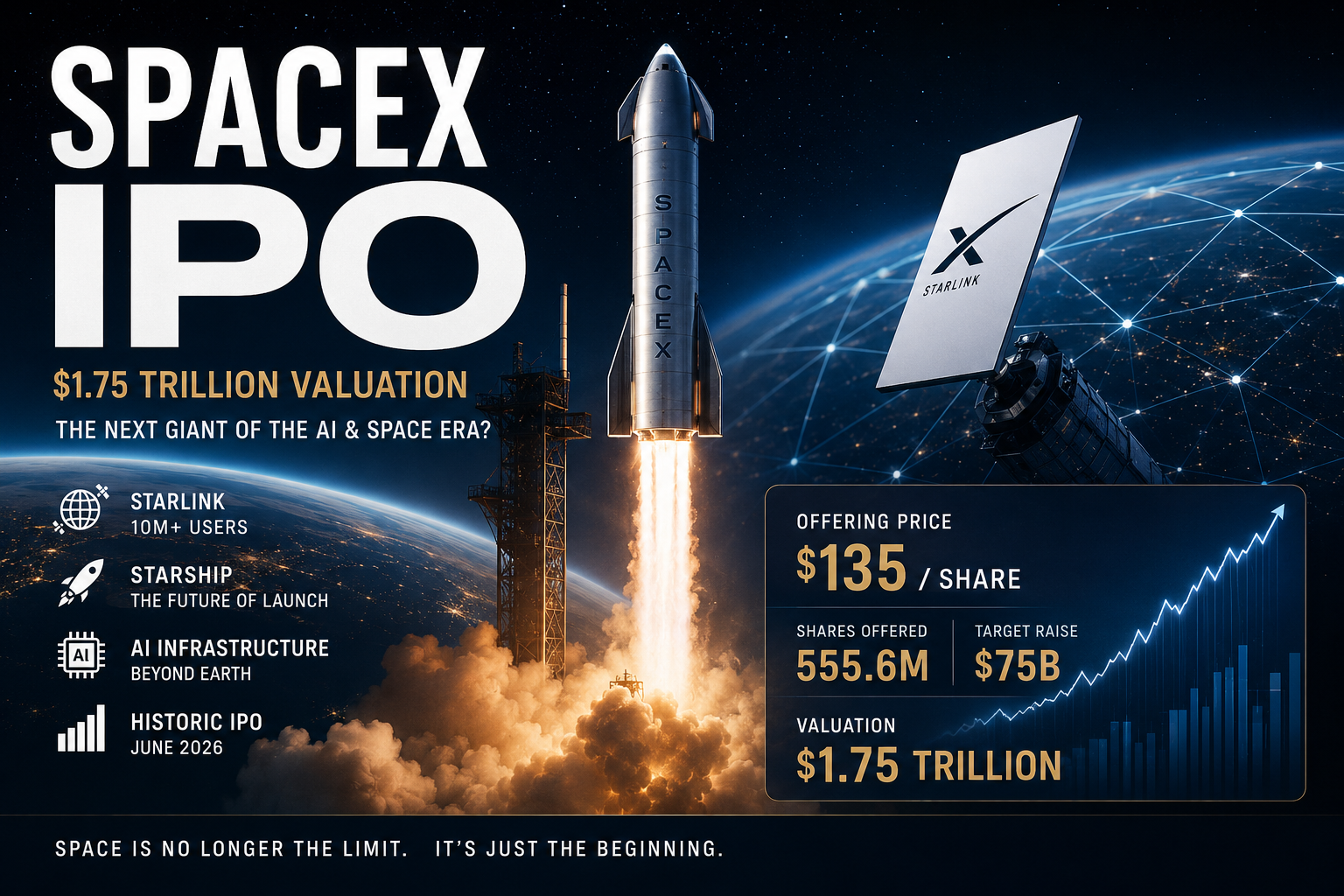
According to multiple reports released in early June 2026, SpaceX is preparing one of the largest initial public offerings in modern financial history. The company is reportedly targeting a fixed IPO price of approximately $135 per share, with an offering size of roughly 555.6 million shares, implying a capital raise near $75 billion and a total valuation approaching $1.75 trillion.
If completed at those levels, SpaceX would instantly become one of the most valuable publicly traded companies on Earth — entering the same valuation conversation as Apple, Microsoft, Nvidia, Amazon, and Saudi Aramco.
But unlike those companies, SpaceX is not a mature software business, consumer platform, or oil giant. It is something far stranger:
A company attempting to build the infrastructure layer of humanity’s future.
And that is exactly why the IPO has triggered such intense excitement — and equally intense skepticism.
Some investors believe SpaceX could become the defining infrastructure company of the 21st century, controlling everything from satellite internet and global communications to launch logistics, orbital AI computing, and perhaps even future interplanetary commerce.
Others argue the valuation represents one of the most aggressive growth assumptions ever embedded into a public offering.
Both sides may be right.
Why This IPO Feels Different From Every Other IPO
Most IPOs are ultimately about monetizing an already successful business model.
SpaceX feels different because investors are not merely buying current earnings.
They are buying access to a vision.
That distinction matters.
Traditional IPOs are often evaluated through relatively straightforward frameworks:
Revenue growth
Profit margins
Free cash flow
Comparable company multiples
Market share
But SpaceX complicates every one of those metrics.
The company simultaneously operates:
A satellite internet platform (Starlink)
A global launch business
A defense and government contractor operation
An AI infrastructure strategy
A long-term space transportation ecosystem
A speculative Mars colonization narrative
In other words:
SpaceX is not being valued like a single business.
It is being valued like an entire future economic system.
And once investors realized that, traditional valuation frameworks started to break down.
The Real Engine Behind SpaceX: Starlink
Despite public fascination with rockets and Mars missions, most institutional investors understand a critical reality:
Starlink is the economic core of SpaceX.
Without Starlink, the current IPO valuation would likely be impossible.
By the end of 2025, Starlink reportedly surpassed more than 10 million global subscribers, generating approximately $11–12 billion in annual revenue and operating at significantly higher margins than the launch business.
That number alone fundamentally changed Wall Street’s perception of SpaceX.
For years, critics dismissed Starlink as an overly ambitious satellite experiment with questionable economics. Satellite internet historically struggled because infrastructure costs were enormous while customer acquisition remained difficult.
But SpaceX changed the equation through vertical integration.
Because SpaceX controls both satellite manufacturing and launch capacity, it can deploy infrastructure dramatically cheaper than competitors.
That advantage compounds over time.
Every Falcon launch lowers deployment costs.
Every satellite generation improves efficiency.
Every additional subscriber spreads fixed costs wider.
And unlike traditional telecom infrastructure, Starlink’s network can scale globally without needing country-by-country fiber deployment.
This creates one of the most important investor narratives surrounding the IPO:
Starlink may eventually resemble a global space-based internet utility.
That possibility dramatically expands the addressable market.
Investors are no longer asking:
“How large can satellite internet become?”
They are asking:
“Could Starlink become one of the dominant global communications platforms?”
That distinction explains why many growth investors are willing to tolerate extraordinary valuation multiples.
Why Investors Are Comparing SpaceX to Nvidia Instead of Boeing
One of the most fascinating dynamics surrounding the IPO is the comparison framework itself.
Historically, aerospace companies traded at modest multiples because they were capital intensive, cyclical, and heavily dependent on government contracts.
Traditional launch and defense companies typically traded between:
2x–6x revenue
10x–20x EBITDA
But SpaceX is not being evaluated under those frameworks.
Instead, investors increasingly compare SpaceX to:
Nvidia
Amazon Web Services
Tesla
Cloud infrastructure companies
Global platform businesses
Why?
Because investors increasingly view SpaceX as an infrastructure platform rather than an aerospace manufacturer.
That shift changes everything.
If SpaceX were simply selling launches, a $1.75 trillion valuation would appear absurd.
But if SpaceX becomes:
The dominant global low-orbit communications network
The cheapest orbital logistics platform
The infrastructure layer for future AI and edge computing in orbit
The gateway to future space commerce
Then investors begin valuing it more like a foundational technology platform.
And foundational platforms historically command massive premiums.
The Elon Musk Factor Cannot Be Ignored
No analysis of SpaceX can ignore the central force shaping investor psychology:
Elon Musk himself.
Whether admired or criticized, Musk has repeatedly demonstrated an ability to achieve outcomes once considered unrealistic.
Tesla was mocked before becoming the most valuable automaker in history.
Reusable rockets were considered economically impractical before SpaceX normalized them.
Starlink was dismissed before becoming one of the fastest-growing global internet platforms.
That track record matters because modern growth investing is partially narrative investing.
Investors are not only buying current fundamentals.
They are buying confidence in future execution.
And Musk’s reputation fundamentally changes the market’s willingness to underwrite long-duration risk.
This creates an unusual dynamic:
Many investors acknowledge that SpaceX appears expensive by traditional metrics.
But they also recognize that betting against Musk-led execution has historically been dangerous.
That tension is at the heart of the IPO debate.
The Bull Case: Why Some Investors Believe SpaceX Could Still Be Undervalued
To many institutional growth investors, the SpaceX IPO is not merely about 2026 revenue.
It is about what the company could become by 2035 or 2040.
The bullish thesis generally rests on several interconnected assumptions.
1. Starlink Becomes a Global Connectivity Standard
Under optimistic scenarios, Starlink expands far beyond rural broadband.
Potential growth vectors include:
Direct-to-cell mobile connectivity
Aviation internet
Maritime communications
Military infrastructure
Emerging markets
Disaster recovery systems
Machine-to-machine communication
If successful, Starlink’s recurring revenue profile could begin resembling global telecom infrastructure — but with significantly higher margins and global scalability.
2. Starship Changes Launch Economics Forever
The second major bull argument centers on Starship.
If SpaceX successfully commercializes rapid reusable heavy launch systems, launch costs could collapse dramatically.
That would unlock entirely new industries:
Orbital manufacturing
Space stations
Point-to-point Earth transport
Lunar logistics
Massive satellite deployment
Deep-space infrastructure
In this scenario, SpaceX would not merely participate in the space economy.
It would define it.
3. AI Infrastructure in Orbit
Perhaps the most speculative — yet potentially explosive — narrative involves AI.
Following the integration of xAI-related initiatives, some investors believe SpaceX could eventually build orbital AI infrastructure systems.
That sounds futuristic today.
But so did reusable rockets fifteen years ago.
As AI models require ever-larger computing infrastructure and energy capacity, some technologists believe space-based computing systems could eventually become viable.
If SpaceX controls both launch economics and orbital infrastructure, it could occupy a uniquely strategic position in future AI ecosystems.
This possibility is highly speculative.
But speculative optionality is precisely what growth markets often price aggressively.
The Bear Case: Why Critics Think the Valuation Is Dangerous
For all the excitement, critics argue the IPO reflects one of the most aggressive market assumptions in recent memory.
Their concerns are substantial.
1. The Revenue Multiples Are Historically Extreme
At approximately $1.75 trillion valuation against less than $20 billion annual revenue, SpaceX trades at revenue multiples far beyond traditional industrial companies.
Even many elite software businesses never sustained those multiples at scale.
To justify current pricing, SpaceX likely needs to sustain extraordinary growth for many years while simultaneously improving margins.
That combination is extremely difficult at scale.
2. Capital Intensity Remains Massive
Unlike software companies, SpaceX cannot scale without enormous physical infrastructure investment.
Starship development alone requires staggering levels of capital expenditure.
Satellite replenishment cycles are expensive.
AI infrastructure buildouts are expensive.
Global telecom expansion is expensive.
Even if revenue grows rapidly, maintaining free cash flow discipline may prove difficult.
3. Regulatory and Political Risks
SpaceX increasingly sits at the intersection of:
National security
Telecommunications regulation
Global spectrum rights
International diplomacy
Defense contracting
As the company grows more influential, regulatory scrutiny will almost certainly intensify.
Political risk also increases alongside geopolitical importance.
4. Market Psychology Can Reverse Quickly
One of the great lessons of modern markets is that narrative-driven valuations can both expand and contract rapidly.
If growth slows materially, or if execution disappoints, the market could aggressively compress valuation multiples.
Critics point to previous periods where transformative narratives eventually collided with financial reality.
That possibility cannot be ignored.
The IPO May Signal a Larger Shift in Capital Markets
Beyond SpaceX itself, this IPO may represent a broader transformation in how modern capital markets allocate value.
Increasingly, markets reward companies that control infrastructure layers rather than end-user applications.
Examples include:
Cloud infrastructure
Semiconductor ecosystems
AI compute platforms
Energy systems
Global communications networks
SpaceX fits that pattern.
It is not merely a product company.
It is potentially becoming an enabling layer for multiple future industries.
That positioning is strategically powerful.
And capital markets increasingly pay extraordinary premiums for strategic infrastructure dominance.
Retail Investors Are Experiencing a New Kind of FOMO
There is also a psychological dimension driving extraordinary IPO attention.
Many retail investors believe they missed:
Amazon in the 1990s
Apple before the iPhone era
Tesla before mass EV adoption
Nvidia before the AI boom
For many participants, SpaceX feels like another chance to invest early in a potentially civilization-scale company.
That perception creates powerful demand momentum.
Whether justified or not, narrative psychology matters in modern markets.
And few companies possess a stronger long-term narrative than SpaceX.
What Happens After the IPO Matters More Than the IPO Itself
Historically, many IPOs experience intense short-term volatility.
But long-term outcomes depend on execution after public listing.
The real questions investors must ask are:
Can Starlink sustain hypergrowth at scale?
Will Starship achieve operational reliability?
Can SpaceX generate durable free cash flow?
Will AI initiatives create real monetizable products?
Can management balance innovation with public market expectations?
Those questions will define the next decade.
Not IPO day headlines.
The Bigger Picture: SpaceX Is Really a Bet on the Future of Human Infrastructure
At its core, the SpaceX IPO is not merely about rockets.
It is about a larger belief:
That the next era of economic growth may increasingly depend on orbital infrastructure, global connectivity, autonomous systems, AI computation, and industrial scale innovation.
SpaceX sits at the intersection of all those themes.
That is why the company commands extraordinary attention.
And that is why valuation debates around SpaceX feel so emotionally charged.
Investors are not simply debating revenue multiples.
They are debating the probability of an entirely different technological future.
Final Thoughts
The SpaceX IPO may ultimately become one of the defining public market events of this generation.
It combines nearly every dominant modern investment narrative:
AI
Infrastructure
Global connectivity
Defense technology
Space commercialization
Long-duration innovation
Founder-led execution
Whether the valuation proves visionary or excessive will depend on execution over many years.
But one thing is already clear:
SpaceX has fundamentally changed how markets think about the future.
For investors, understanding companies like SpaceX requires more than traditional financial ratios. It requires combining narrative analysis, strategic infrastructure thinking, macro trends, technological execution, and scenario modeling.
That is exactly why platforms like alphavue.ai are becoming increasingly important for modern investors.
As markets become more driven by complex technological narratives and multi-layered macro forces, investors need tools capable of analyzing not just earnings reports — but entire future ecosystems.
At alphavue.ai, investors can explore AI-powered market intelligence, deep strategic analysis, valuation frameworks, and emerging technology narratives across global markets.
Because in the AI era, understanding the future may become the ultimate investment edge.