
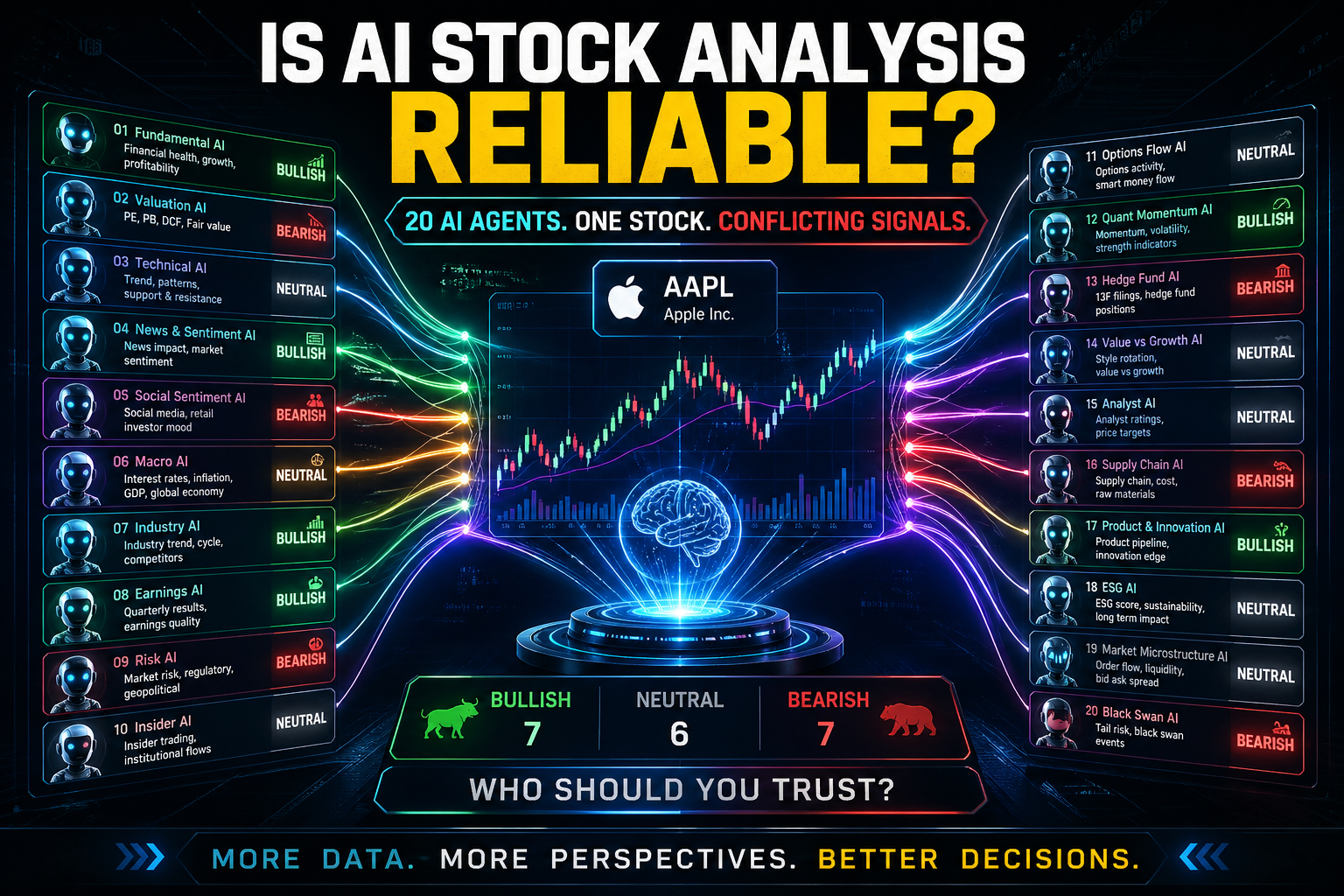
Is AI Stock Analysis Reliable? I Used 20 AIs to Analyze One Stock Simultaneously and Arrived at an Answer Closer to Real Investing
Is AI stock analysis reliable? This is a question many investors are asking today.
On the surface, the question seems simple: if AI can pick stocks that rise, then it is reliable; if AI’s judgments are wrong, then it is not.
But the reality is not that simple.
Because the stock market itself is not a question with a single correct answer. It’s not a matter of “this stock will definitely go up” or “this stock will definitely go down.” It’s a complex system influenced jointly by fundamentals, capital flows, sentiment, technicals, macro environment, industry cycles, and unexpected events.
Therefore, judging whether AI stock analysis is reliable cannot be based solely on whether it gives a “buy” or “sell” conclusion; you need to see whether it helps investors understand a stock more completely.
To test this, I designed an experiment: have 20 AI agents analyze the same stock simultaneously, with each AI responsible for one specific dimension, then aggregate those results to observe where they agree, where they conflict, which conclusions are valuable, and which conclusions carry risks.
The final results were interesting:
AI is not meant to predict your future; it’s better suited to help you reduce information blind spots, detect cognitive biases, and build a more stable decision-making framework.

1. Why asking “Can I buy this stock?” is unreliable
Many people using AI to analyze stocks are in the habit of asking directly:
“Can I buy stock X right now?”
Then the AI generates an answer that looks very professional, usually including a company introduction, fundamentals, risk factors, valuation judgment, and finally a conclusion like “buy with caution,” “hold,” or “not advisable to chase highs.”
The biggest problem with such answers is: they look complete, but are actually hard to verify.
You don’t know which data the AI used, nor which data it ignored. You also don’t know whether its judgment comes from real financial data and market news, or is merely a restatement of common investment analysis templates based on the language model.
More importantly, asking the same question in a different way can produce a different answer from the AI.
Question phrasing AI’s likely leaning Potential problems Is this stock worth buying? Neutral, cautious Responses are usually conservative and lack a clear judgment Analyze this stock from a bullish perspective Optimistic prone to magnifying positive factors Analyze this stock from a risk perspective Pessimistic prone to focusing on risks Will this stock surge in the future? May give a trend-based judgment Can mislead users into thinking the AI has predictive ability
This shows that a single AI analysis is not a stable investment conclusion, but rather a piece of text generated based on current input conditions.
So the issue is not whether AI is useful, but that many people use AI incorrectly.
AI should not be treated as a “fortune-telling tool” or a “buy/sell signal machine.” It’s better placed inside a structured system, responsible for processing a specific type of information, and then have multiple dimensions jointly form the final judgment.
2. What does analyzing one stock with 20 AIs actually test?
The goal of this experiment is not to prove that AI is necessarily better than human analysts, nor that AI can certainly predict stock prices.
What it really tests are three questions:
First, can AI cover more analytical dimensions?
Second, will conclusions from multiple AIs corroborate each other?
Third, when AIs disagree, can those disagreements be converted into more valuable investment information?
Therefore, I didn’t ask the 20 AIs to all answer the same question; I split the stock analysis into multiple subtasks.
Agent type Responsible for Core output Value Fundamental Agent Revenue, profit, cash flow, balance sheet Company quality score Assessing long-term company value Valuation Agent PE, PS, PB, discounted cash flow valuation Valuation reasonableness Judge whether the stock is overpriced Technical Agent Trends, moving averages, volume, support/resistance Short-to-mid term trend judgment Assist timing decisions News Agent Company news, industry news, policy news Event impact assessment Judge short-term catalysts or risks Sentiment Agent Social media, market discussion, investor sentiment Sentiment temperature Judge whether the market is overheated or too cold Risk Agent Macro risk, regulatory risk, industry risk Risk rating Avoid focusing only on returns while ignoring risk Competitive Landscape Agent Peers, market share, moat Competitive advantage assessment Judge long-term certainty Earnings-interpretation Agent Latest quarterly report, management guidance Performance trend Identify whether growth is sustainable
The core idea of this design is:
Don’t let one AI answer everything; let different AIs be responsible for different signals.
This is similar to a real research and investment team. In a mature investment team, there isn’t just one person making buy/sell decisions on a whim; there are analysts who look at fundamentals, traders who watch the market, risk managers who look at risk, and strategists who watch the macro environment.
A multi-agent system essentially automates, structures, and scales this research division of labor.
3. The most important finding of the experiment: AIs do not naturally agree
Many people assume that if 20 AIs analyze the same stock, they should arrive at a unified answer.
But the experiment showed the opposite.
Different agents often produced significant disagreements.
Analysis dimension Possible conclusion Reason Fundamentals Optimistic Company revenue growth is stable, margins improving, cash flow healthy Valuation Cautious Current valuation already reflects high growth expectations Technicals Neutral-weak Recent large gains, volume starting to decline Sentiment Overheated High discussion volume, retail investor exuberance Risk Cautious Macro interest rates, policy changes, or intensifying industry competition
This highlights a very important point:
Disagreements among AIs are not a system flaw, but a real reflection of market complexity.
A stock can very well have several characteristics at once:
The company is good, but the valuation is too high; the long-term logic is sound, but the short-term technicals are weakening; market sentiment is very hot, but the risk-reward profile has deteriorated.
If you only ask one AI, it might compress these contradictions into a single sentence: “recommend buy with caution.”
But a multi-agent system separates these contradictions and lets you see the true situation behind each dimension.
That is where AI stock analysis really adds value.

4. AI’s real advantage is not prediction, but information coverage
One major misconception about AI stock analysis is that people expect AI to tell them whether a stock’s price will rise or fall in the future.
But from practical use, AI’s greatest strength isn’t prediction, it’s coverage.
What do I mean by coverage?
It means scanning as comprehensively as possible all information related to a stock in a shorter amount of time, and categorizing that information by different dimensions.
An ordinary investor analyzing a stock typically looks at a few aspects: what the company does, recent price movements, earnings reports, and whether there’s any news. But due to limited time, many pieces of information get overlooked.
For example:
-
Only looking at price action while ignoring whether the valuation is too high
-
Only looking at revenue growth while ignoring deteriorating cash flow
-
Only looking at positive news while ignoring that the market has already priced it in
-
Only looking at short-term gains while ignoring an industry cycle reversal
-
Only looking at the company story while ignoring changes among competitors
The strength of an AI system is that it can process these pieces of information in parallel.
Capability 普通投资者 单一AI 多Agent系统 Information coverage Limited, depends on individual effort Relatively strong, but easily conflated Strong, each dimension handled independently Analysis speed Slow, usually takes hours Fast, completes within minutes Faster, can analyze in parallel Dimensional completeness Prone to omissions Depends on prompt quality Guaranteed by system architecture Conclusion stability Significantly influenced by emotions Significantly influenced by prompt wording Reduced volatility through multiple signals
So, the problem AI truly solves is not "seeing the future for you," but "helping you miss fewer important pieces of information."
This matter is very important in investing.
Many investment losses are not because investors completely lack understanding, but because they only see the information they want to see. Bulls will keep looking for positives, bears will keep looking for risks. Humans naturally have confirmation bias, while AI systems can, to some extent, force you to see multiple angles.
For example, when you are very optimistic about a company, a Risk Agent might alert you: the company is growing fast, but inventory turnover is slowing; a Valuation Agent might warn: the current market cap already prices in two years of growth; a Sentiment Agent might remind you: market discussion is overheated and there is a high short-term risk of chasing prices.
These pieces of information may not necessarily change your final decision, but they will make your decision more complete.
In investing, the real danger is not making the wrong judgment, but being overconfident when information is incomplete.
5. The key value of multi-AI systems: turning "opinions" into "signals"
When traditional AI answers stock questions, it usually gives you a natural-language opinion.
For example:
"The company's fundamentals are good, but the valuation is high; investors are advised to be cautious."
This sentence looks fine, but its practical value is limited.
Because it does not tell you:
-
How good are the fundamentals, exactly?
-
Is the valuation slightly high, or severely overvalued?
-
Are the risks mainly from short-term volatility, or from long-term changes in the business logic?
-
Would the conclusion differ for long-term investors?
-
For short-term trading, should it be completely avoided?
Therefore, a truly valuable AI research system should not only output opinions, but output structured signals.
Output type Example Value Natural language opinion The company's fundamentals are good, but valuation is high Easy to understand, but hard to quantify Structured scores Fundamentals 82 / 100, Valuation 46 / 100 Easy to compare and track Signal explanation Margin improved, but valuation percentile is high Helps understand score origins Risk breakdown Main risk comes from valuation pullback rather than operational deterioration Helps formulate strategy
This is the biggest difference between multi-Agent systems and ordinary AI Q&A.
Ordinary AI gives you a "conclusion."
Multi-Agent systems give you a set of "signals."
What investment decisions truly need is not an answer that looks correct, but a set of interpretable, comparable, and trackable signals.
6. The core of AI analysis reliability: it's not how strong the model is, but how the system is designed
Many people discussing AI stock analysis always focus on the model itself.
For example: Is ChatGPT stronger, or Claude? Is a certain financial large model more professional? Is the model parameter count larger?
These questions are of course important, but they are not the only factors determining AI research quality.
What truly determines system reliability is the overall architecture.
You can understand it with one formula:
AI research reliability = Data quality × Task decomposition × Multi-dimensional validation × Aggregation mechanism × Human judgment
If any one of these elements is too weak, the final result will have problems.
Stage Role Failure consequence Data quality Ensure input reliability Garbage in leads to garbage conclusions Task decomposition Let AI focus on a single dimension Chaotic analysis, vague conclusions Multi-dimensional validation Avoid being misled by a single perspective Easily swayed by one positive or negative signal Aggregation mechanism Integrate multiple signals into decision reference Lots of information, but unable to form actions Human judgment Combine objectives, risk preference, and position management Treating AI suggestions as trading orders
This is also why I believe:
Whether AI stock analysis is reliable does not depend on how elegantly a single AI answers, but on whether the entire system can continuously produce stable, explainable signals.
7. How to turn the divergence of 20 AIs into a final judgment?
Multi-Agent systems will inevitably produce divergences.
The question is not how to eliminate divergence, but how to utilize it.
Here we can introduce a simple decision framework:
Final judgment = Direction signal + Risk signal + Confidence signal
Signal type Represents Example Direction signal Whether the stock is bullish, bearish, or neutral Fundamentals and trend both positive Risk signal Where potential downside risk comes from Valuation too high, policy uncertainty, increased competition Confidence signal Whether multiple Agents reach a consistent judgment 15 Agents bullish, 3 neutral, 2 bearish
For example:
If a stock's Fundamentals Agent, Earnings Agent, and Competitive Landscape Agent are all bullish, but the Valuation Agent and Technical Agent are cautious, then this indicates it may be a good company, but not necessarily at a good price right now.
In this case, the final conclusion should not simply be "Buy" or "Sell," but rather:
High long-term quality, but short-term poor value; suitable to watch for opportunities after a pullback, rather than chasing in a sentiment high.
This kind of conclusion is truly valuable.
Because it not only tells you the direction, but also the conditions.
Truly good investment advice is not "buy" or "don't buy," but:
-
Under what conditions you can buy
-
Which price ranges are more reasonable
-
What the main risks are
-
Which signals, if they change, require reassessment
-
Whether this stock is suitable for long-term allocation or short-term trading
If an AI system can answer these questions, it truly enters the research level.
8. In which scenarios is AI stock analysis more reliable?
AI is not reliable in all scenarios.
It is better suited for problems where information is sufficient, logic is relatively stable, and data can be structured.
Scenario AI reliability Reason Earnings summary High Data is structured clearly, logic relatively stable Company fundamentals analysis Relatively high Can combine financial data and industry information News impact analysis Medium Requires judging event importance and market reaction Short-term price prediction Relatively low High randomness, greatly influenced by flows and sentiment Black swan prediction Very low Hard to learn similar patterns from historical data
Therefore, AI is suitable for doing these things:
-
Quickly reading financial reports
-
Summarizing company business changes
-
Comparing peer valuations
-
Identifying potential risk points
-
Tracking market sentiment changes
-
Generating structured research reports
But AI is not suitable for these things:
-
Promising that a particular stock will definitely rise
-
Predicting tomorrow's stock price movement
-
Deciding a user's position sizing for them
-
Directly giving trading orders in extreme market conditions
This point is very important.
If you treat AI as a "prediction machine," you will be disappointed; if you treat AI as a "research assistant," it can be extremely valuable.
9. Is AI stock analysis ultimately reliable? My conclusion is not a one-sentence answer
I have said so much above; finally, return to the core question:
Is AI stock analysis reliable?
My answer is not a simple "reliable" or "unreliable."
A more accurate conclusion should be viewed in layers.
Usage Reliability Reason Directly ask an AI whether to buy Low Input unstable, output unverifiable Let AI summarize financial reports and news Relatively high Suitable for information compression and structured organization Let multiple AIs analyze different dimensions High Can reduce single-perspective bias Humans combine multi-agent signals to make decisions Highest AI handles information processing, humans set objectives and risk judgments
Therefore, the real conclusion is:
AI stock analysis itself is neither absolutely reliable nor unreliable; its reliability depends on how you design the analysis process.
If you only ask a single AI for a buy/sell recommendation, it is unreliable.
If you let AI help you process financial statements, news, valuation, risk, and sentiment, and present these signals in a structured way, then it is extremely valuable.
If you further use multiple AI agents for cross-validation and combine that with your investment horizon, risk tolerance, and position management, then AI is no longer a simple tool but becomes your investment research system.
10. What does this mean for ordinary investors?
What ordinary investors most often lack is not information, but the ability to process information.
Today's market produces too much information.
Financial reports, news, research notes, social media, macro data, industry policies, company announcements—large amounts of content are generated every day. The real difficulty is not finding information, but determining which information is important and which is just noise.
This is where AI adds value.
It can help you do three things:
First, quickly compress information.
Compress dozens of pages of financial reports, hundreds of news items, and multi-dimensional data into readable, structured content.
Second, identify overlooked risks.
When you only see the positives, AI can alert you to potential risks; when you are overly pessimistic, AI can point out underestimated positive factors.
Third, create a stable process.
Analyze each stock according to the same dimensions every time, instead of reading the news one day, checking charts the next, and listening to someone else's tip the day after.
This is the most important thing in long-term investing: a stable process.
11. Conclusion: AI is not an answer machine, but decision infrastructure
From this experiment where 20 AIs analyzed a single stock simultaneously, my biggest takeaway is:
The value of AI stock analysis lies not in whether it can produce a magical answer, but in whether it can help investors build a more complete, more stable, and more verifiable decision system.
A conclusion from a single AI may be useful, but it can also be misleading.
Signals from multiple AIs across different dimensions are closer to real investment research.
Truly mature AI stock analysis should not be:
“Can I buy this stock?”
But rather:
“What are the state of this stock’s fundamentals, valuation, trend, sentiment, and risks? Are these signals consistent? If they are inconsistent, where do the differences come from? Under what conditions should I act?”
This is the problem AI-driven investment research should really solve.
So, is AI stock analysis reliable?
If you treat it as a forecasting tool, it is not reliable.
If you treat it as a multi-dimensional investment research system, it can be extremely valuable.
In the future, the most competitive investors may not be those who can best predict the market, but those who can best use AI to organize information, verify hypotheses, and control risk.
Investing will not become simple because of AI.
But AI will make serious investment analysis more efficient, more systematic, and more replicable.
This is what makes AI stock analysis truly worth paying attention to.