
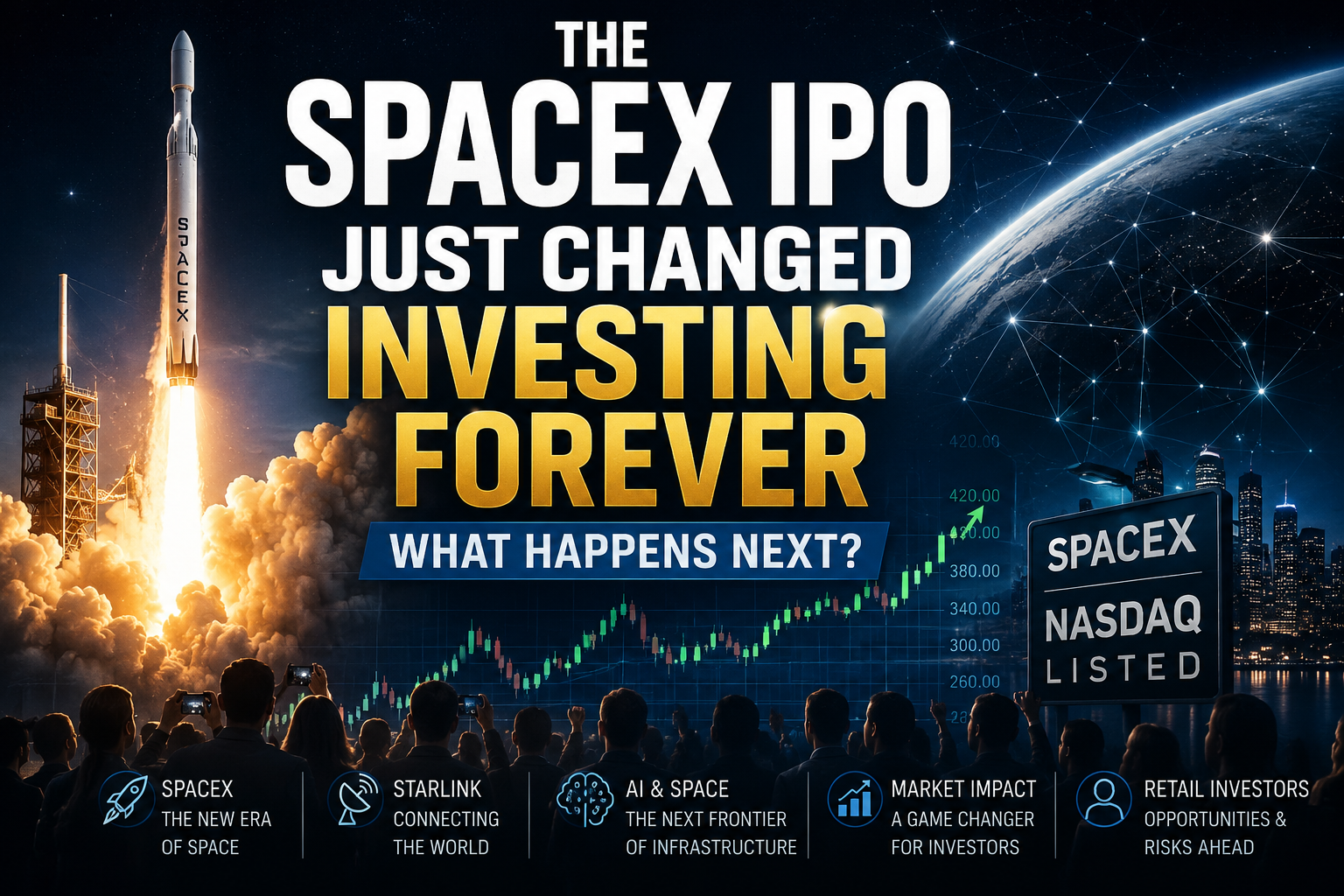
SpaceX did not simply go public.
It changed the way investors think about the future of public markets, artificial intelligence, infrastructure, index funds, and retail stock research.
For years, SpaceX was one of the most desired private companies in the world. Investors could follow its rocket launches, debate its valuation, watch Starlink expand, and speculate about its role in the future of space. But for most ordinary investors, SpaceX remained out of reach.
That changed when SpaceX finally entered the public market.
The SpaceX IPO was not just another technology listing. It was a market event that instantly connected rockets, satellite internet, artificial intelligence, defense infrastructure, orbital logistics, and public-market capital. It gave investors access to one of the most ambitious companies of the modern era, while also forcing them to ask one uncomfortable question:
How do you value a company when the most important parts of its future may not fully exist yet?
That question is why the SpaceX IPO matters far beyond one stock. It is a symbol of a much larger shift in investing. The companies that may dominate the next decade are not simply software companies, advertising platforms, or consumer brands. They are infrastructure companies. They control compute, connectivity, energy, data, logistics, defense systems, and physical networks that other industries may depend on.
SpaceX sits at the intersection of many of those forces.
It launches rockets. It operates Starlink. It works with governments. It supports defense and communications infrastructure. It may play a role in the future of space-based data centers, AI infrastructure, and orbital logistics. Whether all of these ambitions become profitable businesses remains uncertain, but the public market has now been asked to price that possibility.
That is what makes this IPO different.
It is not only about SpaceX becoming a public company. It is about the public market being forced to absorb one of the largest private technology stories of the last two decades.
Why the SpaceX IPO Became a Historic Market Event
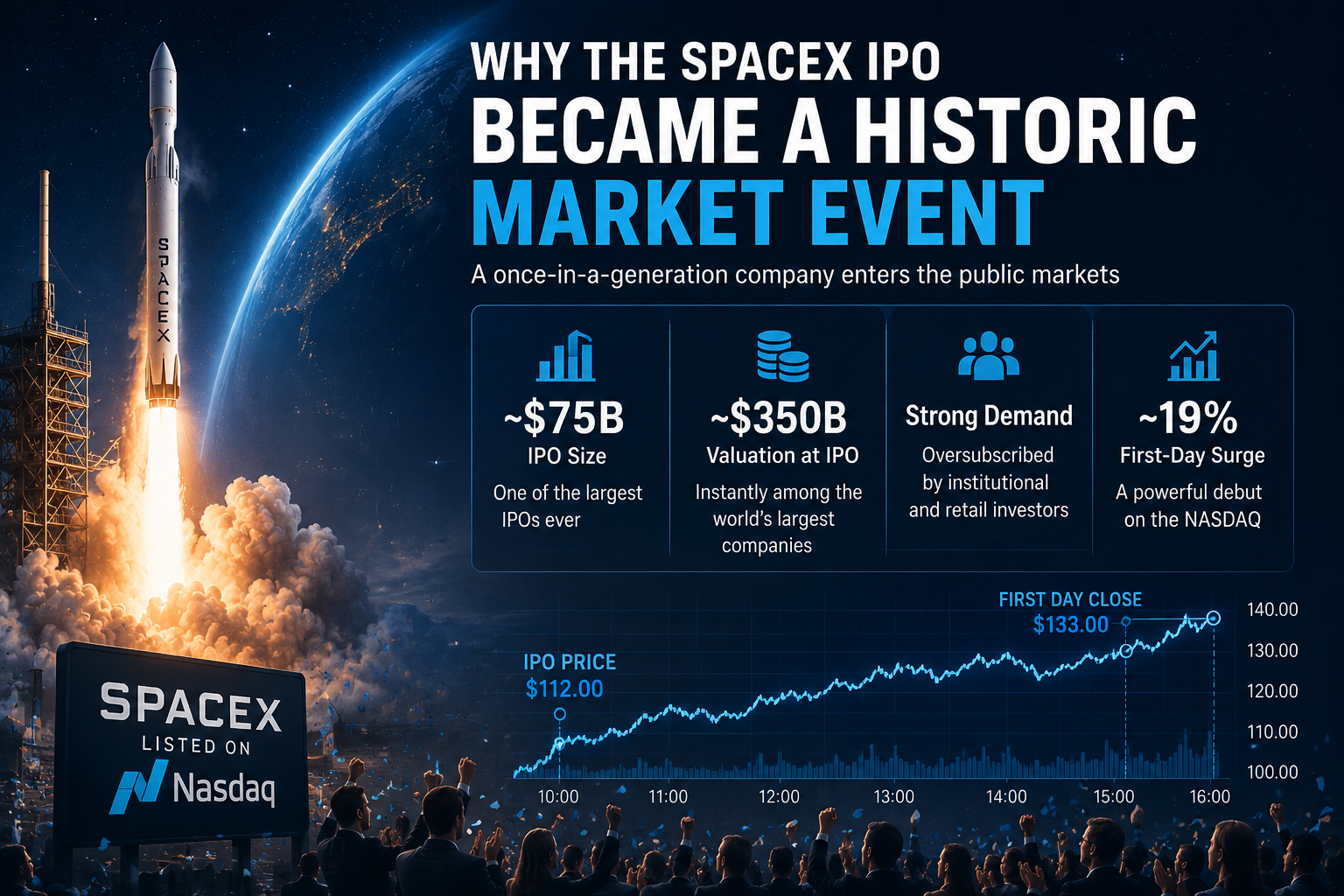
Most IPOs are judged by three basic factors: growth, profitability, and investor demand.
SpaceX arrived with extraordinary demand, massive scale, and one of the most powerful technology narratives in the world. But it also arrived with serious questions about valuation, risk, profitability, governance, and execution.
That combination made the IPO impossible to ignore.
Traditional IPOs often involve smaller companies trying to prove that they can become large public businesses. SpaceX is different. It did not enter the market as a small growth company. It entered as a giant. From day one, investors were not asking whether SpaceX could become important. They were asking whether it could justify already enormous expectations.
This creates a very different investment problem.
When a company is small, investors can focus on growth potential. When a company is already massive, investors must focus on whether future growth is large enough to support the valuation. That is much harder.
For SpaceX, investors are not only buying the current business. They are buying a future story that includes Starlink growth, launch dominance, government contracts, satellite networks, possible AI infrastructure, future space logistics, and long-term space economy expansion.
That is a powerful story. It is also a difficult story to value.
The market is effectively trying to answer questions like:
How large can Starlink become?
Can satellite internet become a durable, high-margin business?
Will launch economics continue to improve?
How much revenue can government and defense contracts generate?
Can SpaceX create new markets beyond launch services and broadband?
Can future space-based infrastructure become commercially meaningful?
How much of the current valuation already assumes success?
These are not easy questions. They require investors to think beyond ordinary financial statements. They require an understanding of technology, regulation, geopolitics, capital intensity, competitive dynamics, and market psychology.
That is why the SpaceX IPO is such a strong example of modern investing.
The opportunity is huge. The uncertainty is huge. The information load is huge. And the market reaction is fast.
SpaceX Is Not Just a Rocket Company
Calling SpaceX a rocket company is like calling Amazon a bookstore in the early 2000s.
Technically, it is true. Strategically, it misses the point.
SpaceX began with rockets, but its long-term value may come from infrastructure. Rockets are the access layer. They allow the company to place satellites into orbit, support government missions, reduce launch costs, and build a broader space-based platform.
Starlink is one of the clearest examples of this shift.
A rocket company launches payloads. A satellite internet company creates recurring revenue. A defense infrastructure company can secure strategic government contracts. A future orbital logistics company could build entirely new markets.
SpaceX is trying to connect all of these layers.
This is why investors are willing to think about SpaceX differently from traditional aerospace companies. The company is not only selling launches. It is building a network. It is building access to orbit. It is building a communications system. It may eventually build new types of space infrastructure.
That is a much bigger story than rockets.
But bigger stories also create bigger risks.
When a valuation depends on multiple future markets, investors need to understand which parts of the thesis are proven and which parts are still speculative. Starlink has real users and real revenue. Launch services have real demand. Government contracts are real. But some long-term visions around space-based AI infrastructure, orbital data centers, and Mars-related economics remain highly uncertain.
That distinction matters.
Great investing is not about believing every exciting idea. It is about separating existing business strength from future optionality.
The Index Fund Effect: Why Ordinary Investors Should Care
One of the most important consequences of the SpaceX IPO may not come from active stock pickers.
It may come from passive investing.
When a company becomes large enough, it can eventually qualify for major indexes. If that happens, index funds and ETFs that track those benchmarks may need to buy the stock. This can create a powerful demand loop.
The company goes public.
The market assigns it a large valuation.
Index providers evaluate eligibility.
Passive funds prepare for potential inclusion.
ETF and retirement-account exposure increases.
Millions of investors may indirectly own the stock.
This is why the SpaceX IPO matters even to investors who never plan to buy SpaceX directly.
If SpaceX eventually enters major indexes, many ordinary investors could gain exposure through broad-market funds, retirement accounts, pension portfolios, and ETFs. In other words, SpaceX could become part of the financial lives of people who never actively chose the stock.
This is one of the most important features of modern markets.
Passive investing has changed how capital flows. Large companies do not only attract investors because people like the story. They may also attract capital because index structure forces exposure.
That does not mean SpaceX will automatically keep rising. It does mean that its market impact could extend far beyond traditional IPO investors.
The public market is no longer simply a place where companies raise capital. It is a machine that turns large companies into default portfolio holdings.
SpaceX may become one of the clearest examples of that machine.
The New Mega-Cap Formula

The last decade of stock market leadership was defined by companies like Apple, Microsoft, Nvidia, Amazon, Alphabet, Meta, and Tesla.
Each became a mega-cap company because it controlled a strategic platform.
Company Core Platform Why It Mattered Apple Consumer devices and ecosystem Controlled premium hardware, services, and user loyalty Microsoft Enterprise software and cloud Became a core layer of business productivity and AI infrastructure Nvidia AI compute Became essential to artificial intelligence training and inference Amazon E-commerce and cloud infrastructure Built distribution, logistics, and AWS cloud dominance Alphabet Search, advertising, data, and AI Controlled search intent and global digital advertising Tesla Electric vehicles, energy, and autonomy Changed how investors viewed mobility, batteries, and robotics SpaceX Space access, satellite internet, and infrastructure May connect launch, broadband, defense, AI infrastructure, and orbital systems
The pattern is clear.
The most valuable companies are not only selling products. They are building platforms that other markets depend on.
SpaceX may represent the next version of this mega-cap formula.
It is not just a rocket manufacturer. It may become a space infrastructure company. It may connect communications, defense, global internet, launch services, and future data infrastructure.
This is why investors are excited.
But this is also why investors need to be careful. The bigger the vision, the easier it is for the market to overpay for possibility. A company can be strategically important and still be an expensive stock.
That is one of the hardest lessons in investing.
Why Traditional Stock Research Is Breaking Down
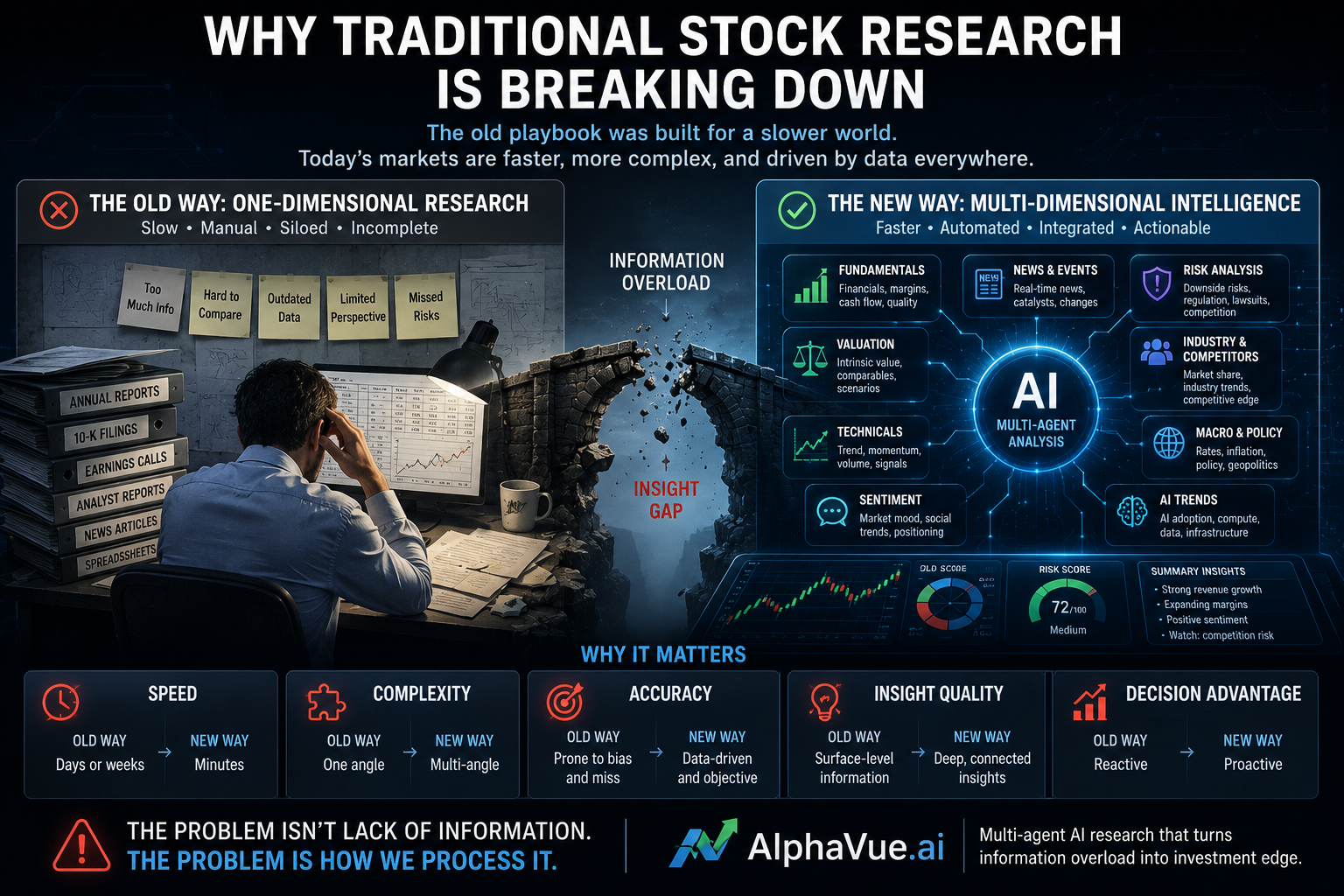
Traditional stock research was built for a slower world.
Investors could read annual reports, compare valuation multiples, study competitors, listen to earnings calls, and form a thesis. That still matters. But it is no longer enough.
Modern companies are more complex.
To understand SpaceX, an investor may need to evaluate:
Rocket launch economics
Satellite broadband demand
Starlink subscriber growth
Government and defense revenue
Capital expenditure requirements
Regulatory risk
International competition
AI infrastructure potential
Index inclusion dynamics
Retail investor sentiment
Governance structure
Long-term profitability assumptions
That is a lot for one investor to process.
And SpaceX is not an isolated case.
Nvidia is no longer just a chip company. It is an AI infrastructure company. Tesla is no longer just a car company. It is an autonomy, robotics, energy, and AI company. Amazon is not only e-commerce. It is cloud computing, advertising, logistics, media, and AI. Microsoft is not only software. It is cloud, cybersecurity, productivity, gaming, enterprise AI, and developer infrastructure.
The investment world is becoming multi-dimensional.
Many investors still use one-dimensional research.
They look at a price chart. They read a headline. They follow social media. They compare a simple valuation multiple. They watch what others are buying.
That may work in simple situations. It is not enough for complex mega-cap technology companies.
The future belongs to investors who can combine multiple perspectives quickly:
Fundamental analysis
Apply this research method to your stock
Enter one ticker and get a research summary you can keep exploring.
Valuation analysis
Technical analysis
News analysis
Sentiment analysis
Risk analysis
Competitive analysis
Macroeconomic analysis
AI trend analysis
No single perspective is enough. The advantage comes from combining them.
The Hidden AI Story Behind the SpaceX IPO
The most interesting part of the SpaceX IPO may not be space.
It may be artificial intelligence.
AI is changing what investors value. In the old market, the most important assets were factories, brands, patents, distribution networks, and software platforms. Those still matter. But in the AI era, the most valuable assets may increasingly be compute, data, energy, connectivity, automation, and infrastructure.
SpaceX has potential exposure to several of these areas.
Starlink creates a global communications network. Rockets provide access to orbit. Satellites transmit data. Future space-based infrastructure could open new possibilities for communications, sensing, computing, and AI-related services.
Whether every part of this future becomes real is uncertain. But the market is clearly trying to price the possibility that physical infrastructure becomes more valuable in the AI era.
This is a major shift.
In the first internet era, the biggest winners controlled attention and distribution.
In the cloud era, the biggest winners controlled computing platforms.
In the AI era, the biggest winners may control compute, data pipelines, energy access, robotics, and physical infrastructure.
That is why SpaceX feels bigger than a space company.
It forces investors to ask:
Who owns the infrastructure behind the AI economy?
Who controls global connectivity?
Who can move physical systems at scale?
Who has access to data and distribution beyond Earth?
Who can combine hardware, software, and government-scale execution?
These questions are not only about SpaceX. They are about the future of investing itself.
What Retail Investors Should Learn From SpaceX

The biggest mistake retail investors can make after a historic IPO is to confuse excitement with strategy.
A great company is not always a great stock at any price.
A historic IPO is not always an easy buying opportunity.
A powerful story does not eliminate risk.
This is especially true with SpaceX. The company may have enormous long-term potential, but investors still need to think carefully about valuation, execution risk, competition, capital intensity, governance, and volatility.
Before buying any high-profile IPO, retail investors should ask several questions.
1. What expectations are already priced in?
If a stock already reflects massive future success, even good news may not be enough to drive strong returns. The company may need to perform extremely well simply to justify the current valuation.
2. What are the major risks?
SpaceX operates in industries that require huge capital investment, technical execution, government relationships, regulatory approval, and long-term patience. These are not low-risk markets.
3. What is the investment horizon?
A company like SpaceX may require a long-term view. Short-term traders may focus on momentum, while long-term investors need to understand business quality, future cash flows, and risk tolerance.
4. How does the stock fit into a portfolio?
Buying a high-profile IPO because everyone is talking about it is not a strategy. Investors need to understand concentration risk, sector exposure, and whether they already own similar themes through other holdings.
5. What information advantage does the investor actually have?
This may be the most important question.
If everyone has access to the same headlines, the same social media posts, and the same basic valuation numbers, where does your edge come from?
That is the core challenge of modern investing.
Information is everywhere. Insight is scarce.
The Market Is Moving From Information Access to Intelligence Access
Twenty years ago, having access to financial information was an advantage.
Today, everyone has information.
Retail investors can access earnings reports, analyst opinions, market news, charting tools, podcasts, newsletters, social media, and real-time price data. The problem is no longer access.
The problem is interpretation.
There is too much information and too little structure.
Investors do not need more noise. They need better intelligence.
This is why AI investing tools are becoming increasingly important.
AI can read faster than humans. AI can compare more companies than humans. AI can summarize filings, detect changes, analyze sentiment, review valuation, and identify risks.
But the most powerful use of AI is not simply asking one model for one opinion.
The future is multi-agent stock research.
Instead of relying on one answer, investors can use multiple AI agents with different roles:
One agent studies the fundamentals.
One agent reviews valuation.
One agent analyzes technical trends.
One agent monitors news.
One agent checks risks.
One agent compares competitors.
One agent challenges the bullish case.
One agent challenges the bearish case.
This is closer to how professional investment teams work.
The difference is that AI can make this kind of multi-perspective research available to individual investors.
That is the shift AlphaVue.ai is built around.
Why AlphaVue.ai Fits This New Investing Era
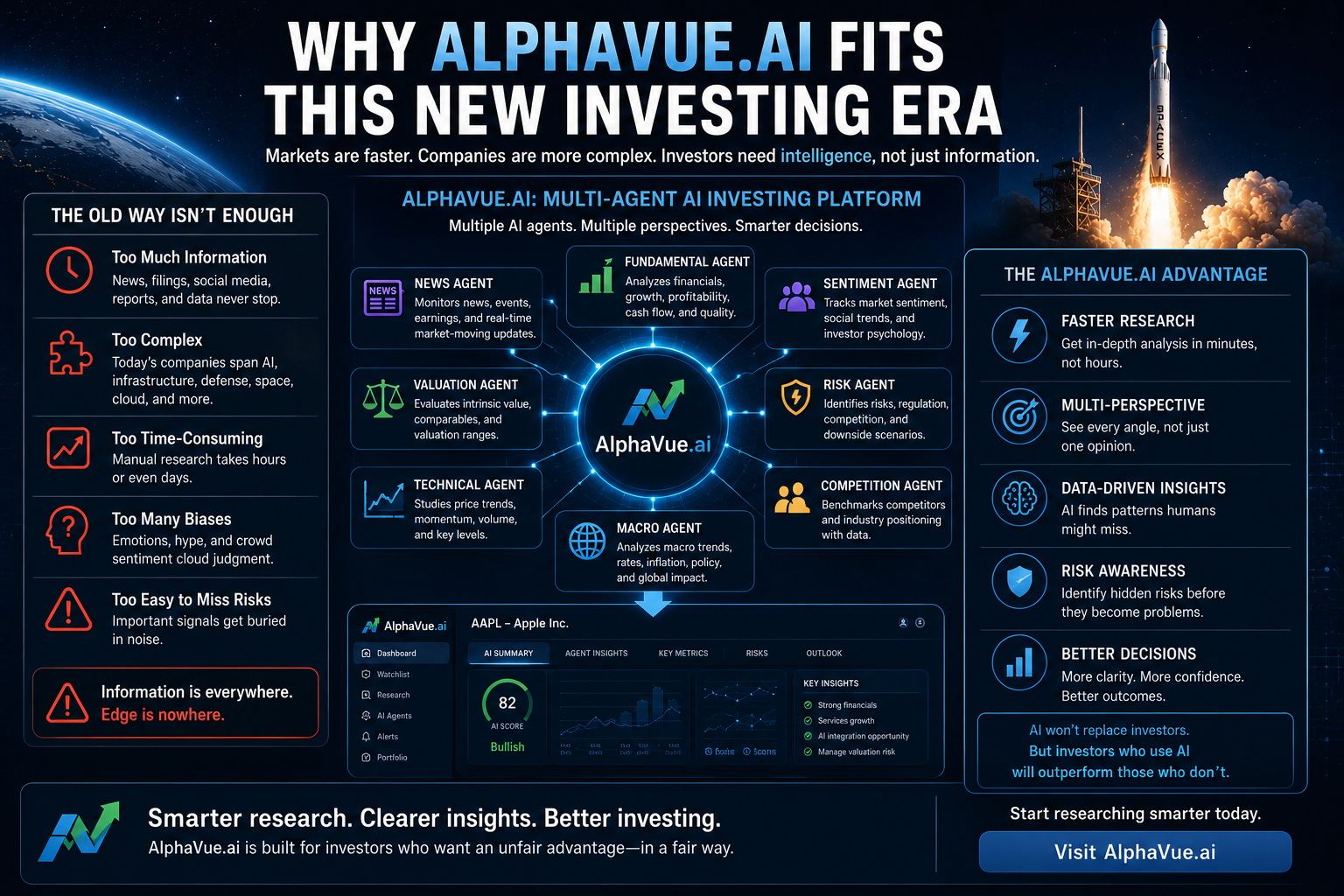
The SpaceX IPO shows why investors need a new research workflow.
Markets are faster. Companies are more complex. Narratives move quickly. Valuations can become extreme. Retail investors need more than headlines and price charts.
AlphaVue.ai is designed for investors who want deeper stock research without spending hours jumping between news sites, spreadsheets, financial reports, market data platforms, and social media.
Instead of looking at a stock from only one angle, AlphaVue.ai uses multiple AI agents to analyze investment ideas from different perspectives.
The goal is not to replace human judgment.
The goal is to improve it.
That distinction matters. AI should not blindly tell investors what to buy. A better AI investing tool helps investors ask better questions, identify risks earlier, compare opportunities more clearly, and avoid emotional decision-making.
When a stock like SpaceX dominates the market conversation, emotions become intense. Some investors fear missing out. Others dismiss the stock as overvalued. Some only see the dream. Others only see the risk.
A multi-agent AI research workflow can help investors slow down and separate signal from noise.
For example, instead of simply asking, “Should I buy SpaceX?” investors can ask:
What is the bull case?
What is the bear case?
What does the valuation imply?
What risks are being ignored?
What comparable companies matter?
What is already priced in?
What could change the investment thesis?
These are the questions serious investors need to ask.
AlphaVue.ai helps make that process faster, clearer, and more structured.
Upgrade Your Stock Research With AlphaVue.ai
Markets are moving faster. Companies are becoming more complex. Investors need more than headlines.
AlphaVue.ai helps investors analyze stocks with multi-agent AI research, compare different viewpoints, identify risks, and build a more disciplined investment process.
Start researching smarter today at AlphaVue.ai.
SpaceX and the Psychology of FOMO
Every historic IPO creates fear of missing out.
Investors remember missing Nvidia. They remember missing Tesla. They remember missing Amazon. They do not want to miss the next generational company.
That emotion is powerful. It can also be dangerous.
FOMO makes investors buy without understanding valuation.
FOMO makes investors ignore risk.
FOMO makes investors chase price instead of process.
The SpaceX IPO may become a legendary long-term investment. It may also go through painful volatility. Both can be true.
Many great companies have experienced brutal drawdowns. Amazon, Tesla, Nvidia, and Meta all went through periods when investors questioned the entire story. Long-term winners are rarely smooth rides.
That is why the right question is not simply:
Should I buy SpaceX?
The better question is:
Do I understand what I am buying, why I am buying it, what could go wrong, and how it fits into my portfolio?
That is how serious investors think.
They do not eliminate uncertainty. They manage it.
The Real Investment Lesson
The most important lesson from the SpaceX IPO is not that every investor should buy SpaceX.
The real lesson is that the market is changing.
The biggest companies of the next decade may not look like the biggest companies of the last decade.
They may be more capital-intensive. They may combine hardware and software. They may operate across national security, AI, energy, connectivity, and infrastructure. They may be harder to value using traditional models. They may move faster than traditional research workflows can handle.
This creates both opportunity and risk.
Investors who understand the shift early may find powerful long-term themes. Investors who chase every headline may get trapped by hype.
The difference is process.
A strong investment process does not depend on one prediction. It depends on asking the right questions repeatedly.
What is changing?
Who benefits?
What is already priced in?
What does the market misunderstand?
What risks are being ignored?
What data would change the thesis?
These questions matter more than ever.
SpaceX is a perfect case study because it touches so many parts of the future at once. It is a space company. It is a communications company. It is a defense company. It is a technology infrastructure company. It may become an AI infrastructure story. It is also now a public market story.
That combination makes it one of the most important stocks to watch.
What Happens Next?
After the IPO, several things matter.
1. Investors will watch trading behavior
Does the stock hold its first-day gains? Does it attract long-term institutional buying? Does volatility rise as early excitement fades? Does retail demand remain strong?
2. Analysts will build public valuation models
Once more research becomes available, the market will debate fair value more seriously. Revenue projections, margin assumptions, Starlink growth, launch economics, and capital expenditure will become central to the conversation.
3. Investors will monitor index inclusion
If SpaceX becomes part of major indexes, passive fund demand could become an important force. This does not guarantee higher prices, but it may increase the stock’s importance inside broad-market portfolios.
4. SpaceX will need to prove execution
The IPO gives SpaceX capital and visibility. But public investors will want results. They will want growth, profitability, clearer reporting, and evidence that the long-term story is becoming real.
5. Related stocks may react
SpaceX going public may change how investors value other space, satellite, defense, AI infrastructure, and communications companies. Some may benefit from renewed attention. Others may suffer if capital rotates toward SpaceX.
This is another reason investors need structured research. A major IPO does not only affect one stock. It can reshape an entire sector.
The Next Wave of AI Investing
The SpaceX IPO arrives at a time when AI is changing investing itself.
Investors are no longer only researching AI companies. They are using AI to research companies.
That difference is important.
The first wave of AI investing was about buying AI winners.
The next wave is about using AI to become a better investor.
A retail investor cannot manually monitor every important stock, every market-moving headline, every valuation change, every earnings call, and every risk factor. But AI agents can help process that information and organize it into a clearer research workflow.
The goal is not to make investing effortless.
The goal is to make serious research more accessible.
That matters because the public market is becoming more complex. Companies like SpaceX are not easy to understand from a single headline. Neither are Nvidia, Tesla, Palantir, Microsoft, Amazon, or the next generation of AI infrastructure companies.
Investors need tools that match the complexity of the market.
That is the opportunity.
Why Investors Should Register for AlphaVue.ai
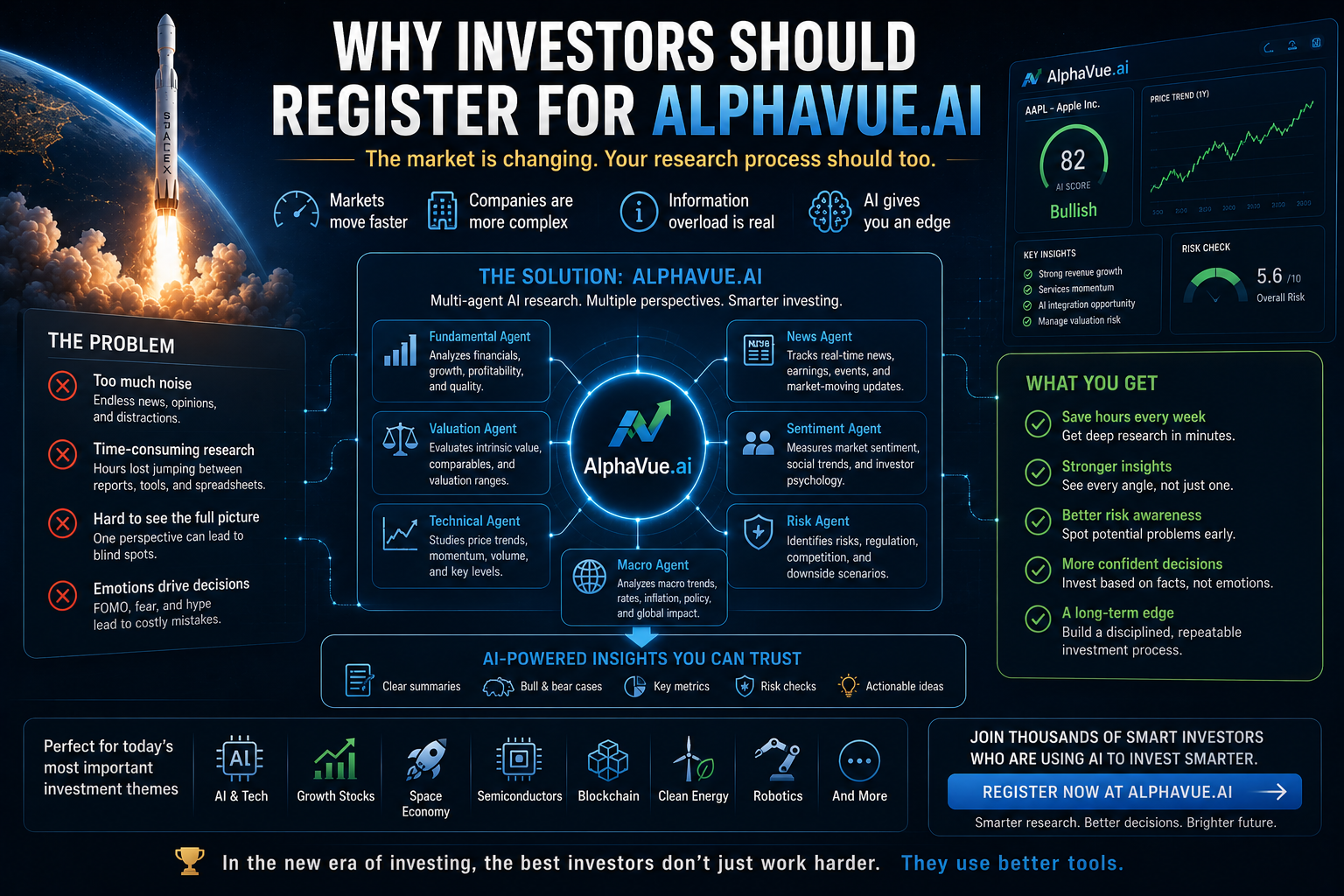
If the SpaceX IPO made one thing clear, it is this:
The next era of investing will reward better research.
Not louder opinions.
Not faster reactions.
Not emotional chasing.
Better research.
AlphaVue.ai is built for investors who want to analyze stocks with the help of multiple AI agents. It can help users explore opportunities, compare viewpoints, evaluate risks, and build a more disciplined investment process.
When the market is calm, this helps investors prepare.
When the market is emotional, this helps investors think clearly.
When a major event like the SpaceX IPO happens, this helps investors avoid being overwhelmed by noise.
The investing world is changing. The tools investors use should change too.
If you are following SpaceX, AI stocks, high-growth technology companies, or the future of public markets, AlphaVue.ai can help you research smarter and faster.
You do not need to replace your judgment.
You need to upgrade your research process.
Research Stocks Smarter With AlphaVue.ai
SpaceX is just one example of how complex modern investing has become. AlphaVue.ai helps investors analyze stocks through multiple AI agents, structured research workflows, risk checks, and clearer investment perspectives.
Register at AlphaVue.ai and start exploring stock ideas with AI-powered research.
Final Thoughts
The SpaceX IPO is not just a financial milestone.
It is a symbol of where the market is going.
The future of investing will be shaped by companies that build infrastructure for the next technological era. SpaceX may become one of those companies. But whether the stock becomes a great investment depends on valuation, execution, competition, risk, and time.
Investors should be excited.
They should also be careful.
The best response to a historic IPO is not blind optimism or automatic skepticism. It is disciplined curiosity.
SpaceX has given the market a new story to analyze.
Now investors need better tools to analyze it.
The companies are changing. The market is changing. The research process must change too.
For investors who want to keep up, AI-powered stock research is no longer just a nice-to-have. It is becoming part of the future of investing.
Start your next stock research session at AlphaVue.ai.