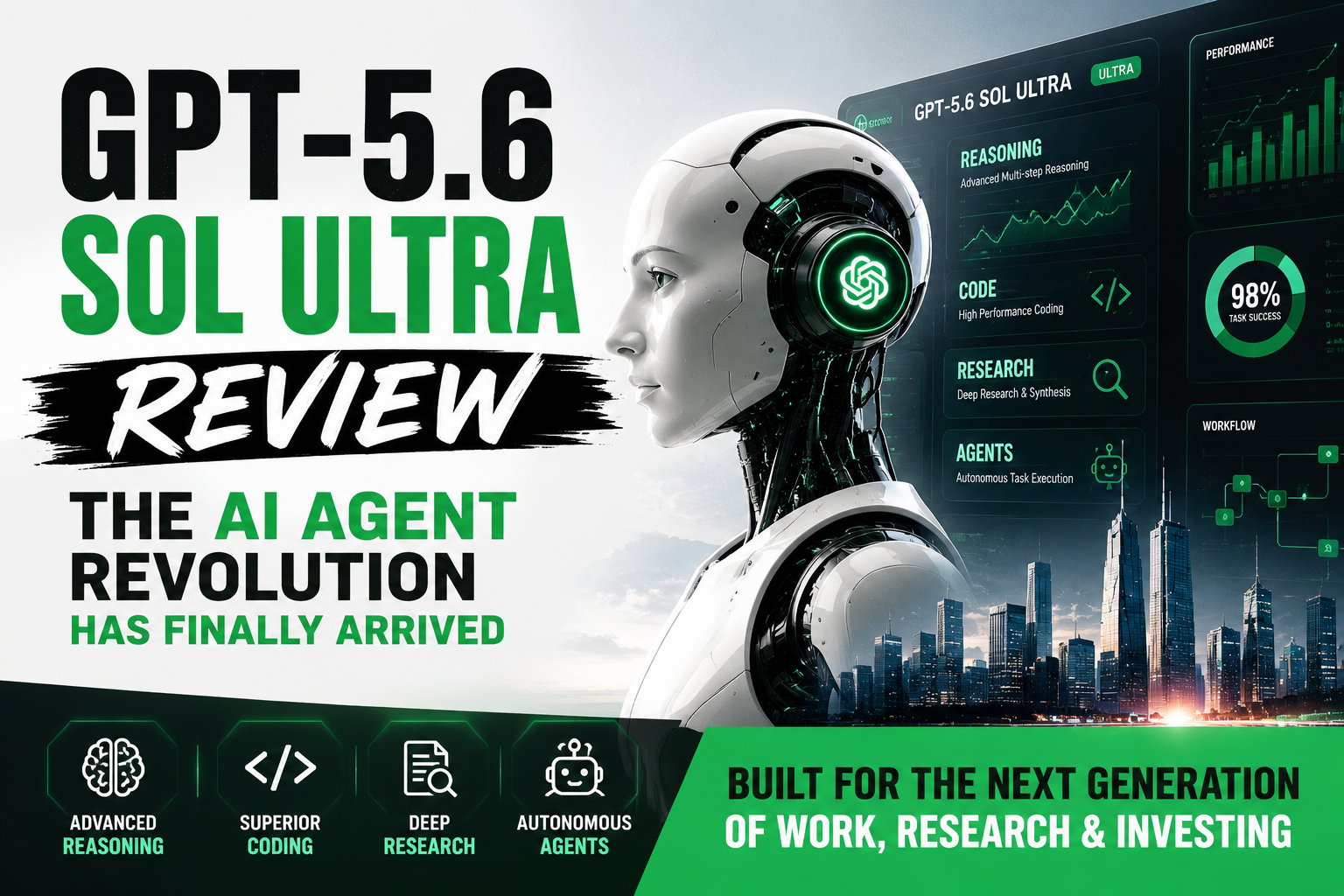
GPT-5.6 Sol Ultra is not just another model upgrade. It is a preview of a new computing layer: AI systems that do not merely answer questions, but plan, research, code, verify, debate, monitor, and execute long-horizon workflows.
For most people, the history of modern artificial intelligence has been experienced through a chat box. You type a question. The model answers. You ask for a rewrite. The model rewrites. You paste code. The model explains it. This interface was powerful enough to change how students learn, how developers debug, how marketers write, and how analysts summarize information. But it also created a misleading mental model. It made AI feel like a smarter search engine or a faster assistant, when the deeper technological shift was always about something larger: the transformation of software from static tools into adaptive agents.
That is why GPT-5.6 Sol Ultra matters. The most interesting question is not whether it writes better paragraphs than previous models, or whether it can solve one more benchmark question than a rival system. Those details matter, but they are not the center of the story. The real story is that models like GPT-5.6 Sol Ultra make AI feel less like a text generator and more like a workflow engine. They can sustain context, reason through multi-step tasks, use tools, coordinate subtasks, and make decisions that feel closer to how a senior operator works through a problem.
In this GPT-5.6 Sol Ultra review, we focus on what matters for real users: reasoning quality, coding ability, research depth, agentic behavior, reliability under complex instructions, and the practical implications for high-value domains such as investment research. The conclusion is clear: the AI industry is entering a phase where the winning product is no longer the best chatbot. The winning product is the best AI-native workflow.
Why GPT-5.6 Sol Ultra Feels Different
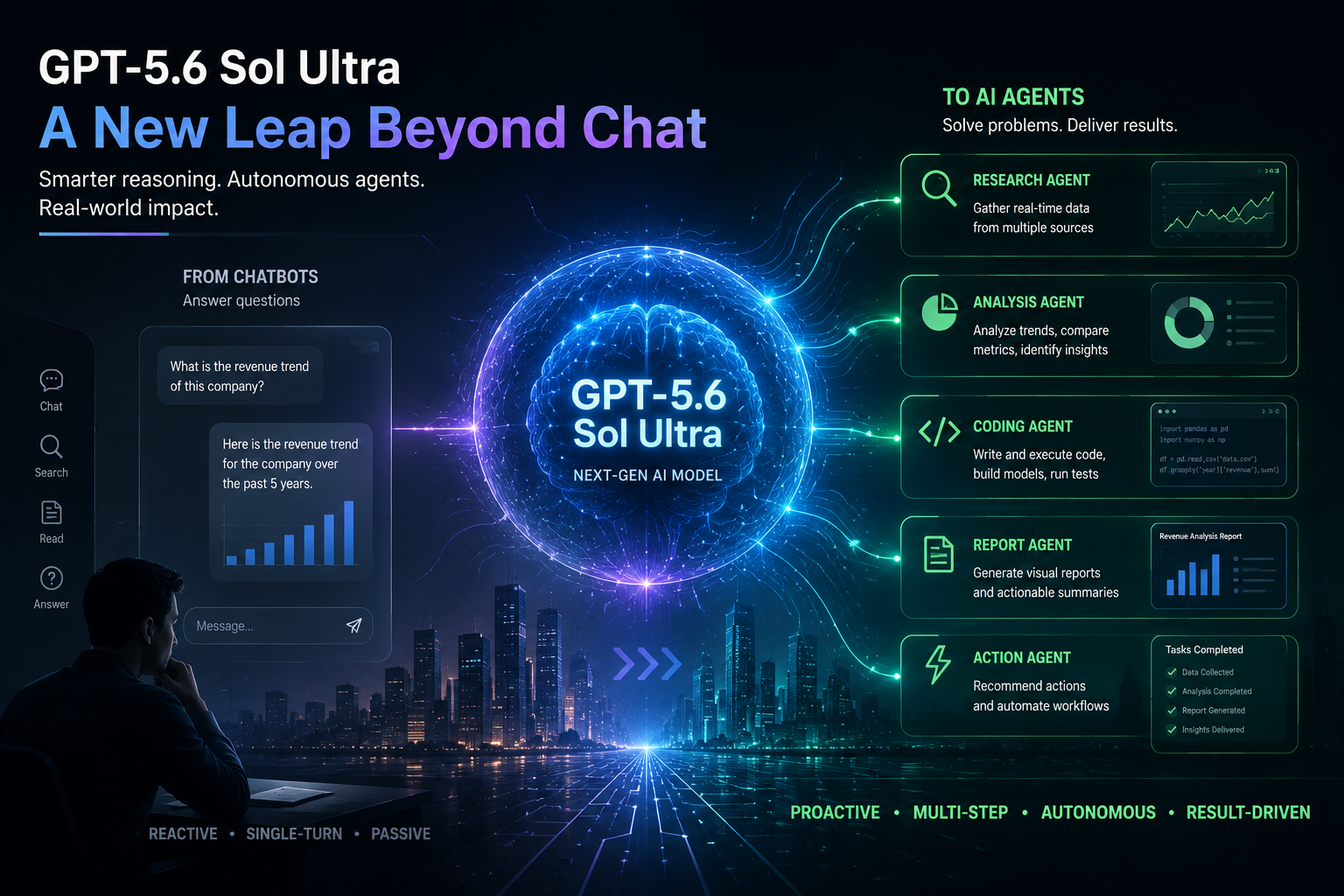
Every major AI release now arrives with a familiar cycle: early demos, benchmark charts, social media hype, skepticism, prompt screenshots, and a few viral examples that make the model look either magical or overrated. GPT-5.6 Sol Ultra deserves a more serious lens. The name itself suggests two ideas. “Sol” represents the flagship tier of the GPT-5.6 family, while “Ultra” points toward a higher-effort mode designed for more complex work. That distinction matters because the future of AI will not be defined by a single default model. It will be defined by model routing, reasoning budgets, specialized modes, and agent orchestration.
In practical terms, GPT-5.6 Sol Ultra feels different because it appears built around harder tasks rather than shorter answers. Earlier models often performed impressively when the user broke the work into small steps. The user had to act as the project manager: define the plan, ask for the next step, detect errors, retry failed reasoning, and decide when the output was good enough. Sol Ultra shifts more of that burden onto the model. It is better suited for prompts where the user says: here is the goal, here are the constraints, here is the context, now work through the problem like an expert.
This does not mean the model is perfect. It can still overstate confidence. It can still miss hidden assumptions. It can still produce answers that need verification, especially in domains where facts change quickly or where private data determines the correct conclusion. But the practical difference is that the model is more useful in messy, open-ended work. It is not only answering; it is organizing.
From Chatbots to AI Agents: The Real Evolution Begins
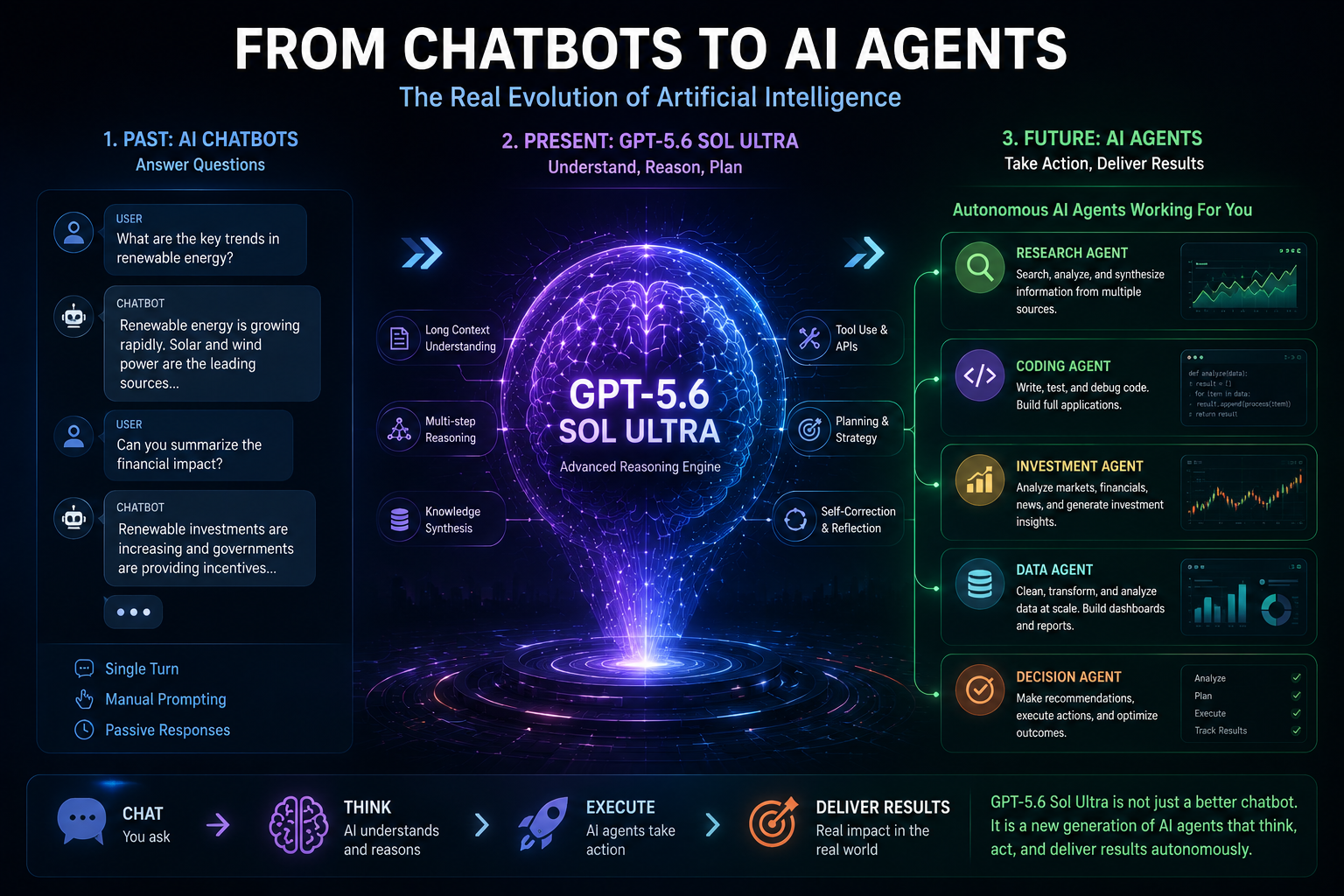
The most important shift in AI is the move from chatbots to agents. A chatbot responds. An agent acts. A chatbot waits for the next prompt. An agent can plan the next step. A chatbot gives an answer. An agent can use tools, search data, compare alternatives, check assumptions, and produce a decision-ready result.
This shift sounds simple, but it changes the software economy. Traditional software is built around fixed workflows. A dashboard shows metrics. A CRM stores contacts. A code editor edits files. A trading terminal displays charts and financial data. The user navigates these tools manually and decides what to do. AI agents invert that relationship. The user expresses intent, and the system assembles the workflow dynamically.
For example, instead of opening ten tabs to research a company, an AI investment agent can gather filings, news, price action, analyst revisions, valuation data, peer comparisons, management commentary, risk factors, and technical indicators. Instead of asking the user to interpret each source separately, the agent can synthesize the evidence into a bull case, bear case, risk checklist, and monitoring plan. This is not a cosmetic upgrade. It is a new product architecture.
GPT-5.6 Sol Ultra sits directly in this transition. Its value is not limited to better language. Its value comes from the ability to hold a larger problem in mind, decompose it, execute subtasks, and return something closer to a completed work product. That is why the “AI agent revolution” is not marketing language. It is the direction software is moving.
Reasoning Review: The Model Is Better at Keeping the Goal Alive
The biggest weakness of many earlier AI models was not intelligence in the abstract. It was goal drift. They could solve local problems but lose the bigger objective. They could follow one instruction but forget another. They could produce a polished answer while missing the reason the user asked the question in the first place.
GPT-5.6 Sol Ultra improves the feeling of continuity. When given a complex task, it is better at preserving the user’s original goal across multiple reasoning steps. This matters enormously in professional work. A financial analyst does not simply need a summary of a company. They need to know what could move the stock. A developer does not simply need a function. They need code that fits the architecture, passes edge cases, and does not introduce future maintenance problems. A founder does not simply need a market overview. They need a strategy that accounts for budget, timing, competition, and risk.
In reasoning-heavy tasks, Sol Ultra’s strength is not that it always arrives at a surprising answer. Its strength is that it can structure uncertainty. It can separate what is known from what is assumed. It can explain why one factor matters more than another. It can compare scenarios instead of forcing a single conclusion. That makes the output feel more like professional analysis and less like a generated essay.
This is especially important in investment research. Markets punish simplistic answers. A stock can have strong revenue growth and still be overvalued. A company can report weak earnings and still become attractive if expectations have reset. A merger can look accretive on paper but fail due to integration risk. A model that only summarizes information is not enough. A useful AI investing system must reason through competing signals.
Coding Review: The Developer Workflow Is Becoming Agentic
Coding is one of the clearest areas where GPT-5.6 Sol Ultra shows why agentic AI matters. Traditional AI coding assistants are useful for autocomplete, boilerplate, refactoring suggestions, and explaining unfamiliar syntax. But real software engineering is rarely about one isolated snippet. It is about understanding a codebase, tracing dependencies, identifying the root cause of a bug, designing a migration path, writing tests, and balancing speed against technical debt.
Sol Ultra is better aligned with that real workflow. It can reason about implementation plans, not just code fragments. It can explain trade-offs between approaches. It can turn a vague bug report into a debugging strategy. It can propose database indexes, identify potential bottlenecks, and outline rollout steps. It can also act like a stronger pair programmer because it can hold more of the surrounding context in mind.
The important change is that AI coding is moving from “generate this function” to “complete this engineering task.” That is a major difference. In the first mode, the developer remains the full-time operator and the model is a helper. In the second mode, the developer becomes a reviewer, architect, and quality controller. The model drafts the plan, edits the code, writes tests, and explains the risks. The human still matters, but the leverage changes dramatically.
This does not eliminate developers. It raises the value of developers who can define good systems, judge outputs, and guide agents. The future developer is not someone who types every line manually. The future developer is someone who can convert business intent into robust technical workflows, then use AI agents to accelerate execution without losing engineering discipline.
Research Review: Search Is No Longer Enough
Search engines helped people find information. AI agents help people turn information into decisions. That distinction is becoming more important every year because the internet is no longer scarce in information. It is scarce in trust, synthesis, and time.
When users search for a topic, they usually receive links. They still have to decide which sources matter, which claims are outdated, which numbers are comparable, and which conclusions follow from the evidence. In many domains, the problem is not lack of data. The problem is that the data is scattered across articles, filings, PDFs, charts, dashboards, social posts, and internal documents.
GPT-5.6 Sol Ultra points toward a different research experience. Instead of simply retrieving content, an AI agent can structure the research process. It can ask: what is the core question? What evidence would change the answer? What sources are reliable? What assumptions need verification? What are the strongest counterarguments? What should be monitored after the conclusion is formed?
That last question is especially important. Traditional research often ends with a report. Agentic research should end with a monitoring loop. If the thesis depends on margin expansion, the system should watch gross margin, cost guidance, supply chain signals, and management commentary. If the thesis depends on regulatory approval, the system should watch filings, agency updates, and competitor responses. The research should not be static. It should evolve as reality changes.
Cybersecurity and Safety: Why Capability Requires Control
One reason GPT-5.6 Sol Ultra has attracted attention is its stronger performance in complex technical and cybersecurity-related tasks. This is both promising and sensitive. Better AI can help defenders find vulnerabilities, review code, patch systems, and understand attack surfaces. At the same time, more capable models create misuse risks if they can be used for harmful offensive workflows.
This is why the release strategy and safety design matter. Advanced AI models are no longer just creative writing tools. They are becoming operational systems that can influence code, infrastructure, research, and decision-making. As models become more agentic, safeguards need to become more robust as well. A system that can coordinate complex work must be designed to distinguish legitimate defensive tasks from dangerous misuse.
For enterprises, this means AI adoption will not be only a question of raw capability. It will also be a question of governance. Who can access which tools? What data can the model see? What actions can it take automatically? Which outputs require human approval? How are errors logged? How are risky requests handled? These questions will define enterprise AI deployment as much as model benchmarks do.
The Biggest Change: Intelligence Is Becoming a Workflow Layer
The most useful way to understand GPT-5.6 Sol Ultra is not as a chatbot, but as a workflow layer. In older software, workflows were hard-coded. In AI-native software, workflows can be generated, adapted, and improved based on user intent. This is why agentic AI is so powerful. It brings intelligence closer to execution.
Apply this research method to your stock
Enter one ticker and get a research summary you can keep exploring.
Consider how a professional works through a complex task. They do not simply produce an answer. They define the objective, gather context, identify constraints, break the problem into parts, execute steps, check quality, revise, and communicate the result. That is a workflow. The more a model can perform those steps, the more it becomes a productive system rather than a conversational interface.
GPT-5.6 Sol Ultra makes this direction clearer. It is not enough for AI to be fluent. It must be operational. It must understand tasks, maintain state, use tools, handle ambiguity, and produce outputs that can be trusted enough to move work forward. The future of AI products will be shaped by how well they convert model intelligence into reliable workflows.
Why Financial Research Will Be Transformed
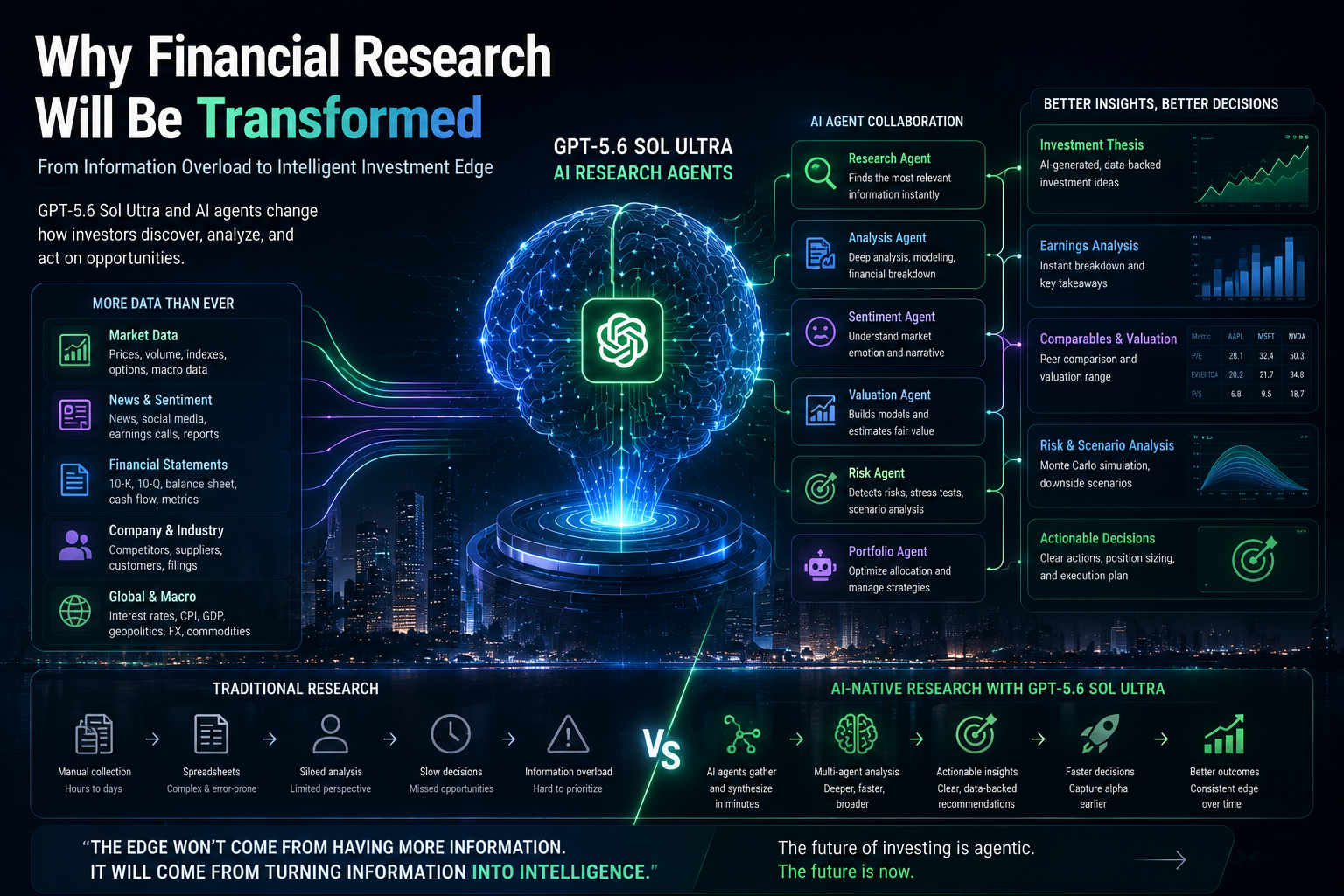
Financial research is one of the best examples of a domain ready for AI agents. The traditional process is fragmented. Investors read earnings transcripts, scan financial statements, monitor news, compare valuation multiples, review charts, follow macro indicators, and interpret market sentiment. Professional teams may have access to expensive terminals and research platforms, but the workflow is still heavily manual. Retail investors often have even less structure, relying on headlines, social media, and scattered data.
AI agents can change this by creating a more systematic research process. Instead of asking “is this stock good?”, a stronger AI investment workflow asks a sequence of better questions. What is the business model? What is the current market expectation? What are the key drivers of revenue and margin? What is already priced in? What could surprise the market? What risks are underappreciated? What events should be monitored next?
This is exactly where models like GPT-5.6 Sol Ultra become interesting. They can support multi-step reasoning, compare opposing arguments, and maintain a thesis across evidence. A good AI investment agent should not simply produce bullish or bearish language. It should produce structured judgment. It should show the bull case, bear case, base case, key assumptions, evidence strength, and triggers that would change the conclusion.
For example, imagine analyzing a high-growth AI infrastructure company. A simple chatbot might summarize recent earnings. A better agent would map revenue segments, customer concentration, capex trends, margin pressure, competitive threats, supply constraints, valuation multiples, analyst expectations, and upcoming catalysts. It would then explain which variables matter most and why. That is a very different level of usefulness.
The AlphaVue.ai Perspective: From Static Dashboards to AI Investment Agents
This is where AlphaVue.ai fits naturally into the next phase of AI. The investing world does not need another static dashboard with more charts. It needs AI-native research workflows that help users turn data into decisions. As models become more capable, the product opportunity shifts from displaying information to orchestrating intelligence.
AlphaVue.ai is built around that direction: using AI agents to help investors research markets, analyze stocks, compare opportunities, monitor risks, and understand what matters. The goal is not to replace human judgment. The goal is to give investors a stronger research system. In a market where information moves quickly and narratives change overnight, the advantage belongs to people who can process evidence faster without becoming careless.
Traditional investing tools often assume that the user already knows what to look for. AlphaVue.ai moves toward a more guided model. Instead of only showing a chart, the system can help explain what the chart may imply. Instead of only listing news, it can help connect the news to a thesis. Instead of only showing financial metrics, it can help interpret whether those metrics support or weaken a view. That is the difference between data access and decision intelligence.
GPT-5.6 Sol Ultra strengthens the case for this kind of platform. If frontier AI models are becoming better at reasoning, coding, research, and agentic workflows, then the most valuable financial products will be those that package these capabilities into practical investing experiences. The model is the engine, but the workflow is the product. AlphaVue.ai is positioned around that workflow layer.
Why Investors Need AI Agents, Not Just AI Answers
Investors do not lose money because they lack opinions. They lose money because they lack process. They chase headlines. They overweight recent events. They ignore valuation. They underestimate risk. They sell when volatility rises without understanding whether the thesis has changed. A simple AI answer does not solve this. In fact, a confident answer can make the problem worse if the user treats it as certainty.
An AI agent can be more useful because it can impose structure. It can ask what the thesis is. It can identify the assumptions behind the thesis. It can monitor whether those assumptions remain valid. It can compare a company against peers. It can detect when the market narrative changes. It can remind the user that a good business is not always a good stock at any price.
This kind of discipline is especially valuable for retail investors. Professional investors often have process, checklists, and teams. Retail investors often have access to more information than ever, but less structure than they need. AI agents can close part of that gap. They can make research more repeatable, more transparent, and less emotionally reactive.
Human + AI: The New Competitive Advantage
The best way to think about GPT-5.6 Sol Ultra is not “AI versus humans.” It is “humans with agents versus humans without agents.” This is the same pattern that appeared in many previous technology shifts. Spreadsheets did not eliminate finance professionals; they changed what good finance work looked like. Search engines did not eliminate researchers; they changed how research was performed. Code editors did not eliminate developers; they changed the speed and complexity of software creation.
AI agents will do the same. They will not make judgment irrelevant. They will make weak judgment more exposed and strong judgment more scalable. A user who asks vague questions and accepts every answer will still make mistakes. A user who defines clear goals, checks evidence, compares alternatives, and uses AI to accelerate thinking will gain leverage.
This is why the future belongs to AI-native operators. In investing, that means users who can combine market intuition with structured AI workflows. In software, it means developers who can guide agents through complex codebases. In business, it means leaders who can turn strategy into repeatable agent-driven processes. The winners will not be people who avoid AI. The winners will be people who learn how to manage it.
What GPT-5.6 Sol Ultra Still Does Not Solve
A serious review should also discuss limitations. GPT-5.6 Sol Ultra may be more capable, but capability does not equal truth. The model still depends on context, data quality, tool access, and user instructions. It can reason impressively from incomplete information, but incomplete information remains incomplete. It can generate a strong investment thesis, but markets can move for reasons outside the model’s context. It can write code, but production systems require testing, monitoring, security review, and human accountability.
There is also the issue of overtrust. As models become more fluent and more agentic, users may become less skeptical. This is dangerous. The better the answer sounds, the more important verification becomes. AI agents should be designed with transparency: what data was used, what assumptions were made, what confidence level is appropriate, and what would change the conclusion.
For financial research, this is critical. No model should be treated as a guaranteed prediction engine. The right use case is not “tell me what stock will go up tomorrow.” The right use case is “help me understand the evidence, risks, scenarios, and monitoring signals so I can make a better decision.” That is a healthier and more durable way to use AI.
The SEO Reality: Why Everyone Will Search for GPT-5.6 Sol Ultra
From a market perspective, GPT-5.6 Sol Ultra will attract attention because it sits at the intersection of several powerful search trends: GPT-5.6 review, AI agent, reasoning model, AI coding assistant, cybersecurity AI, OpenAI model benchmarks, and AI investing. Users are not only searching for what the model is. They are searching for what it means.
That is why the most important content around this model should not simply repeat announcement details. It should explain the shift. People want to know whether GPT-5.6 Sol Ultra changes the AI landscape. They want to know whether it is better for coding. They want to know whether it can power autonomous agents. They want to know whether it will make current tools obsolete. They want to know how it compares with Claude, Gemini, and other frontier models. Most importantly, they want to know how they should adapt.
The answer is that adaptation should begin at the workflow level. Do not ask only which model is best. Ask which workflows can now be redesigned. Which repetitive research tasks can become agentic? Which dashboards can become reasoning systems? Which business processes can move from manual coordination to AI-assisted execution? Which investment decisions can become more structured and evidence-driven?
How Sol Ultra Changes Product Design
For years, many AI products were built as thin wrappers around model calls. A user entered a prompt, the application sent it to a model, and the answer appeared in a clean interface. This was useful, but it was also limited. It treated intelligence as a feature rather than an architecture. GPT-5.6 Sol Ultra pushes product teams to think differently. The model is no longer only a content generator. It becomes a component that can plan, inspect, call tools, evaluate results, and decide whether the task is complete.
This changes how software should be designed. Instead of one prompt and one answer, AI-native products need memory, retrieval, permissions, evaluation, monitoring, and fallback systems. They need ways to separate low-risk tasks from high-risk tasks. They need interfaces that show the user not only the output, but the reasoning structure behind the output. They need confidence signals, source grounding, and action logs. A powerful model without workflow design is like a high-performance engine without brakes, steering, or a dashboard.
In the context of investment research, this is especially important. A user should not simply receive a sentence saying a stock looks attractive. The system should show the evidence chain. Which financial metrics support the view? Which news items matter? Which peer comparisons are relevant? Which risks could invalidate the thesis? Which upcoming events should be watched? A strong model makes these workflows possible, but a strong product makes them usable.
Benchmarks Are Useful, But Real Work Is the Better Test
Benchmark scores matter because they give the market a common way to compare models. They help developers understand relative strengths. They help enterprises choose between cost, speed, and capability. But benchmarks are not the same as real work. A benchmark usually measures a controlled task. Real work is messy. It includes incomplete instructions, conflicting priorities, stale documents, hidden assumptions, and the need to explain decisions to other people.
GPT-5.6 Sol Ultra should be judged by both standards. If it performs well on coding benchmarks, that is a useful signal. If it shows stronger cybersecurity reasoning, that is an important milestone. But the deeper test is whether it improves daily workflows. Can it help a developer resolve an incident faster? Can it help an analyst produce a better research memo? Can it help a founder compare strategic options? Can it help an investor avoid a shallow thesis? These are the tests that matter for adoption.
The early lesson is that Sol Ultra is most valuable when the task has structure but also ambiguity. It is less interesting for simple answers that a smaller model can handle cheaply. It is more interesting for tasks where a wrong answer is costly, where the reasoning chain matters, and where multiple steps must be coordinated. This is why model selection will become more sophisticated. Not every task needs the most powerful model. But the tasks that do need it can become dramatically better.
Cost, Speed, and Intelligence: The New AI Trade-Off
As AI models become more capable, users and companies will need to think carefully about cost and speed. The best model is not always the right model for every task. A simple classification job may require a fast, inexpensive model. A customer support rewrite may require a balanced model. A legal analysis, codebase migration, or investment thesis may justify a higher-reasoning model. This is why the GPT-5.6 family concept is important: different models and modes can serve different workloads.
Sol Ultra represents the high-effort end of that spectrum. It should be used when deeper reasoning matters. That includes multi-step analysis, complex coding, research synthesis, technical debugging, risk assessment, and agentic execution. In a well-designed system, cheaper models can handle routine work while Sol Ultra handles the hardest parts of the workflow. This is not only more economical; it is also more reliable because each task can be routed to the right level of intelligence.
For AlphaVue.ai, this principle matters directly. Investment research contains many different task types. Some tasks are simple: normalize a ticker, summarize a headline, classify a document. Other tasks are complex: decide whether a company’s margin expansion is sustainable, compare a stock against peers, or evaluate whether a selloff creates opportunity or reflects real deterioration. AI-native investing platforms should route these tasks intelligently instead of treating every question the same way.
What a GPT-5.6 Sol Ultra Investment Workflow Could Look Like
Imagine a user opens AlphaVue.ai and asks for a complete analysis of a company before earnings. A traditional platform might show a chart, consensus estimates, recent news, and valuation ratios. A GPT-5.6 Sol Ultra-style workflow would go further. It would begin by identifying the investment question: is the market underestimating or overestimating the company’s next phase of growth?
Then the agent would collect and organize evidence. It could review revenue trends, segment performance, margin drivers, cash flow quality, balance sheet risk, insider activity, analyst estimate changes, recent management commentary, and peer valuation. It could separate short-term catalysts from long-term fundamentals. It could identify which variables are most likely to move the stock after earnings. It could produce a scenario table: upside case, base case, downside case, and the evidence required for each one.
Most importantly, the workflow would not stop at a report. It would create a monitoring plan. If the thesis depends on demand acceleration, the agent should monitor order commentary, channel checks, web traffic, pricing signals, and competitor commentary. If the thesis depends on cost reduction, it should monitor margin guidance, headcount changes, supplier costs, and operating expense discipline. That is where AI agents become more valuable than static analysis. They keep the thesis alive after the user closes the page.
Why This Matters for Retail Investors
Retail investors often face an unfair problem. They have access to more information than any previous generation, but they do not have the same process, time, or institutional support as professional teams. They see breaking news, social media opinions, earnings headlines, analyst upgrades, influencer threads, valuation screenshots, and macro commentary. The result is often not clarity. It is cognitive overload.
AI agents can help by turning overload into structure. A retail investor does not need more noise. They need a system that explains what matters, what does not, what is already priced in, and what should be watched next. They need a way to compare a stock’s narrative against its fundamentals. They need to understand whether a market move is driven by real information or temporary emotion.
GPT-5.6 Sol Ultra makes this future more realistic because it improves the quality of complex reasoning. But the model alone is not enough. The user experience must be built around the investor’s journey. That is why platforms like AlphaVue.ai matter. They can translate frontier AI capability into a workflow that helps users ask better questions, avoid shallow conclusions, and build stronger investing habits.
How Enterprises Should Think About Sol Ultra
Enterprises should not adopt GPT-5.6 Sol Ultra simply because it is new. They should adopt it where the business case is clear. The best use cases are high-value workflows with meaningful reasoning requirements: engineering productivity, security review, internal research, financial analysis, customer intelligence, operations planning, and executive decision support. In these workflows, a more capable model can save time, improve quality, and reduce missed signals.
However, enterprises also need controls. They must define access policies, data boundaries, audit trails, and human approval points. The more agentic the system becomes, the more important governance becomes. A model that only drafts text has limited operational risk. A model that can use tools, change files, query databases, or recommend decisions requires stronger oversight.
The best enterprise AI systems will combine capability with discipline. They will not let every agent do everything. They will create specialized agents with clear scopes. They will monitor outputs. They will evaluate performance. They will route tasks based on risk. They will keep humans in the loop where judgment, compliance, or financial impact is significant. This is how AI becomes a reliable business layer rather than an experimental toy.
The Competitive Landscape: Claude, Gemini, and the Agent Race
GPT-5.6 Sol Ultra also needs to be understood within the broader frontier model race. OpenAI is not competing only on chat quality. It is competing against other frontier systems that are also improving reasoning, coding, context handling, tool use, multimodal understanding, and enterprise deployment. Claude, Gemini, and other advanced models are all pushing toward the same destination: AI that can do real work across longer time horizons.
This competition is healthy for users. It forces every model provider to improve capability, safety, pricing, and developer experience. It also means that the long-term advantage may not belong to one model forever. Products need to be model-aware and model-flexible. The best AI platforms will be able to route work across models, evaluate output quality, and upgrade their intelligence layer as the frontier moves.
For users, this means the question “which model is best?” will become less important than “which product turns AI into the best workflow?” A powerful model is necessary, but not sufficient. The real user value comes from how the model is connected to data, tools, memory, evaluation, and domain-specific design.
Practical Takeaways for Investors, Developers, and Founders
For investors, the takeaway is that AI will increasingly reshape research workflows. Do not treat AI as a stock-picking oracle. Treat it as a research amplifier, thesis organizer, risk monitor, and second analyst. Use it to challenge assumptions, compare scenarios, and improve process.
For developers, the takeaway is that coding agents are becoming more capable, but engineering judgment is still essential. Learn how to write clear task specifications, review AI-generated code, design tests, and use agents to accelerate large workflows. The developer who can manage AI agents will outperform the developer who only uses autocomplete.
For founders and product builders, the takeaway is that the next wave of AI products will not be won by adding a chat box to an old interface. The winning products will redesign workflows around intelligence. They will combine models, data, tools, memory, permissions, and evaluation into systems that solve real problems end to end.
Final Verdict: The AI Agent Revolution Has Finally Arrived
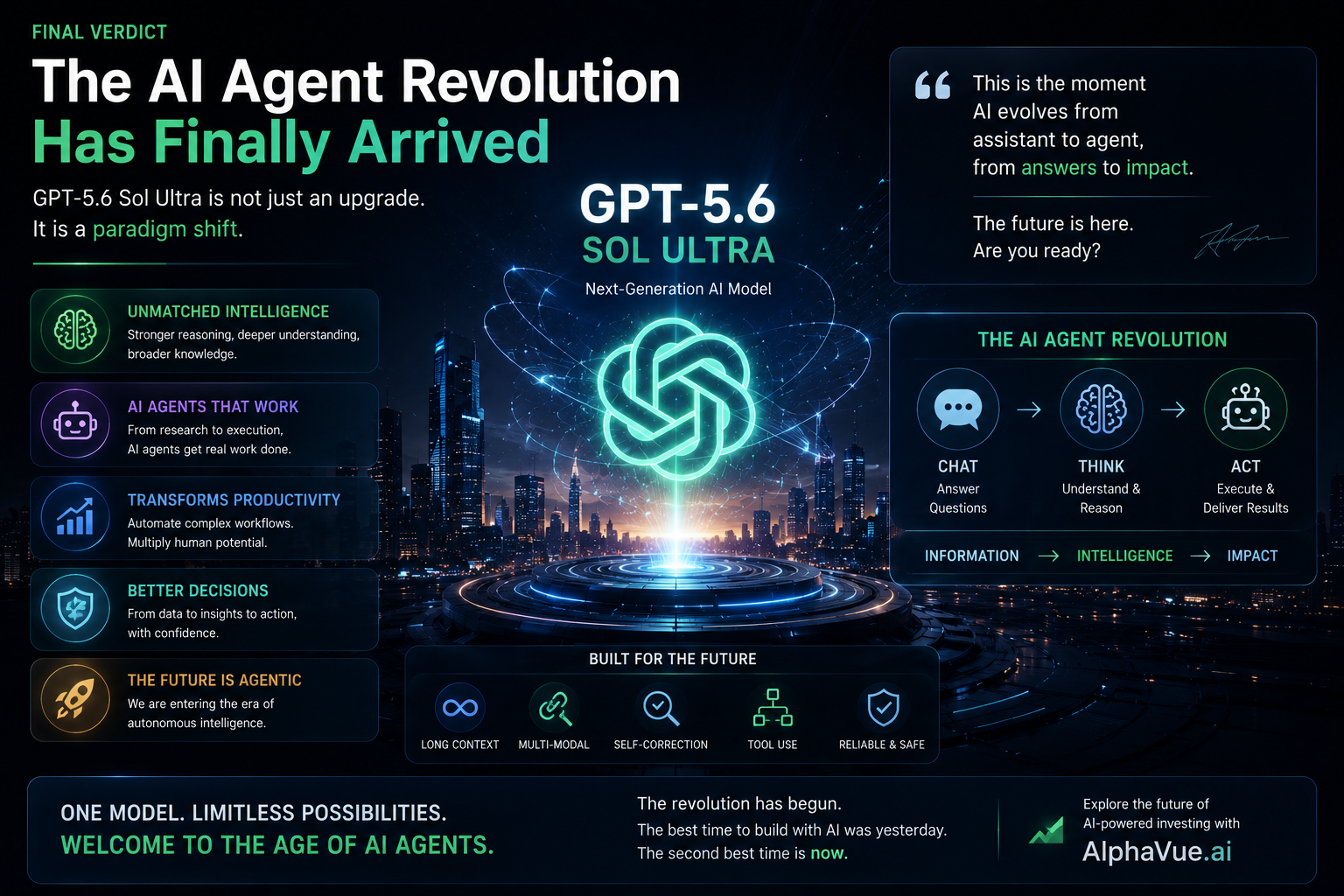
GPT-5.6 Sol Ultra is important because it makes the next phase of AI easier to see. The industry is moving beyond chat. It is moving toward agents, workflows, reasoning budgets, tool use, and domain-specific intelligence. The best AI products will not be the ones that simply connect a model to a text box. They will be the ones that turn model capability into repeatable, trustworthy, high-value work.
For developers, this means coding agents will become more capable partners. For researchers, it means information synthesis will become faster and more structured. For enterprises, it means AI governance and workflow design will become central. For investors, it means the research process can become more disciplined, more dynamic, and more intelligent.
That is why AlphaVue.ai is aligned with this moment. The future of investing will not be defined by who has the most tabs open or who reads the most headlines. It will be defined by who can use AI agents to transform scattered market data into structured insight. In that world, platforms that combine financial data, AI reasoning, thesis monitoring, and agentic workflows will become increasingly important.
The question is no longer whether AI can answer your questions. The question is whether your workflow is ready for AI agents.
If you want to experience where AI-native investment research is heading, visit AlphaVue.ai and start building a smarter way to analyze markets.