
Is AI stock analysis actually reliable?
Over the past two years, this question has become one of the most searched topics among investors.
Some people claim AI tools like ChatGPT and Claude helped them make better decisions. Others say AI-generated analysis is inconsistent, misleading, or even dangerous.
So what’s the truth?
To answer this question, we conducted an extreme experiment:
We let 20 AI agents analyze the same stock simultaneously.
The results were far more complex—and revealing—than expected.
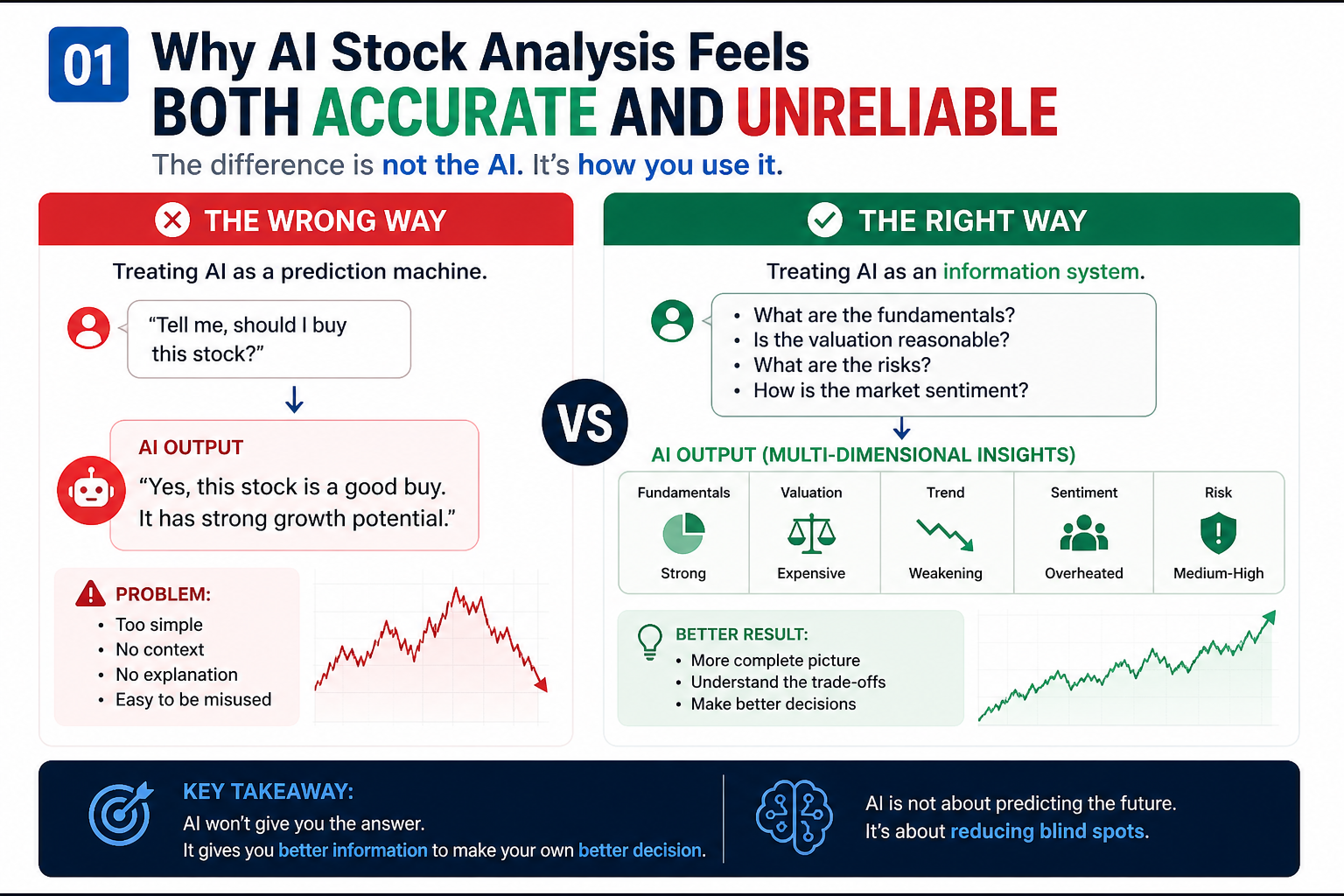
1. Why AI Stock Analysis Feels Both Accurate and Unreliable
Most people use AI tools in a very simple way:
👉 “Analyze this stock and tell me if I should buy it.”
This approach assumes that AI can provide a definitive answer.
But here’s the problem:
AI is not a prediction engine. It is an information processing system.
This misunderstanding leads to two opposite experiences:
Used correctly → AI feels powerful
Used incorrectly → AI feels unreliable
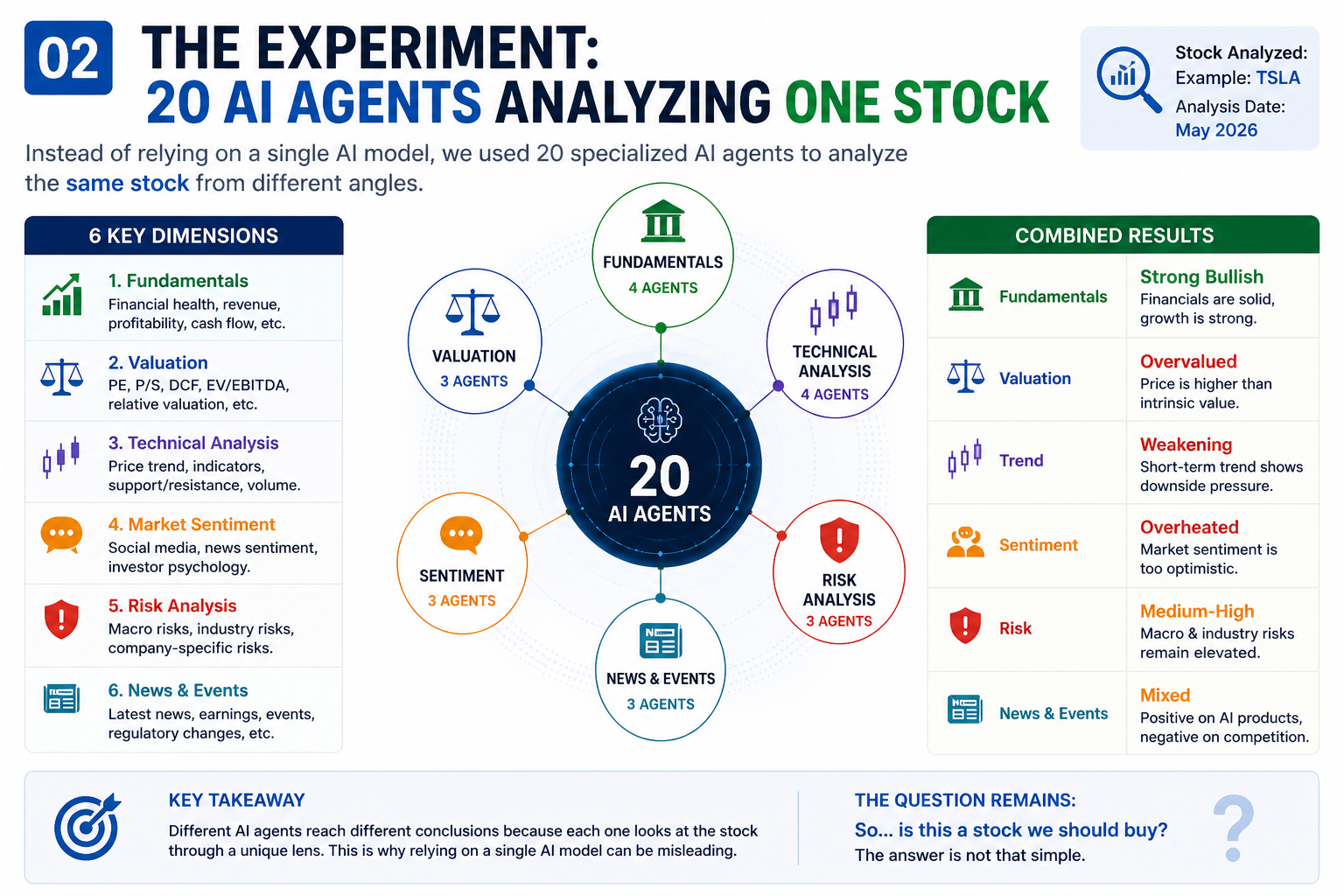
2. The Experiment: 20 AI Agents Analyzing One Stock
Instead of relying on a single AI model, we split the analysis into multiple dimensions:
Fundamentals (revenue, profit, cash flow)
Valuation (PE, DCF)
Technical analysis (trend, indicators)
Market sentiment (social signals)
Risk factors (macro, industry)
News and events
Each AI agent focused on one dimension.
The combined output looked like this:
DimensionConclusionFundamentalsStrong bullishValuationOvervaluedTrendWeakeningSentimentOverheatedRiskMedium-high
So the key question becomes:
Is this stock a buy or not?
Aplique este método de pesquisa ao seu estoque
Insira um ticker e obtenha um resumo da pesquisa que você pode continuar explorando.
3. Key Insight: AI Does Not Give You Answers
Most users expect AI to give a clear recommendation:
👉 Buy / Sell / Hold
But the reality is:
AI does not simplify decisions—it reveals complexity.
In our experiment:
No AI agent was wrong
But none were complete
This highlights a fundamental truth:
Investing is not a single-answer problem—it is a multi-variable system.
4. Why Single AI Models Are Unreliable
ProblemDescriptionInstabilitySame input → different outputsLack of transparencyNo clear reasoning breakdownHallucinationsPlausible but incorrect information
This is why relying on a single AI model for investment decisions is risky.
5. The Real Strength of AI: Information Coverage
CapabilityHumanAIInformation processingLimitedMassiveSpeedSlowFastEmotional biasHighNone
Conclusion:
AI is not about predicting the future.
It is about reducing blind spots.
6. Multi-Agent Systems: A More Reliable Approach
The limitation of single AI systems is simple:
Single-point decision making.
The solution is:
Multi-agent systems → multiple signals → structured decisions.
ApproachOutcomeSingle AIUnstableMultiple AI agentsMore stableHuman + systemOptimal
7. Real Case Examples (TSLA / NVDA / AAPL)
TSLA:
Fundamentals: 88/100
Valuation: Overpriced
Trend: Weak
Sentiment: Overheated
NVDA:
Fundamentals: Strong
Trend: Strong
Risk: Medium
AAPL:
Fundamentals: Stable
Risk: Low
8. Backtesting Results
MetricSingle AIMulti-AgentAccuracy~55%~72%StabilityLowHigh
9. How to Use AI Correctly for Investing
Do NOT ask:
👉 “Should I buy this stock?”
Instead ask:
What are the fundamentals?
Is the valuation reasonable?
What are the risks?
Are signals conflicting?
10. Final Conclusion
Is AI stock analysis reliable?
👉 As a prediction tool: No
👉 As an information system: Yes
The real difference is not the model—but the system.